
 Russian
 French
 Spanish
 Arabic
 Thai
 Indonesian


The previous article, "Key Technologies and Practices for High-Speed Railway Bridge Pier and Abutment Construction," focused on pier and abutment construction and reviewed key technical points including formwork design and installation, layered concrete pouring and vibration, prestressing tendon layout and timing of tensioning, appearance quality control, and the connection treatment of the abutment-to-subgrade transition section, clarifying the construction control logic of piers and abutments as the "connecting link" between superstructure and substructure. Above the piers and abutments, the girder is the direct load-bearing element of a high-speed railway bridge. The control of its precasting and cast-in-situ processes, the precision of prestress application, and the reliability of erection and alignment directly determine the bridge's load-bearing performance, geometric alignment smoothness, and operational safety. This article focuses on three stages—precast girders, cast-in-situ girders, and girder erection—and systematically reviews key technologies and practical points, from formwork fabrication, reinforcement processing and installation, concrete pouring, and prestressing tensioning and grouting, to support system design and erection, preloading monitoring, and continuous pouring, and further to bridge erection machine selection and commissioning, transport and lifting, and alignment and fixation.
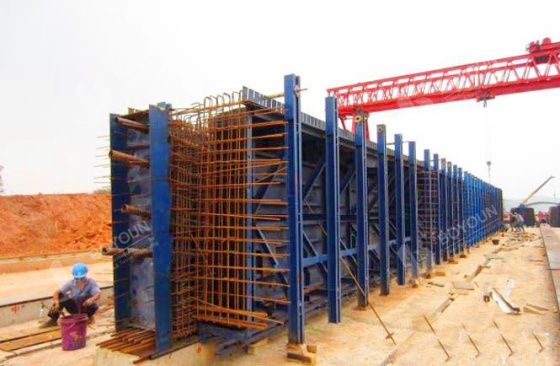
Formwork fabrication and installation for girders must ensure dimensional accuracy and structural stability. Formwork processing requires control of surface flatness and joint gaps, with materials of suitable strength selected for fabrication and shaping. During installation, the axis and elevation must be precisely controlled to ensure tight splicing and avoid problems such as grout leakage and deformation during pouring. A comprehensive inspection must be carried out after installation. Reinforcement processing and installation for girders require strict control of processing precision. Reinforcement cutting and bending must meet design dimensional requirements, and joint treatment must ensure connection strength. During installation, reinforcement spacing and layer spacing must be reasonably arranged, and reinforcement positions precisely fixed to ensure that the spacing between reinforcement and formwork meets standards. A comprehensive inspection and verification must be conducted after installation. Concrete pouring for girders requires control of feeding uniformity, with layered pouring adopted. During vibration, the vibration frequency and depth must be controlled to ensure concrete compactness. Concrete workability must be monitored during pouring, and the pouring rate adjusted in a timely manner to avoid quality defects such as segregation and honeycombing. Prestressing for girders requires reasonable layout of prestressing tendons based on the structural characteristics of the girder, precise control of the cutting length and installation position of prestressing tendons, and ensuring that the tendons are laid flat and free from damage. The timing of prestress application must be strictly controlled during construction to ensure the effectiveness of prestress application. Tensioning and grouting for girders must be carried out in an orderly manner. During tensioning, the tensile force must be applied slowly, with precise control of tensioning stress and elongation. Grouting must be carried out promptly after tensioning is completed, with suitable grouting materials selected and grouting pressure and speed controlled to ensure grouting compactness and prevent problems such as duct blockage and grout leakage.
Support system design and erection must take into account the girder load and construction environment, with reasonable selection of support materials and erection spacing to ensure that the overall stiffness and strength of the support system meet construction requirements. During erection, the elevation and flatness of the support system must be precisely controlled, and the firmness of the support system inspected after erection to prevent erection hazards. Support preloading requires the selection of suitable preloading materials, with loads applied progressively in accordance with the construction process, real-time monitoring of support settlement and deformation, and adjustment of the preloading scheme based on monitoring data. After preloading is completed, the load is removed and support stability verified to ensure the safety of subsequent construction. Concrete construction for cast-in-situ girders requires advance preparation for pouring, control of concrete mixing quality, adoption of continuous pouring, and layered vibration to ensure concrete compactness. During pouring, the deformation of formwork and supports must be monitored, with timely adjustment measures taken. After pouring is completed, timely covering and moisture retention are required. Prestressing for cast-in-situ girders requires reasonable arrangement of the prestress application process in light of the characteristics of cast-in-situ construction, precise control of the installation accuracy of prestressing tendons, and control of stress values and application speed during prestress application to ensure that the prestress is compatible with the girder structure and to guarantee the load-bearing performance of the girder.
Bridge erection machine selection and commissioning require the selection of an appropriate model based on girder weight, span, and construction site conditions. During commissioning, the performance of all components of the bridge erection machine must be comprehensively inspected, and operating precision calibrated to ensure stable operation and reliable control of the bridge erection machine and to meet erection construction requirements. Girder transport and lifting require the selection of suitable transport equipment and lifting machinery. During transport, the girder position must be fixed and the transport speed controlled to avoid girder swaying and collision. During lifting, the lifting angle and speed must be precisely controlled to lift the girder smoothly and prevent damage to the girder. Girder alignment and fixation require precise control of the girder position, adjustment of the girder axis and elevation to ensure that alignment deviations meet construction requirements, and timely fixation measures after alignment is completed to enhance the stability of the fixed parts, prevent girder displacement, and ensure erection quality.
Precast girder construction takes formwork precision, reinforcement processing and installation quality, concrete pouring compactness, and the standardization of prestressing tensioning and grouting as its core control points. Cast-in-situ girder construction, on the basis of support system design, erection, and preloading monitoring, emphasizes the organization of continuous pouring and real-time monitoring of formwork and support deformation. Girder erection depends on the reliability of bridge erection machine selection and commissioning, the smoothness of transport and lifting, and the precision of alignment and fixation. Although the three stages follow different process paths, they all point to the same goal—ensuring girder structural strength, geometric alignment precision, and erection quality, so that every girder can be safely and accurately positioned in place.

We focus on turn-key solutions and types of formwork for Bridge and Viaduct Construction at home and abroad since 2006.


International Department: Room 2507-2508, Tower C of Wanda Plaza, Tongzhou District, Beijing 101118, China.
+86-13021287080
info@boyoun.cn

