
 Russian
 French
 Spanish
 Arabic
 Thai
Thai Indonesian

In complex geographical environments such as mountainous canyons or cross-sea/river areas, long-span steel structure bridges with high piers have become the mainstay of modern transportation construction due to their superior spanning capabilities and structural aesthetics. However, as pier heights and span lengths continue to increase, structural stability and alignment accuracy control during construction have become major technical challenges for the industry. From the counterweight balance of asymmetric cantilever casting to the formwork techniques for thin-walled hollow piers, every step directly affects the bridge's final quality and service life. This article systematically analyzes four key techniques: balanced cantilever casting counterweight, thin-walled high pier construction, closure segment stress coordination, and collaborative alignment control. By integrating real-time monitoring and dynamic adjustment methods, it provides a comprehensive solution for overcoming construction difficulties in long-span steel bridges.
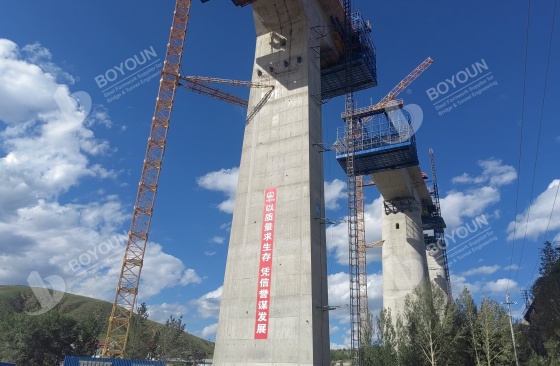
The core of the balanced cantilever casting counterweight technique lies in using counterweights to regulate structural stability. This technique employs an asymmetric cantilever casting process, placing counterweight blocks or water tanks on the side-span cantilever sections to offset mid-span moment differences and ensure smooth main beam alignment. Propulsion technology utilizes hydraulic systems to apply horizontal thrust, thereby adjusting the stress distribution in the piers and reducing the risk of pier displacement. During the closure segment construction phase, contractors must weld the stiffening skeleton during low-temperature periods, use temporary restraint devices to fix the main beam ends, and control deformation caused by thermal expansion and contraction to ensure the concrete remains in a compressive final setting state after pouring. Throughout the construction process, adding or removing counterweights must be synchronized with the extension of cantilever sections. Displacement sensors are used to monitor beam elevation changes in real-time, allowing dynamic adjustment of the counterweight ratio. After completing the concrete pouring process, the counterweights must be unloaded in stages synchronously to avoid sudden load changes that could cause main beam cracking or pier stress concentration. Double-sided continuous seam welding is used for the stiffening skeleton, prioritizing the connection nodes of the web and flange plates to enhance the skeleton's overall stiffness. During construction, contractors must also continuously monitor environmental changes and dynamically adjust work periods to avoid external factors interfering with structural stability.
The thin-walled hollow high pier construction technique relies on formwork processes to effectively improve the stability of high-pier structures. Contractors need to use techniques such as turn-over formwork, climbing formwork, or slipform to cast thin-walled hollow piers section by section. Specifically, turn-over formwork is used for layered support, climbing formwork for integral lifting of the formwork, and slipform for ensuring pier continuity. Simultaneously, total stations must be used to monitor the pier axis deviation in real-time, and jacks adjust the formwork position to ensure the pier inclination complies with specification limits. For high-altitude work, tower crane bases should be embedded, enclosed operating platforms configured to improve material transport efficiency, and latticed steel structure supports with diagonal bracing selected to enhance overall stiffness. Before construction, preloading tests must be completed to avoid non-elastic deformation of supports. Reaction frames should be embedded at the pier top to provide rigid support for the form traveler's bottom form. During the concrete pouring stage, layered vibration techniques must be applied, controlling each layer's thickness within the effective range of the vibrator. Cooling water pipes should be laid inside the pier cavity, and curing blankets placed on the external surface to control the humidity gradient.
The closure segment stress coordination technique relies on mechanical equilibrium principles to effectively control deformation phenomena, thereby ensuring the continuity of the bridge structure. Contractors need to select construction periods with minimal diurnal temperature variation, lock the stiffening skeleton, use temporary restraint devices to fix the main beam ends, and optimize the welding sequence to reduce residual stress. Before pouring concrete, micro-expansion compensation materials should be installed. During layered pouring, the vibration depth and compactness must be controlled, and the unloading rate of counterweight blocks adjusted synchronously. After welding the stiffening skeleton, temperature sensors should be placed to monitor the thermal cycle in the weld zone, and windshields used to reduce interference from environmental airflow, avoiding welding deformation. After the closure segment concrete reaches final set, the temporary restraints must be released in stages, using hydraulic jacks to adjust the mid-span stress distribution and eliminate additional bending moments introduced during construction. After completion, contractors must continuously monitor the deck paving condition. If anomalies are found, secondary tensioning of prestressed steel strands can be used to restore the structural stress balance.
The collaborative alignment control technique relies on multi-dimensional monitoring to help contractors dynamically adjust construction plans, thereby precisely controlling the bridge's geometry. Specifically, during construction, contractors use GPS positioning systems, total stations, and electronic levels to build a real-time monitoring network, collecting elevation, displacement, and torsion data to establish a model capable of dynamically predicting alignment deviations. Based on this model, during the cantilever casting stage, hydraulic jacks adjust the front support height of the form traveler and correct the formwork camber. Multi-stage loading processes are used, monitoring pier displacement while applying thrust in stages, and employing deformation inversion algorithms to optimize subsequent thrust parameters. Before installing formwork, preloading tests must be completed to eliminate non-elastic deformation of supports. During pouring, layered vibration techniques control concrete slump, avoiding aggregate segregation leading to cross-section dimension deviations. During pier construction, laser plummets are used to calibrate the formwork axis. After each pouring section, verticality is re-measured, and accumulated errors corrected using fine-tuning bolts. Before locking the closure segment, contractors should continuously monitor diurnal temperature variations, establish a temperature-alignment compensation curve to determine the optimal timing for welding the stiffening skeleton, and optimize the sequence for releasing restraint forces.
In summary, the construction of long-span steel structure bridges with high piers is a systematic project integrating precise control and dynamic adjustment. From using counterweight blocks for balanced cantilever casting to employing climbing formwork for thin-walled high piers; from choosing low-temperature periods for locking closure segments to coordinating stress, to building multi-dimensional monitoring networks for collaborative alignment control, the core of each technique lies in real-time monitoring, pre-simulation, and dynamic correction. In practice, only by deeply integrating jack thrust forces, counterweight adjustments with monitoring data on temperature and displacement can risks like concrete cracking and pier displacement be effectively avoided. As bridge construction environments become increasingly complex, merely mastering these core construction methods is no longer sufficient to meet all challenges. Construction contractors should focus more on shifting their mindset from technical execution to quality management.
Having mastered the key techniques mentioned above, how to systematically and meticulously ensure the effective implementation of these methods becomes the critical factor determining project success. In our next article, we will delve into a series of strategies to enhance the construction quality of long-span steel structure bridges with high piers.

We focus on turn-key solutions and types of formwork for Bridge and Viaduct Construction at home and abroad since 2006.


International Department: Room 2507-2508, Tower C of Wanda Plaza, Tongzhou District, Beijing 101118, China.
+86-13021287080
info@boyoun.cn

