
 Russian
 French
 Spanish
 Arabic
 Thai
Thai Indonesian

Long-span cantilever segmental box girder construction is one of the most widely used and mature construction technologies in modern bridge engineering, which is commonly applied to the main construction of continuous beam bridges, rigid frame bridges and cable-stayed bridges. As the core special equipment for cantilever casting construction, the structural design rationality, working condition adaptability and on-site construction standardization of the form traveler directly determine the construction safety, linear precision, concrete compactness and overall durability of bridges.
This article systematically sorts out the core design key points and standardized construction processes of form travelers for long-span cantilever box girders, providing professional and practical technical references for cantilever construction of bridge projects.
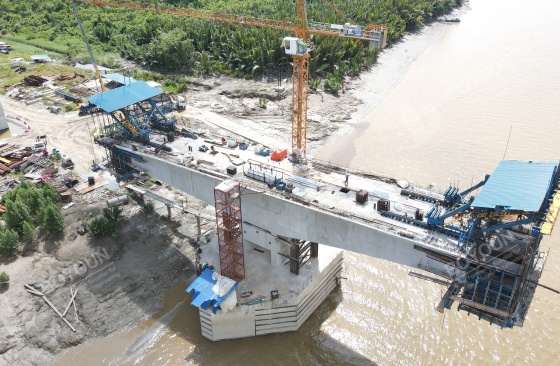
The design of form travelers for long-span cantilever segmental box girder construction needs to fully adapt to the characteristics of large load, variable cross-section and high-precision construction of long-span bridges. The core design analysis covers key parameters, special working condition adaptation, design verification process and industry development trends.
Bearing capacity is the primary design indicator of a form traveler. The designed bearing capacity shall fully cover the maximum weight of single girder segments. In terms of stiffness control, the deformation of the main truss is strictly limited to ≤ L/500 to effectively guarantee the linear accuracy of the completed bridge.
For the anchoring system, counterweight measures shall be added when the rear anchoring force is insufficient to resist the construction overturning moment, so as to improve the overall anti-overturning and anti-sliding stability of the equipment. In terms of structural adaptability, the bottom formwork is optimized to adapt to the parabolic variable-height beam bottom structure, realizing flexible adaptation to variable cross-section box girder construction.
For large-cantilever inclined web box girders, the diamond-type form traveler is adopted to optimize the internal force transmission path. Transverse stiffeners are added to significantly enhance the overall stability of ultra-wide box girders and solve the deformation and shaking problems of wide-width girder construction.
Aiming at the common single-box three-chamber box girder structure in long-span bridges, the bottom formwork beam system is strengthened to disperse the concentrated concrete load evenly to each sling, avoiding local overload and structural deformation. During the bridge closure process, after the form traveler moves forward in place, the temporary connection structure and counterweight parameters shall be accurately adjusted to ensure stable and balanced stress of the closure segment.
The form traveler design implements a standardized and rigorous verification process. First of all, comprehensive load calculation is carried out, covering the dead weight of box girder concrete, construction dynamic load, wind load and self-weight of the form traveler, realizing full coverage of all working condition loads.
Secondly, finite element simulation verification is conducted to analyze the stress distribution of the main truss, the tensile strength of slings and the overall structural stability, so as to optimize weak structural parts in advance. Finally, a preloading test is carried out before formal construction to eliminate non-elastic deformation of the equipment. The measured elastic deformation values are adopted to guide the elevation setting of formwork, ensuring high-precision construction.
Front-support form travelers have been gradually applied to cable-stayed bridge construction. With stay cables as the front support structure, the span adaptability of traditional construction equipment is greatly improved. In future engineering design, the form traveler structure should be comprehensively optimized according to the actual bridge span, girder section form and on-site construction environment, focusing on improving equipment bearing capacity and deformation control performance to adapt to the construction needs of super-long-span and ultra-wide bridges.
According to actual engineering requirements, structural stiffness, stress distribution and safety acceptance standards, two reliable prestress layout schemes can be adopted for form traveler cast-in-place box girders. The first is the three-way prestress system including longitudinal, transverse and vertical directions, which is suitable for high-standard and large-load key bridge projects. The second is the longitudinal and transverse two-way prestress system, which can simplify construction procedures and improve efficiency while meeting bridge stiffness and safety requirements. Both schemes have been fully verified and proven safe and reliable in practical cantilever construction projects.
Concrete casting is the core link of cantilever segmental box girder construction. The whole process must strictly follow the principles of symmetry, segmentation and layering to ensure construction quality and operational safety. The standardized process and key control points are summarized as follows.
Formwork adjustment and anchoring: After the form traveler is positioned accurately, the elevation of the bottom and side formworks is precisely adjusted through the suspension rod system to ensure tight fitting with the cast girder segments and eliminate construction staggering. The anchoring system adopting fine-threaded reinforcing bars shall be fully locked, and the bearing capacity shall be verified through preloading tests.
Steel bar and prestressed pipe installation: Bind the bottom plate and web steel bars in strict accordance with the design drawings, and embed longitudinal, transverse and vertical prestressed pipes with a positioning error controlled within 5mm. Inspect the tightness of all pipelines to prevent slurry leakage and pipe blockage. Complete the installation of embedded parts and reserved holes for form traveler rear anchoring synchronously.
(1) Layered and Segmented Casting Control
For the bottom plate concrete, symmetric pouring is carried out from both sides to the middle with a single layer thickness ≤ 30cm, preventing formwork deformation caused by unbalanced load. The left and right webs are poured synchronously and symmetrically with a layered thickness of 40-50cm, and side form supports are strengthened to avoid form expansion.
For the top plate and flange plate, construction follows the sequence from the middle to both sides, with a flange layered thickness of 30-40cm to control the top surface cross slope and flatness. The single casting segment length is usually 2 to 4 meters, adopting the backward pouring method from the front end of the form traveler to the cast girder segment. The full-section casting is completed in two times: the first pouring covers the bottom plate and webs; the second pouring covers the top plate and flange plate after the inner formwork is erected.
(2) Vibration and Compaction Control
Insertion vibrators are used for concrete vibration following the principle of "fast insertion and slow pulling out", avoiding collision with prestressed pipes and steel bars. Key areas require enhanced vibration: fully compact the concrete behind the anchor plate to ensure the compactness of the prestressed anchorage area; conduct secondary re-vibration at web chamfers to eliminate internal bubbles; complete the pouring of the upper concrete layer before the initial setting of the lower layer to prevent construction cold joints.
(3) Temperature Control and Curing Measures
In summer, concrete pouring is arranged during low-temperature periods with the concrete inlet temperature controlled ≤ 30°C. Thermal insulation measures are adopted for winter construction. Temperature measuring points are embedded to monitor the internal temperature of concrete, and the temperature difference between inside and outside is kept within 25°C to prevent temperature cracks.
After pouring, cover the concrete with geotextile for moisture retention. Water curing shall be started within 24 hours and last for no less than 7 days. Pedestrian trampling and equipment loading are prohibited before the concrete strength reaches 2.5MPa.
Strictly control the unbalanced load of cantilever ends. The concrete pouring deviation between the two sides shall not exceed the design allowable value (usually ≤ 5%). Balance the load by adjusting the water tank counterweight or optimizing the pouring speed. Monitor the deformation and displacement of the form traveler in real time, and suspend construction immediately for adjustment in case of abnormalities.
The closure segment shall be constructed at low temperature periods with micro-expansion concrete. Unload the counterweight water tank synchronously during pouring to maintain the stability of the closure opening structure.
Three groups of concrete test blocks shall be reserved for each girder segment. Prestress tensioning can only be carried out when the concrete strength reaches more than 90% of the design value. The allowable deviation of section size is ±5mm, and the bridge linear error is controlled within L/5000 (L refers to the span length).
Retighten the suspender bolts within 12 hours after pouring to compensate for settlement deformation and prevent settlement cracks. Layered symmetric pouring, precise vibration and strict temperature and curing control can effectively ensure the compactness and durability of box girder structures. Engineering practice proves that introducing third-party full-process monitoring for form traveler casting can further improve construction quality and safety management level.
The quality of long-span cantilever segmental box girder construction depends on scientific form traveler design, standardized pouring technology and refined quality control. Every link from form traveler parameter optimization and special working condition adaptation to on-site concrete pouring and curing supervision determines the overall quality of the bridge.
Shandong Boyoun Heavy Industry focuses on the customized R&D and technical supporting services of bridge form travelers, formworks and steel structure equipment. We provide one-stop construction equipment solutions for various long-span cantilever bridge projects.
In our next blog, we will elaborate on the complete tensioning steps of prestressed anchorage for form traveler construction and systematically sort out the full set of construction precautions for long-span cantilever segmental box girders, helping engineering teams standardize construction and avoid common hidden dangers.

We focus on turn-key solutions and types of formwork for Bridge and Viaduct Construction at home and abroad since 2006.


International Department: Room 2507-2508, Tower C of Wanda Plaza, Tongzhou District, Beijing 101118, China.
+86-13021287080
info@boyoun.cn

