
 Russian
 French
 Spanish
 Arabic
 Thai
Thai Indonesian

In the preceding three articles, we have systematically reviewed the structural characteristics and selection criteria for steel box girders and cast-in-place beams, as well as the core construction process points for prefabricated installation of steel box girders and cast-in-place beam construction, thereby initially establishing a technical cognitive framework for both beam types from design through construction. However, the precise execution of construction processes ultimately requires a systematic and rigorous quality control system to ensure compliance. Quality is the lifeline of bridge engineering. Although steel box girders and cast-in-place beams differ significantly in material properties and construction methodologies, they converge on the same quality control objectives—safety, durability, and reliability. Quality control for steel box girders must run through the entire chain from steel processing, welding and forming, to on-site installation, with focused attention on material properties, weld quality, and geometric accuracy. Quality control for cast-in-place beams must cover the entire process from formwork and falsework, concrete placement, to prestressing application, with emphasis on concrete strength, prestressing effectiveness, and structural forming quality. At the same time, both beam types share numerous common quality management principles in areas such as personnel qualifications, equipment management, and process acceptance. As the fourth installment of this series, this article systematically constructs a comprehensive quality control framework from three perspectives: the dedicated quality control points for steel box girders, the dedicated quality control points for cast-in-place beams, and the common quality control measures applicable to both beam types.
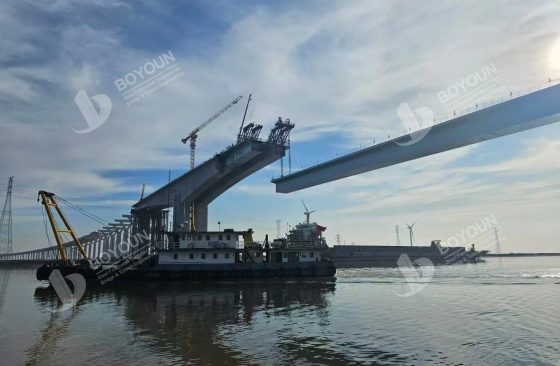
Dedicated quality control for steel box girders must focus on the critical links of materials, fabrication, and installation. In terms of material control, steel materials shall be accompanied by mill test certificates. Upon delivery, sampling inspection shall be conducted for yield strength, tensile strength, and elongation; substandard materials are strictly prohibited from use. Welding consumables (electrodes and filler wires) shall be matched to the base steel—for example, Q355 steel shall use E50-series electrodes. Electrodes shall be baked as required (baking temperature 350–400°C, held for 1–2 hours), stored in insulated electrode ovens, and dispensed for immediate use. Fabrication control shall focus on monitoring component dimensional accuracy: the flatness deviation of top and bottom plates shall be ≤2 mm/m, and the verticality deviation of webs shall be ≤1 mm/m. Welding quality shall be subject to 100% non-destructive testing (NDT); the ultrasonic testing (UT) grade for butt welds shall be no lower than Grade B, and the acceptance rate for Grade I welds shall reach 100%. Installation control shall entail real-time monitoring of girder elevation and alignment; after installation is completed, the mid-span deflection shall comply with the specified design limits. For high-strength bolted connections, the final tightening torque shall be inspected, with torque deviation ≤±10%, and the slip coefficient of the faying surfaces shall be ≥0.45 (determined through testing), ensuring reliable force transfer at the connection nodes.
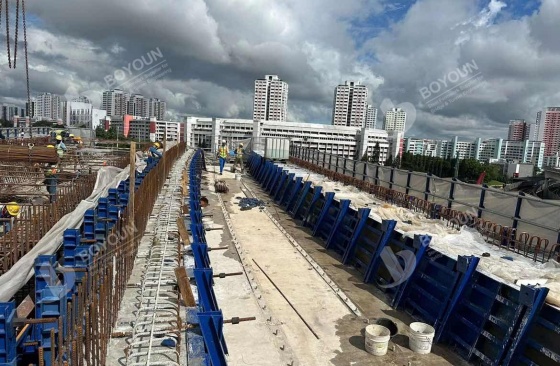
Dedicated quality control for cast-in-place beams shall establish targeted control measures for concrete, prestressing, and structural forming quality. In concrete quality control, raw materials shall be inspected in batches: cement strength and soundness, aggregate gradation and clay content, and water-reducer water-reducing rate shall all comply with specification requirements. During concrete placement, test cubes shall be retained as specified (one set per 100 m³, with 3 cubes per set); the 28-day compressive strength of the cubes shall be ≥ the specified design strength. For prestressing construction control, the tendon stressing sequence, jacking force, and elongation values shall be verified, and the stressing records shall be complete and traceable. For duct grouting, the cement grout fluidity (10–17 s) and bleed rate (≤3%) shall be tested. After grouting, non-destructive testing (e.g., ground-penetrating radar) shall be employed to inspect the fullness of the ducts. Structural forming control shall include monitoring the formwork removal timing (formwork may only be struck after the concrete strength reaches at least 75% of the design strength). After form removal, the girder surface shall be inspected for visual appearance; there shall be no exposed rebar, honeycombing, or bug holes (defect area ≤0.5% of the component surface area), and the geometric dimension deviations shall comply with the code requirements.
The common quality control for steel box girders and cast-in-place beams shall establish a full-process control system covering "personnel, equipment, process, and acceptance." In terms of personnel, special-operations workers (e.g., welders, prestressing tensioning operators, and crane operators) must hold valid certifications and receive specialized training and assessment before taking up their posts. Technical personnel shall provide thorough technical briefings to the construction teams, clearly specifying the process and quality standards. For equipment, construction machinery shall be maintained on a regular basis: routine maintenance once per month and comprehensive overhaul once per quarter. Measuring instruments (e.g., total stations, levels, and torque wrenches) shall be calibrated once per year and may only be used after passing calibration. For process control, a quality inspection system shall be established; construction shall implement the "three-inspection system" (self-inspection, mutual inspection, and special inspection). Critical processes (such as steel box girder welding and cast-in-place beam prestressing tensioning) shall be designated as quality control points and shall be subject to full-time site supervision. For acceptance, inspections shall be organized in strict accordance with the applicable codes; sub-divisional works may proceed to the next construction sequence only after passing acceptance. All acceptance documentation shall be properly archived to ensure quality traceability.
Steel box girders and cast-in-place beams, as the core structural components of bridge engineering, have construction processes and quality control measures that bear directly on the safe service of bridges. This article, by analyzing the structural characteristics and applicable scenarios of both beam types, systematically presenting the process points for prefabricated lifting and erection of steel box girders as well as concrete placement and prestressing construction of cast-in-place beams, and establishing a quality control system that integrates both dedicated and common measures, provides a technical guideline for practical construction. In the future, with the advancement of intelligent technologies, Building Information Modeling (BIM) and Internet of Things (IoT)-based monitoring can be further integrated into the construction process to enable real-time monitoring and dynamic adjustment of beam construction quality, thereby driving bridge construction toward greater precision and intelligence, and providing stronger support for the high-quality construction of transportation infrastructure.
In summary, this series of articles, focusing on the two major bridge structural forms—steel box girders and cast-in-place beams—has progressed from structural characteristics and selection criteria, to detailed construction process points for steel box girders, then to construction process points for cast-in-place beams, and finally concluded with the quality control system. Together, they have systematically established a complete technical chain covering "selection and design—process implementation—quality assurance."
Shandong Boyoun Heavy Industry Co., Ltd. will continue to deepen its commitment to the field of bridge construction equipment, providing superior products and services to support the high-quality development of bridge engineering. At the same time, we will closely follow industry technological advancements and practical engineering demands, and continue to release more research and practical outcomes focused on key bridge construction technologies. We welcome your attention and engagement.

We focus on turn-key solutions and types of formwork for Bridge and Viaduct Construction at home and abroad since 2006.


International Department: Room 2507-2508, Tower C of Wanda Plaza, Tongzhou District, Beijing 101118, China.
+86-13021287080
info@boyoun.cn

