
 Russian
 French
 Spanish
 Arabic
 Thai
Thai Indonesian

Prestressed concrete box-girders are widely adopted in highway and railway engineering owing to their rational force-bearing performance and large spanning capacity. Nevertheless, diagonal web cracks, a common structural defect, directly impair the load-carrying capacity and durability of bridges. This paper systematically investigates the crack-inducing causes from four dimensions: design, construction, materials and service operation. Improper prestressing layout and insufficient shear-reinforcement configuration in the design phase; deviation in corrugated duct positioning and defective concrete placement during construction; alkali-aggregate reaction and steel-bar corrosion at the material level; as well as overloading and environmental erosion in service may all trigger cracking.
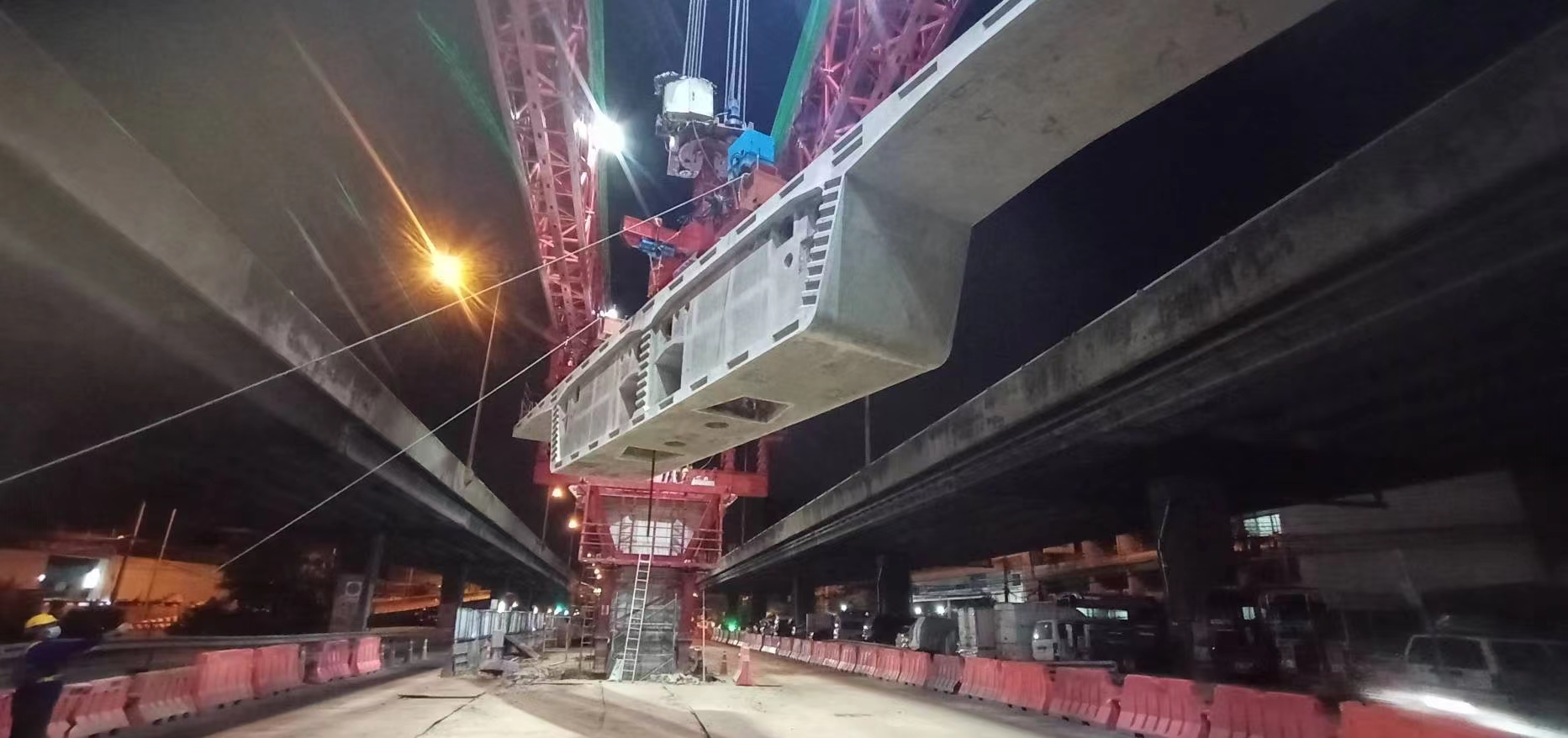
Deficiencies in design constitute the root cause of diagonal web cracks. An ill-conceived prestressing system, for instance excessively sparse prestressing tendons or insufficient tendon-bending angles, results in low effective pre-compressive stress in the web. Furthermore, mismatching between longitudinal and vertical prestressing tendons (e.g. excessive spacing of vertical prestressing bars exceeding 60 cm) leads to inadequate shear resistance of the web. Pursuing economic efficiency in some designs sets the stirrup spacing at the upper code limit (e.g. 15 cm) without arranging diagonal structural reinforcement. Consequently, concrete bears over 60 % of the shear force (the code recommendation is ≤ 50 %), rendering shear failure prone under over-loading conditions. Insufficient web thickness (e.g. merely 20 cm at mid-span) or abrupt thickness variation (e.g. sharp reduction from 30 cm at supports to 20 cm at mid-span) gives rise to abrupt sectional stiffness change and stress-concentration zones.
Defective construction quality acts as a direct trigger for crack initiation. Horizontal or vertical deviation of corrugated ducts exceeding 5 cm during construction displaces prestressing tendons from their designed positions and brings about insufficient local pre-compressive stress in the web. Improper slump control during web casting (> 200 mm) causes concrete segregation; inadequate vibration (especially underneath corrugated ducts) produces honeycombing and voids, lowering the concrete tensile strength by 15%-20%.
Precise formwork fabrication and on‑site installation play a practical role here. Reliable bridge steel formwork helps maintain accurate section geometry and uniform concrete pouring conditions, avoiding unexpected stress concentration derived from dimensional deviation.
In addition, cold joints formed by excessively long interval (> 2 hours) between successive casting layers weaken the monolithic integrity of the web. Incorrect tensioning sequence (e.g. tensioning longitudinal tendons prior to vertical tendons) or insufficient controlled tensioning stress (only 90 % of the design value) yields uneven distribution of web pre-compressive stress and tensile stress in local regions.
Deteriorated material properties significantly promote crack development. For example, high alkali content in local aggregates (> 3 kg/m³) reacts with alkalis in cement to form expansive gel, generating mesh-shaped web cracks that further evolve into diagonal cracks. Bridge inspection data reveals that alkali-aggregate reaction may reduce the elastic modulus of web concrete by 25 % and its tensile strength by 30 %. Insufficient concrete cover (< 3 cm) leads to corrosion of vertical prestressing bars or stirrups with a cross-section loss ratio of 10%-15%. Corrosion not only weakens the shear contribution of reinforcement but also induces concrete cracking due to corrosion-induced expansion. Excessive cement dosage (> 400 kg/m³) or low fly-ash replacement ratio (< 15 %) increases early-age shrinkage of concrete, which generates shrinkage cracks under restraint conditions; such cracks often superpose and propagate together with diagonal cracks.
Adverse in-service conditions accelerate crack initiation and propagation. Repeated actions of overloaded vehicles subject the web to shear force and bending moment far beyond design values. Solar temperature difference creates a temperature gradient over the web (up to 15 ℃/m), superimposing vertical and transverse thermal stresses and forming tensile-stress zones in the middle portion of the web. In summer high-temperature conditions, thermal stress in certain bridge webs can reach 1.2 MPa, serving as a major contributor to crack propagation. Differential settlement of piers and abutments exceeding 5 cm induces additional bending moment and shear force in box-girders and triggers excessive local web stress. Bridges built on soft-soil foundations are particularly susceptible to this problem: every 1 mm increment in differential settlement raises additional web stress by 0.2 MPa.
In summary, diagonal web cracks are characterised by complex multi-source causes, strong superposition effects and persistent hazards. Strict control over design, construction and operation links by addressing all contributing factors is essential for crack prevention. For existing bridges with diagonal web cracks of varying severity, selecting appropriate strengthening and repair technologies according to defect grade, crack morphology and structural stress state to close cracks, restore load-bearing capacity and improve overall box-girder durability constitutes a core task for bridge maintenance and rehabilitation. Therefore, the following paper will systematically present strengthening countermeasures for diagonal web cracks under different defect conditions, elaborate the applicable scenarios, construction procedures, parameter criteria and performance of various strengthening techniques, and provide detailed technical references for defect repair and performance upgrading of similar bridges.

We focus on turn-key solutions and types of formwork for Bridge and Viaduct Construction at home and abroad since 2006.


International Department: Room 2507-2508, Tower C of Wanda Plaza, Tongzhou District, Beijing 101118, China.
+86-13021287080
info@boyoun.cn

