
 Russian
 French
 Spanish
 Arabic
 Thai
Thai Indonesian

In our previous article, we systematically analyzed the four core causes of diagonal cracks in prestressed concrete box girder webs, including defective design specifications, irregular construction operations, degraded material performance, and adverse service environment loads. These multi-factor superimposed defects not only reduce the structural integrity of box girders but also seriously threaten the long-term safety and durability of bridge structures. While standardized design, high-quality concrete pouring, and scientific operation management are the fundamental means to avoid crack formation, high-precision bridge steel formwork and customized box girder formwork also play an indispensable role in controlling section dimensional accuracy, avoiding stress concentration caused by formwork deformation, and reducing initial crack risks. For existing web diagonal cracks of different severity grades, targeted professional reinforcement technologies are required to repair defects, restore structural bearing capacity, and extend bridge service life. This article elaborates on four mainstream and efficient web crack reinforcement solutions, covering technical principles, construction processes, quality control standards and application effects, providing practical technical references for bridge maintenance and reinforcement projects.
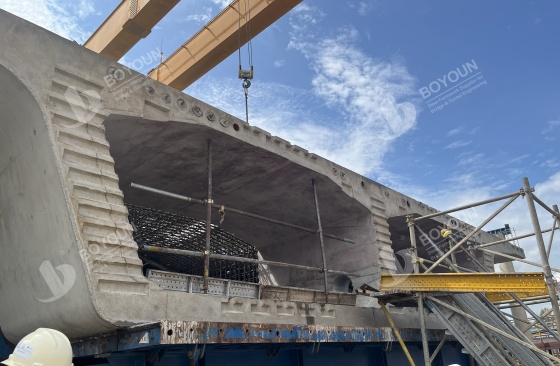
External prestress reinforcement improves the pre-compressive stress of girder webs by adding prestressing tendons on the outer side of the web, which is suitable for medium-damage bridges with crack width ≤ 0.3mm. U-shaped or broken-line external tendons are adopted, anchored at the beam ends or the upper part of the webs, and deflection blocks are used to adjust the force transmission direction, realizing the uniform distribution of pre-compressive stress along the web height.
In a practical reinforcement case, 2 sets of 15-7 steel strands were arranged on each side of the web with a controlled stress of 0.65fptk, increasing the web pre-compressive stress from 1.0MPa to 2.2MPa. The construction follows a standardized procedure: first, epoxy resin slurry is used for crack grouting repair to seal internal cracks; then external tendon casings and anchoring devices are installed. Graded loading (10% controlled stress per stage) is adopted during tensioning to prevent excessive additional stress on the web.
After reinforcement, the shear bearing capacity of the structure is increased by 30%-40%, and the crack propagation rate is reduced by more than 80%. Practical engineering verification shows that the crack width of the bridge treated with this technology has no growth within 5 years, achieving stable and reliable reinforcement effects.
Grade I unidirectional carbon fiber cloth is adopted for web reinforcement, available in two mainstream specifications: 200g/m² for minor cracks and 300g/m² for dense crack areas (crack density > 3 cracks/m) to enhance structural restraint. Supporting high-performance epoxy adhesives, including primer, repair adhesive and impregnating adhesive, are matched to ensure stable working performance within -30℃ to 60℃. The bonding layer is generally 2-3 layers determined by shear stress calculation. Standard construction parameters are followed: each layer lap length ≥ 100mm, longitudinal bonding range exceeding crack endpoints by over 50cm, and U-shaped hoops with spacing ≤ 20cm are arranged near supports to guarantee uniform stress bearing.
Strict surface pretreatment is required before construction: polish the web concrete surface with a diamond grinder to remove 2-3mm laitance and carbonized layer, clean dust and oil stains to control surface flatness error within 3mm. The epoxy primer is mixed at a 3:1 ratio and evenly coated, then cured to dry. The impregnating adhesive is uniformly stirred and coated on both the concrete surface and carbon fiber cloth.
Lay the cloth along the main tensile stress direction and scrape thoroughly to eliminate bubbles. Ensure sufficient adhesive thickness at lap joints. No external disturbance is permitted within 24 hours after pasting. Standard 7-day curing at 20℃ is required, with thermal insulation measures for low temperatures below 5℃. Finally, trim excess cloth and seal edges with repair adhesive to complete the reinforcement construction.
For severe web diseases such as crack width > 0.5mm or penetrating cracks, the web thickening method is adopted for reinforcement. By increasing the concrete section size, the shear stiffness and bearing capacity of the box girder are fundamentally improved. This construction process has high requirements for section size accuracy and concrete forming effect, which relies on high-standard custom box girder steel formwork to ensure flat and compact concrete surface and consistent section thickness, avoiding secondary cracks caused by formwork deformation and uneven concrete pouring.
In construction, a 10-15cm thick reinforced concrete layer is poured on the outer side of the original web. A new steel mesh (φ12@150) is connected to the original web through bar planting with a bar planting depth ≥ 10d, ensuring coordinated stress and joint work between new and old concrete. Before pouring, the original web is chiseled to expose coarse aggregates to enhance interface bonding performance. Micro-expansive concrete with an expansion rate of 2-4×10⁻⁴ is adopted for pouring, and the humidity is kept above 90% during the curing period to prevent shrinkage cracks of new concrete.
After web thickening reinforcement, the section moment of inertia increases by 20%-30%, and the structural shear bearing capacity is improved by more than 60%. Practical bridge engineering cases show that the mid-span deflection of the reinforced main bridge is reduced by 40%, and all original web cracks are completely closed, achieving excellent long-term reinforcement effects.
Slight cracks (width < 0.1mm) will gradually expand under long-term vehicle load and environmental erosion, so timely repair and anti-corrosion treatment are required to block crack development paths. The pressure grouting method (grouting pressure 0.2-0.4MPa) is adopted, and low-viscosity epoxy resin slurry mixed with 5% nano-SiO₂ is used to improve permeability, ensuring the crack filling rate reaches more than 90%.
After grouting and curing, 2 to 3 layers of permeable anti-corrosion coatings (such as polyurea coating) are uniformly painted on the web surface to form a dense waterproof and anti-corrosion protective layer, blocking the invasion of external moisture, chloride ions and corrosive media. In addition, a crack width monitor with an accuracy of 0.01mm is used for quarterly detection and data recording. Once the annual crack width growth exceeds 0.05mm, targeted reinforcement measures will be initiated in time to eliminate structural safety hazards.
Crack Width (mm) | Applicable Reinforcement Technology | Shear Bearing Capacity Improvement | Crack Propagation Rate Reduction | Single-Span Construction Period |
< 0.1 | Crack Repair + Anti-Corrosion Treatment | 5%-10% | 50%-60% | 1-2 days |
0.1-0.3 | External Prestress Reinforcement | 30%-40% | Above 80% | 3-5 days |
0.1-0.5 | Carbon Fiber Cloth Bonding Reinforcement | 40%-55% | 70%-80% | 2-3 days |
> 0.5 | Web Thickening Reinforcement Method | Above 60% | Above 90% | 7-10 days |
Table 1 Comparison of Reinforcement Technologies and Effects for Different Crack Grades
Diagonal cracks in box girder webs are mostly distributed at an inclination of 45°-60° near supports, dense corrugated duct sections and section mutation positions, which are closely related to structural shear action. The formation of cracks is the result of the superposition of multiple unfavorable factors, including unreasonable prestress design and reinforcement layout, construction deviations in duct positioning and concrete pouring, material performance degradation caused by alkali-aggregate reaction and steel corrosion, and long-term adverse effects such as vehicle overload and temperature difference in operation.
Different targeted reinforcement technologies can effectively repair cracks, improve structural shear resistance and restrain crack expansion according to crack severity. To fundamentally prevent web diagonal crack diseases, full-process quality control must be implemented. In the design stage, optimize the coordination of prestress system and shear reinforcement to ensure web pre-compressive stress ≥ 1.8MPa, stirrup spacing ≤ 10cm and web thickness change rate ≤ 10%/m. In the construction stage, strictly control the positioning deviation of corrugated ducts within 3cm, adopt self-compacting concrete with a slump of 180-200mm for web pouring, and ensure the prestress tensioning stress reaches 100%-105% of the design value. Meanwhile, adopting high-precision bridge steel formwork and standardized construction technology can effectively control concrete forming quality, avoid structural stress concentration caused by dimensional errors, and reduce the probability of initial crack generation. Full-life cycle management of "design optimization - construction control - operation maintenance" can comprehensively guarantee the safety, stability and long-term durability of prestressed concrete box girder bridges.
As a professional manufacturer focusing on bridge formwork and cantilever construction equipment for more than 20 years, Shandong Boyoun Heavy Industry integrates R&D, customization, production and technical services. We provide high-precisionbridge steel formwork, customized box girder formwork and professional bridge construction technical solutions for various highway and railway bridge projects worldwide. We not only deliver high-quality standardized and customized formwork products to ensure accurate concrete forming and reduce structural crack risks from the source, but also provide one-stop technical support for bridge construction quality control and later-stage reinforcement and maintenance. If you have project demands for bridge formwork customization, construction technical consultation or structural optimization solutions, feel free to contact our professional technical team for tailored project solutions and free technical guidance.

We focus on turn-key solutions and types of formwork for Bridge and Viaduct Construction at home and abroad since 2006.


International Department: Room 2507-2508, Tower C of Wanda Plaza, Tongzhou District, Beijing 101118, China.
+86-13021287080
info@boyoun.cn

