
 Russian
 French
 Spanish
 Arabic
 Thai
Thai Indonesian
Building upon the foundational overview of "4 Construction Techniques for Long-Span Steel Structure Bridges with High Piers" discussed in the previous section, this article delves deeper into three core strategies for enhancing construction quality: the precise, closed-loop regulation of process parameters; the immutable, full-life cycle traceability of material properties; and the dynamic, real-time correction of structural deformation. These strategies, powered by sensor technology, data analytics, and digital management platforms, form the bedrock of modern, high-quality bridge construction.
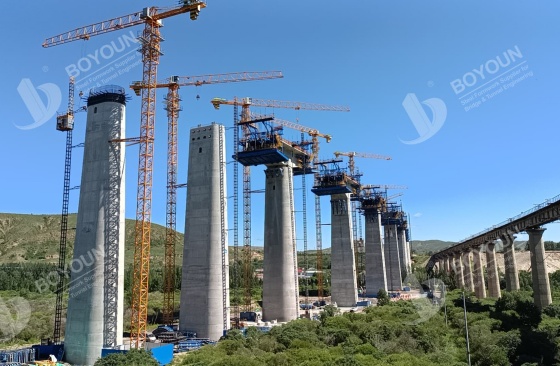
The construction contractor should install high-precision sensors to collect pressure data from the hydraulic synchronous jacking system and further optimize parameter combinations using algorithmic models. During the jacking construction phase, a closed-loop control system should be employed to dynamically adjust the jacking speed of the hydraulic jacks based on feedback regarding slip track deformation. For welding operations, a current-voltage matching curve should be established, and an infrared thermal imager should be used to monitor the temperature distribution in the weld zone, thereby adjusting the travel speed of the welding torch. During concrete placement, a slump meter should be used to detect the mix's fluidity in real time, adjusting the immersion depth of vibrators and controlling the thickness of layered pours. After assembling the balanced cantilever form traveler , a no-load trial run should be implemented to verify the synchronization of the traveling mechanism, and the pre-tightening force of the anchoring system should be corrected based on the trial run results.
Take, for example, the establishment of a dynamic database for welding current, temperature gradient, and loading rate. Construction personnel need to deploy high-precision current sensors in the welding area to collect real-time data on the welder's output current, arc voltage, and temperature distribution in the weld zone. Before welding, an infrared thermal imager should be used to scan the base metal's surface temperature field, and then, based on preset temperature control thresholds, commands for the welding torch's travel speed should be generated to control the interpass temperature gradient. Simultaneously, an ultrasonic flaw detector should be used to inspect for internal defects in the weld, and a model reflecting the correlation between current, temperature, and defects should be established by combining this with temperature distribution data. Throughout the welding process, current, voltage, and temperature data should be continuously collected and entered into the dynamic database. Machine learning algorithms should be utilized to mine the patterns of correspondence between parameters and weld quality, thereby generating an optimized temperature control threshold model. The regulation of loading rate should be based on simulation results of stress distribution in the welded joint, using finite element models to back-analyze deformation trends under different loading conditions and generate graded loading instructions. Throughout the entire construction process, construction personnel should compare actual parameters in real-time based on the dynamic database and trigger the welder control system, prompting it to automatically correct the wire feed speed, thus forming a closed-loop control chain of "data collection - model iteration - parameter correction."
Upon the arrival of steel at the site, the construction contractor should use a spectrometer to analyze its chemical composition and a universal testing machine to verify indicators such as yield strength. For welding consumables, compatibility tests should be completed, using a metallurgical microscope to observe the microstructure of the weld metal and confirm tensile strength. Concurrently, in the concrete mix design, anti-crack fibers or expansion agents should be incorporated, and a slump meter should be used to dynamically optimize the mix proportion. After prestressing strands arrive on site, their surface defects should be inspected, and friction coefficients should be calibrated using hydraulic sensors before tensioning. In this process, the construction contractor needs to establish an electronic material archiving system, utilizing blockchain technology to record information, thereby ensuring data immutability.
Taking the implementation of a batch-by-batch re-inspection system for incoming steel as an example. After the steel is transported to the storage yard, construction personnel should use a spectrometer to scan its surface chemical composition to check whether the content of elements like carbon, manganese, sulfur, and phosphorus meets specification limits. Simultaneously, a universal testing machine should be used to tensile test steel specimens to verify indicators such as percentage elongation after fracture, and batches exhibiting lamellar tearing or failing cold bending tests should be rejected. Furthermore, magnetic particle testing should be used to inspect the steel surface for cracks or rust damage, marking areas that exceed standards and returning them for disposal. During this process, the construction contractor should introduce an electronic steel archiving system, encrypt information such as purchase contracts, heat numbers, and test reports, generate a unique identification code, and print it as a QR code label to be affixed to the ends of the steel members. During construction, construction personnel can scan the QR code to access the material's performance data. Before welding, they should verify the compatibility report between the steel and the welding consumable, confirming that the strength of the deposited metal is not lower than the base metal standard. After steel cutting and processing, the component number should be recorded, and laser marking should be used to track the process flow. When an abnormal batch of steel triggers an alert, a quarantine procedure should be initiated, and the locations where steel from the same heat number was used should be traced, relying on ultrasonic flaw detection to re-inspect the performance of the welds and the heat-affected zone.
Before construction begins, the contractor should install GPS base stations at critical sections such as pier tops and the main girder to continuously collect data on elevation, displacement, and torsion. After assembling the balanced cantilever form traveler, a graded preloading test should be implemented to eliminate the elastic deformation of the falsework, while simultaneously recording the load-displacement curve. During the cantilever pouring stage, hydraulic jacks should be used to adjust the front support point elevation of the balanced cantilever form traveler, dynamically correcting the camber of the formwork based on alignment monitoring results. In incremental launching construction, a multi-stage loading process should be employed to apply jacking force in stages, monitoring pier displacement to optimize subsequent jacking parameters. After the concrete reaches final set, temporary restraints should be released in stages, and hydraulic jacks should be used to apply jacking force to adjust the stress distribution across the mid-span.
Taking the preloading test after the assembly of the balanced cantilever form traveler as an example. The construction contractor needs to install displacement sensors and use strain gauges to monitor the elastic and inelastic deformation of the falsework. Simultaneously, using counterweights that simulate the concrete placement load, loading should be applied in stages up to the design load, followed by a holding period for observation. During the loading process, data on falsework settlement, lateral displacement, and stress distribution should be collected in real time, while simultaneously plotting load-displacement curves and stress contour maps to identify weak points. After unloading, the proportion of residual deformation versus inelastic deformation should be analyzed, compensation values for the formwork camber should be calculated, and then the front support elevation of the balanced cantilever form traveler should be corrected, optimizing the pre-tightening force of the anchoring system. Concurrently, the preloading data should be imported into a BIM platform to generate a 3D deformation field model, which is then compared against the design alignment to determine the adjustment amount for the balanced cantilever form traveler 's traveling track and optimize formwork positioning parameters. During the no-load trial run of the balanced cantilever form traveler , the synchrony of the traveling wheel sets should be re-measured, the adjusted track evenness should be verified, and the trend of changes in traveling resistance should be recorded to further calibrate the correction coefficient for the camber.
In conclusion, elevating the construction quality of long-span steel structure bridges with high piers demands an integrated approach that transcends individual construction techniques. The strategies outlined Precise Control of Process Parameters, Full-Cycle Traceability of Material Properties, and Dynamic Correction of Structural Deformation—collectively form a robust, intelligent quality assurance system. By shifting from passive inspection to active, sensor-driven data acquisition and analysis, construction teams can transform complex challenges into manageable, quantifiable processes. The closed-loop of data collection, model iteration, and parameter adjustment ensures that every weld, every batch of steel, and every structural deflection is managed with surgical precision. Ultimately, the successful implementation of these strategies not only guarantees the safety, durability, and geometric accuracy of these monumental structures but also sets a new benchmark for excellence and innovation in the field of bridge engineering.

We focus on turn-key solutions and types of formwork for Bridge and Viaduct Construction at home and abroad since 2006.


International Department: Room 2507-2508, Tower C of Wanda Plaza, Tongzhou District, Beijing 101118, China.
+86-13021287080
info@boyoun.cn

