
 Russian
 French
 Spanish
 Arabic
 Thai
Thai Indonesian

Cylindrical piers are core vertical load-bearing components in highway, railway, municipal viaduct, and bridge engineering. The construction process involves multiple complex and high-risk procedures, including surveying and setting out, steel bar binding, formwork erection, concrete pouring, and work at height. The complex construction environment and the difficulty of safety control mean that even slight negligence can lead to safety accidents such as formwork collapse, falls from height, machinery-related injuries, and falling objects. Such incidents not only delay the project schedule but also threaten the safety of construction personnel and create hidden quality defects in the project. Construction safety control must adhere to the principle of prevention first and source control. Meticulous planning and strict control during the preparation stage are crucial for safeguarding the entire construction process and serve as the core prerequisite for ensuring the smooth progress of subsequent procedures and the successful completion of the project. This article focuses on the preparation stage of cylindrical pier construction, detailing various safety control measures step by step to solidify the pre-construction foundation and establish the first line of defense for full-cycle construction safety.
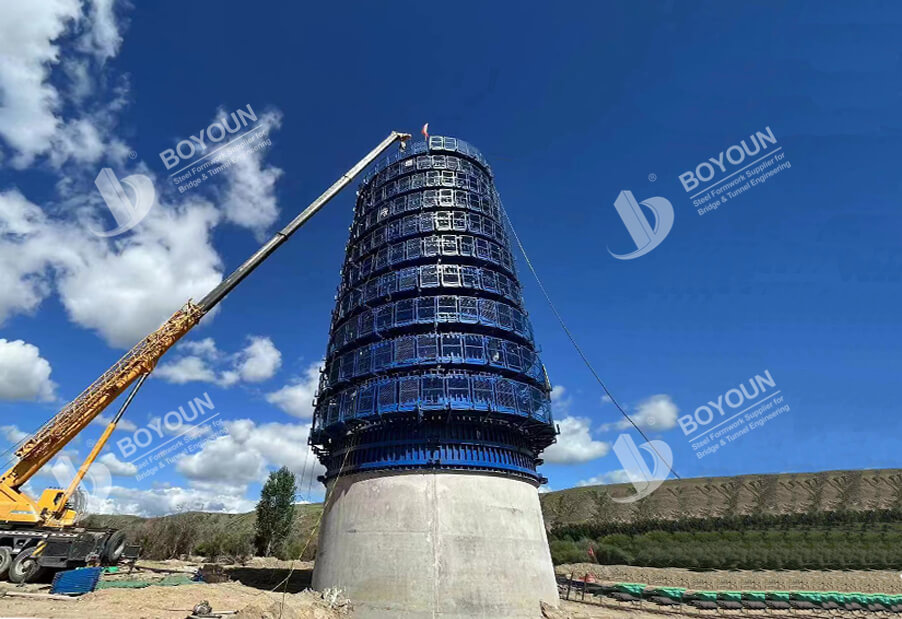
During the preparation stage of cylindrical pier construction, the construction plan must precisely cover four core areas: First, the pier formwork support system, which requires clear specifications for support selection, erection parameters, stability verification calculations, load transfer paths, and special force calculations for high piers and large-diameter pier columns. Second, the steel bar binding plan, which must specify bar specifications, spacing, lap lengths, connection methods, and construction sequence, with strict control over installation accuracy and fastening. Third, the concrete pouring technique, determining the pouring sequence, layer thickness, vibration frequency, and curing measures to ensure pouring quality. Fourth, work-at-height safety protection, implementing measures to prevent falls from height and falling objects, clearly defining requirements for the erection of working platforms, the use of safety harnesses for high-altitude work, and the installation of guardrails. Concurrently, a specialized safety risk assessment must be conducted to systematically identify potential safety hazards in each construction phase. Targeted prevention and control measures should be developed for high-frequency risks such as formwork collapse, machinery-related injuries, falls from height, and electric shock. A comprehensive accident emergency plan must also be prepared, outlining emergency response procedures, rescue organizational structure, personnel evacuation routes, and the allocation of emergency supplies, ensuring proactive risk identification and efficient incident response.
The quality of construction equipment and building materials directly determines construction safety and engineering quality. All equipment and materials delivered to the site must undergo rigorous inspection and verification and can only be used after confirming compliance with national standards, design requirements, and construction specifications. Critical equipment such as lifting appliances, concrete construction equipment, and formwork support components must be checked individually for valid inspection certificates, annual maintenance records, and manufacturer certificates to ensure proper functionality.
Incoming concrete raw materials, including rebar, cement, aggregates, and admixtures, must be accompanied by complete factory certificates, material test reports, and quality guarantees. Construction personnel must conduct on-site sampling for testing. Rebar must be retested for yield strength, tensile strength, and elongation. Cement must be retested for strength grade and soundness. Aggregates must be retested for gradation, silt content, and other indicators. All materials can only be used after passing these tests. Regarding the specialized steel formwork for cylindrical piers, the flatness deviation should be ≤2mm, the rigidity and load-bearing capacity must meet design load requirements, welds must be sound without cracks, detachment, or missing welding, bolt hole positions must be accurate without deformation or burrs, ensuring stable support formation and tight joints during subsequent erection.
The construction site requires standardized zoning. Rebar, formwork, concrete raw materials, and components should be stored in designated areas by type and specification. Stacking height should not exceed 1.5m, with materials elevated from the ground for moisture protection and stacked stably to prevent sliding or collapse. Material storage areas must maintain a safe distance from construction operation zones and emergency access routes. It is strictly prohibited to occupy main construction access ways or emergency evacuation routes, ensuring unobstructed passage. Construction machinery such as mixers, vibrators, and cranes must be placed on compacted, level, hardened ground. Areas around equipment should be kept clean, with timely removal of oil stains and standing water, and equipment protection measures implemented. Dedicated waste material storage areas should be established on-site for the classified collection of rebar offcuts, scrap formwork, packaging waste, and other debris. These materials must be centrally stored in designated areas; indiscriminate dumping or scattered堆放 is strictly prohibited. Construction personnel should regularly clear and remove waste to prevent excessive accumulation that could hinder construction access or create fire hazards. On-site facilities for rain, wind, and moisture protection should be provided to shield various raw materials from weather effects. Main access roads and emergency routes on the site must be kept level and clear, with a minimum width of 1.5m; no materials or debris may be stacked on either side. Construction roads should be regularly watered for dust control. During rainy conditions, timely drainage and placement of anti-slip mats are necessary. Drainage ditches should be excavated around foundation pits and deep excavations to maintain smooth drainage, preventing water accumulation from softening the foundation or eroding slopes. For night operations, the work area must have adequate lighting with illumination intensity not less than 50 lux to ensure clear visibility.
Safety control during the preparation stage forms the foundation for the entire life cycle of cylindrical pier construction. Only by strictly managing the four core aspects—construction planning, material verification, equipment inspection, and site organization—can various safety risks be mitigated at the source, paving the way for subsequent critical procedures such as formwork erection, concrete pouring, and work at height. The more meticulous the preliminary preparation and the stricter the control, the fewer the potential safety hazards during the construction process. The subsequent on-site construction phase represents a high-incidence period for safety accidents, where the stability of formwork and protection during work at height are particularly crucial. In our next article, we will detail the key safety control points during the construction process to secure the mid-term construction safety line.

We focus on turn-key solutions and types of formwork for Bridge and Viaduct Construction at home and abroad since 2006.


International Department: Room 2507-2508, Tower C of Wanda Plaza, Tongzhou District, Beijing 101118, China.
+86-13021287080
info@boyoun.cn

