
 Russian
 French
 Spanish
 Arabic
 Thai
Thai Indonesian

Once the preparatory work for cylindrical pier construction is completed and all prerequisite conditions are verified to meet standards, the project enters the substantive on-site construction phase. This phase represents the core segment of the entire construction cycle, characterized by the highest concentration of safety risks, the greatest management difficulty, and the most complex operations. Common high-incidence safety hazards during this phase include the instability and collapse of the pier formwork support system, falls and falling objects during work at height safety for piers, uneven stress during concrete placement, and non-compliant temporary electrical installations. This part focuses on the entire on-site construction process of cylindrical piers, detailing the practical operational key points of two core areas: the stability control of the formwork support system and the safety protection for work at heights.
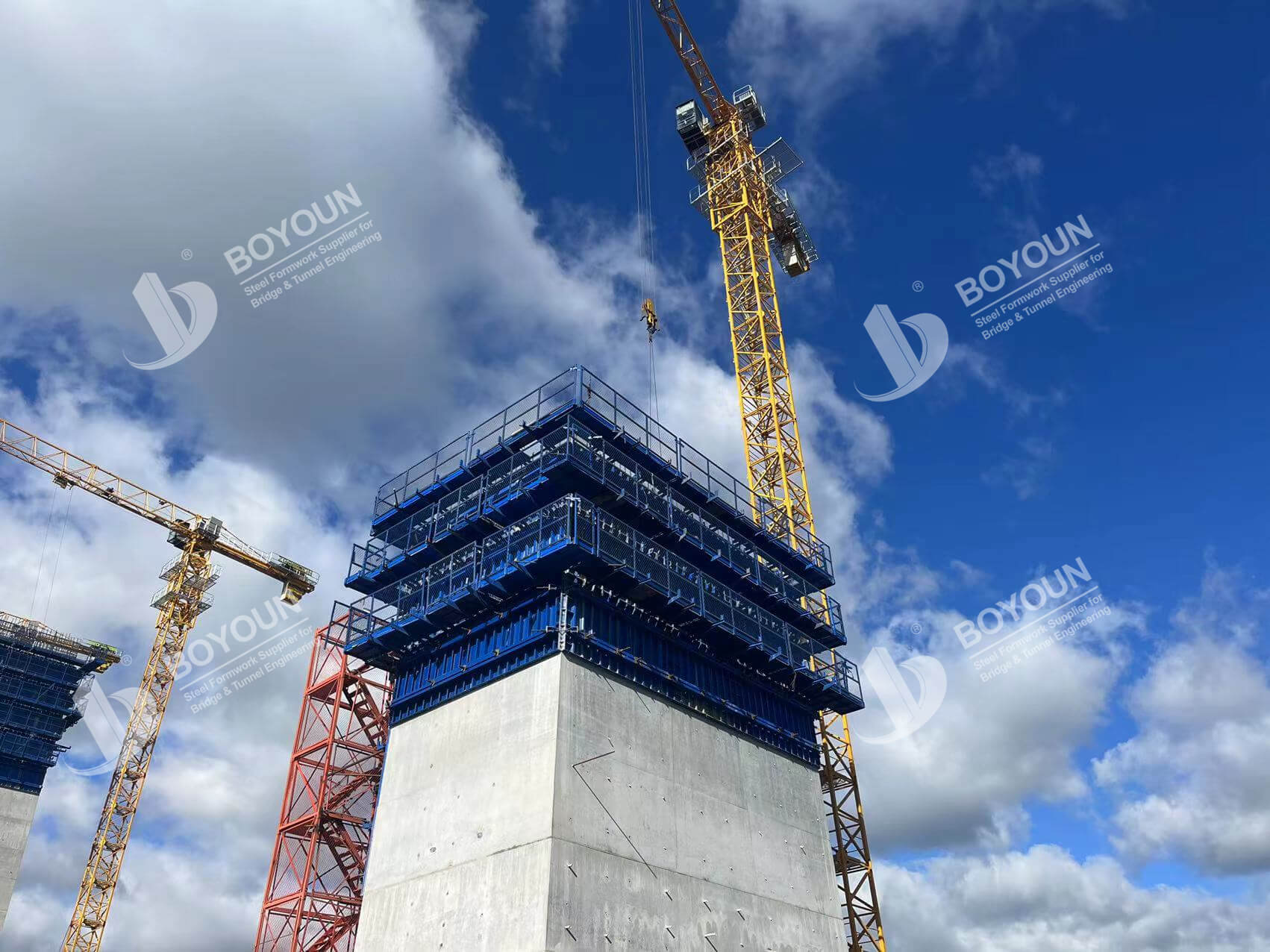
The pier formwork support system is the core load-bearing structure for cylindrical pier construction, bearing the full lateral pressure from concrete placement and construction loads. Its stability is directly critical to the safety of construction personnel and the quality of the finished pier. The maximum spacing of vertical members shall be ≤1.2m, and the spacing of horizontal members and diagonal bracing shall be ≤1.5m, ensuring adequate rigidity and uniform stress distribution within the overall system. Support materials should preferentially be compliant Q235 steel, with steel pipe outer diameters of 48–51mm and wall thicknesses ≥3.5mm. During erection, the verticality deviation of vertical members must be strictly controlled to ≤1/500. Timber pads ≥50mm thick or steel bases shall be placed at the bottom to increase the bearing area and prevent settlement. Horizontal members must be installed at the nodes of vertical members, with one level installed every 1.5m. Diagonal bracing angles shall be controlled between 45° and 60°. For support structures exceeding 4m in length, bidirectional diagonal bracing must be added. All connecting bolts must be tightened and secured, with no loose components or detachment. Before concrete placement, designated personnel must conduct a comprehensive inspection of the formwork and support system, confirming secure connections, tightened bolt fasteners, no bending or deformation of vertical members, and compliance of internal reinforcement with design requirements. For high piers exceeding 8m in height, specialized load-bearing capacity calculations must be performed, and additional supports or hoop reinforcement must be added if necessary. The lateral pressure on the formwork must be accurately calculated based on a concrete unit weight of 23–24 kN/m³, combined with the on-site placement rate and vibration method. Displacement monitoring devices shall be installed at critical locations, strictly controlling deformation values to ≤3mm.
Concrete pouring safety for piers must strictly adhere to the principles of layered, segmented, symmetrical, and uniform pouring. The thickness per layer shall be ≤500mm, and the placement rate ≤2m/h, avoiding concentrated discharge on one side which can cause uneven stress, leading to formwork displacement, bulging, or cracking. During vibration, the vibrator must maintain a safe distance from the formwork; directly touching the steel formwork is strictly prohibited to prevent displacement or bolt loosening caused by excessive vibration force. After placement is complete, the formwork and support system must remain undisturbed until the concrete strength reaches at least 70% of the design strength before formwork removal. Formwork removal shall follow the principles of proceeding from top to bottom, symmetrical segmentation, and sequential dismantling to prevent sudden instability and collapse of the support system. During removal, finished pier concrete shall be protected to avoid impact damage to the concrete surface. After removal, the formwork and support components must be promptly cleaned, inspected for damage or deformation, sorted, and stored properly for subsequent reuse.
Cylindrical pier construction frequently involves high-altitude operation for bridge piers exceeding 2m. Before operations commence, the project department must conduct a specific safety and technical briefing for the day's work content, clarifying operational procedures, safety regulations, and precautions for hazard avoidance. Personnel performing the work must consistently wear qualified personal protective equipment, including safety helmets, safety harnesses, non-slip footwear, and high-visibility vests, strictly in accordance with regulations. Safety harnesses must be attached using the "high anchor point, low attachment point" method, secured to a main structure capable of bearing a load ≥15kN. Attachment to unstable facilities such as movable components, formwork, or scaffolding is strictly prohibited. The principle of dual fall protection must be strictly implemented to establish a double-layer safeguard against falls.
A hard-barricaded isolation zone must be designated below the work-at-height area, with conspicuous warning signs posted and dedicated personnel assigned for monitoring, to strictly prevent injuries from falling objects. Construction tools and small materials must be placed in tool bags or securely fastened with lanyards; throwing tools or materials up or down is strictly prohibited, as is placing items loosely where they could fall and cause injury. Work-at-height equipment such as lifting devices and suspended platforms must undergo a comprehensive pre-use inspection covering wire rope wear, hook deformation, and brake responsiveness. During operation, overloading and over-crewing are strictly prohibited, and lifting/lowering must be carried out smoothly.
The on-site construction phase represents the core challenging period for cylindrical pier safety control. It involves numerous procedures, multiple risks, and many variables. Every process, every operation, and every inspection must be executed with utmost diligence, leaving no room for negligence or complacency. Only by strictly controlling the stability of the pier formwork support system and strengthening comprehensive fall protection for work at height safety for piers—achieving standardized operations, continuous monitoring, and immediate rectification of hazards—can various safety accidents be effectively avoided. After all major construction processes are completed, safety control during the final phase must not be overlooked. Risks still exist in processes such as formwork removal, structural acceptance inspection, and site clearance. In the third part, we will detail the key points for safety acceptance, formwork removal control, and site restoration after construction completion, thus fully closing the loop for the comprehensive cycle of cylindrical pier safety control.

We focus on turn-key solutions and types of formwork for Bridge and Viaduct Construction at home and abroad since 2006.


International Department: Room 2507-2508, Tower C of Wanda Plaza, Tongzhou District, Beijing 101118, China.
+86-13021287080
info@boyoun.cn

