
 Russian
 French
 Spanish
 Arabic
 Thai
Thai Indonesian

As a core structural component in highway, municipal and railway bridge engineering, precast T-beams directly determine the overall structural safety, durability and appearance quality of bridges, and serve as a key assessment index for project acceptance. In the current stage, the construction standards for concrete T-beams in bridge engineering are constantly rising. Not only do the concrete strength and durability need to comply with design and specification requirements, but stringent standards are also imposed on the surface flatness and color consistency of beam bodies, with appearance defects such as honeycombing, pitting surface, air bubbles and color difference strictly prohibited. The quality control of precast T-beam construction hinges on the standardized operation of key processes including formwork construction, concrete pouring, formwork removal and curing. Any oversight in any link may lead to quality problems, increase project rework costs and delay the construction period. Combining practical experience in bridge engineering construction, this paper sorts out the core control measures for precast T-beam construction from four dimensions: T-beam steel formwork construction, concrete pouring technology, formwork demoulding and curing, and other construction details. It provides actionable quality control solutions for road and bridge construction contractors and project departments, helping to ensure precast T-beam construction meets standards at one time and achieves zero rework in acceptance.
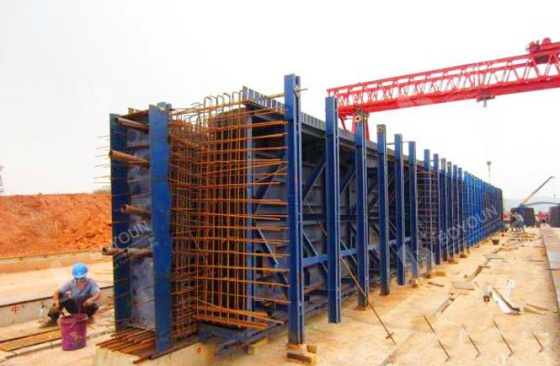
Specialized customized steel formwork must be adopted for assembly during construction to ensure the standardization and prefabrication of T-beam formwork construction. Meanwhile, to guarantee the high efficiency of subsequent formwork assembly, the accuracy of each bolt connection hole and surface flatness shall be ensured in actual assembly. Before formwork assembly, rust, stains, scum and other impurities on the formwork surface shall be thoroughly cleaned, and a high-efficiency release agent shall be evenly applied on the surface to prevent adverse effects on the appearance quality of concrete. To effectively avoid grout leakage at the bottom plate, sponge rubber strips can be pasted on the side of the bearing platform. The side formwork shall be assembled from the middle to both sides in sequence, connected with tie rods, and the tie rods on the beam top shall be adjusted. During actual construction, the tie rods on the beam top and the bearing platform shall be firmly fixed to ensure the overall stability and safety of the formwork system.
Sponge rubber strips can be pasted at the formwork joints to prevent the outflow of concrete slurry, which can effectively narrow the joints when the formwork is subjected to external forces and stop slurry from leaking out. To avoid gaps between various reserved holes, high-strength and high-viscosity foam caulking materials are used for sealing, so as to ensure the installation quality of end and tooth plate formwork meets specification requirements to the maximum extent. When installing attached vibrators, the formwork joints shall be avoided as much as possible. At the same time, to ensure the compactness of concrete under the anchor bearing plate, attached vibrators shall be reasonably arranged according to the specific conditions of the end formwork.
Post-tensioning method is adopted for the construction of concrete T-beams, with corrugated pipes arranged inside the concrete. The use of inserted vibrators for vibration is strictly prohibited during concrete pouring to avoid disturbance and damage to the corrugated pipes. The cohesiveness and slump of concrete must be strictly controlled in the construction of T-beam concrete. Due to the dense reinforcement arrangement and small spacing at the joint of web and horse-shoe part, coupled with the obstruction of corrugated pipes, vibration is not easy to carry out in actual construction, which is prone to concrete missing vibration and causes problems such as difficulty in discharging air bubbles. Therefore, scientific control of its cohesiveness and slump is essential.
During the pouring of T-beam concrete, small-diameter inserted vibrators can be used for vibration at the formwork corners and dense reinforcement areas, and attached vibrators are adopted for vibrating the lower part of corrugated pipes. The inclined section and horizontal layer pouring method shall be adopted for T-beam concrete pouring, and the concrete shall be continuously poured and formed at one time, with the thickness of layered pouring not exceeding 300mm. The pouring of the top plate shall be carried out step by step from one end to the other, with inserted vibrators for vibration.
Key Points of Concrete Formwork Removal and Curing
The removal of T-beam concrete formwork shall be strictly implemented in accordance with specification requirements. Formwork removal can only be carried out when the concrete strength reaches more than 12.5MPa and the pouring time exceeds 18 hours. To ensure the quality of T-beam concrete, formwork shall be removed in a scientific and orderly manner, and violent knocking and prying are strictly prohibited. In addition, the wet joint position shall be chiseled in a timely manner after formwork removal, with the chiseling depth controlled at 4~6mm. The hydration of T-beam concrete is closely related to its internal humidity, but the hydration will stop when the internal humidity drops to 80% of the initial level, leading to cracks in the T-beam concrete.
Due to the special structure of precast T-beams, their curing method is different from the conventional one: steam curing shall be adopted in winter to ensure a constant temperature of not less than 15℃; in summer, the surface shall be covered with geotextile and cured with automatic sprinkler irrigation. After the completion of T-beam concrete pouring, curing shall be carried out in strict accordance with the standard temperature and humidity conditions to prevent concrete cracking. Meanwhile, the concrete curing time shall be strictly controlled, not less than 14 days in winter and 7 days in summer.
The following three issues shall also be noted in T-beam concrete construction:
(1)Strictly control the concrete mixing time to avoid excessively long or short mixing. Overlong mixing will cause concrete segregation, while overly short mixing will result in uneven mixture.
(2)Prevent water loss during concrete transportation, and ensure the inner surface of the transport truck tank is smooth and airtight to avoid water absorption and grout leakage.
(3)Strictly control the concrete vibration time to prevent over-vibration and missing vibration. Missing vibration will cause poor structural compactness and low strength, while over-vibration will lead to many air bubbles inside the concrete and affect the appearance quality.
In summary, the refined quality control of precast T-beam construction is an important guarantee for the overall quality of bridge engineering. From the assembly and sealing of customized steel formwork, to the process control of concrete pouring, and then to the temperature and humidity management of formwork removal and curing, each process must strictly follow the specifications and practical key points. Only in this way can appearance defects such as honeycombing, cracks and air bubbles be avoided from the source, and the structural performance and appearance quality of T-beams be guaranteed. In actual bridge engineering construction, contractors need to flexibly adjust the construction control strategies according to the project's regional environment (winter/summer), T-beam span specifications and construction period requirements, and implement standardized operations in every construction detail.
As a professional manufacturer of bridge steel formwork, Boyoun Heavy Industries can customize customized steel formwork for precast T-beams of various spans. The formwork is manufactured with high-precision processing technology, featuring tight joints and stable structure, which can reduce grout leakage, formwork expansion and other problems from the source. Combined with professional construction technical guidance, we help construction contractors improve the construction efficiency and quality of precast T-beams. If your bridge project is carrying out precast T-beam construction and you need to customize high-adaptability customized steel formwork for T-beams or obtain targeted construction supporting solutions, you can directly send us a private message or leave a message. We will provide you with one-on-one technical connection and quotation services to ensure the efficient progress of your project.

We focus on turn-key solutions and types of formwork for Bridge and Viaduct Construction at home and abroad since 2006.


International Department: Room 2507-2508, Tower C of Wanda Plaza, Tongzhou District, Beijing 101118, China.
+86-13021287080
info@boyoun.cn

