
 Russian
 French
 Spanish
 Arabic
 Thai
Thai Indonesian

In the field of tunnel engineering construction, the tunnel secondary lining serves as a key link to ensure the structural stability and extend the service life of tunnels, and its construction quality directly determines the overall safety and operational reliability of tunnel projects. With the continuous advancement of transportation infrastructure projects, the technical requirements and quality standards for tunnel secondary lining construction have been continuously raised. However, various quality hazards and technical problems still occur from time to time in actual construction scenarios, which not only affect the construction progress but also may lay hidden safety risks for tunnel operation. This paper focuses on the construction process of tunnel secondary lining, deeply analyzes the common core problems therein, and provides a reference direction for the quality control and technical optimization of tunnel secondary lining projects.
In actual projects, the selection of the construction timing for the secondary lining is often affected by both construction period pressure and empirical judgment. In order to speed up the progress, some construction units are eager to construct the secondary lining before the surrounding rock deformation is stabilized, which causes the lining structure to bear the additional stress generated by the continuous deformation of the surrounding rock prematurely. This is very likely to trigger circumferential or longitudinal cracks and even structural damage in severe cases. On the contrary, if the construction is too late, the initial support may suffer from strength attenuation, steel bar corrosion and other problems due to long-term exposure to humid and corrosive environments, which not only increases the difficulty of base surface treatment but also may weaken the overall performance of the composite support system. Therefore, the lack of scientific and quantitative criteria to guide the construction timing is a common technical shortcoming in the current construction of tunnel secondary lining.
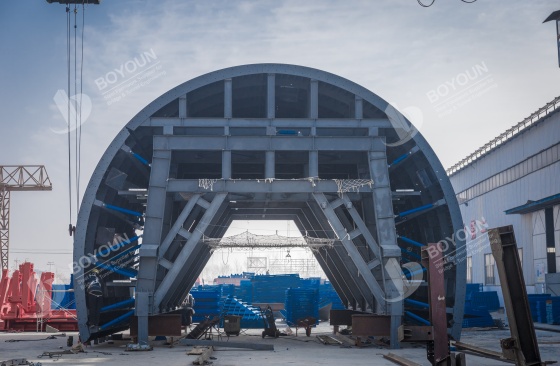
As the core equipment for the forming of tunnel secondary lining, the positioning accuracy of the formwork trolley directly determines the geometric dimensions and clear space quality of the lining structure. However, in actual operation, problems such as center line deviation, elevation error or inconsistent section contour often occur due to measurement errors, trolley deformation, uneven tracks or insufficient experience of operators. These problems may not only lead to insufficient tunnel clear space and affect the subsequent installation of electromechanical equipment, but also cause excessive concrete consumption or insufficient local thickness, thereby affecting the structural bearing capacity and durability. Especially in curved sections or variable cross-section sections, the positioning deviation is more likely to be amplified without the support of a high-precision guidance system, making it difficult to guarantee the construction quality.
As the main material of the secondary lining, the construction quality of concrete is directly related to the structural performance. During the pumping process, unreasonable mix proportion design, such as a high water-binder ratio or improper admixture content, is likely to cause concrete segregation and bleeding, affecting the homogeneity. During the pouring process, due to the limited space at the vault, it is difficult for the vibrator to be effectively inserted. In addition, the coarse aggregate sinks under the action of concrete self-weight, which often forms defects such as voids and honeycombs at the vault. Furthermore, if the circumferential construction joints are not fully chiseled or the interface is not thoroughly cleaned, the bonding force between the new and old concrete will be insufficient, which is likely to become a water seepage channel. If the curing link is neglected, the concrete will lose water too fast in the early stage, resulting in significant plastic shrinkage and dry shrinkage cracks, which weakens the structural integrity and waterproof performance.
The waterproof system is the key to ensuring the long-term water-tightness of tunnels. However, during the construction process, the laying of waterproof boards is often punctured by sharp objects due to inadequate base surface treatment, or the welds are not firm due to improper control of welding temperature and speed. Some construction personnel do not attach enough importance to the air pressure detection of double welds and fail to detect and repair minor damage points in a timely manner. More seriously, if there are large depressions or cavities on the surface of the initial support, the waterproof board may be pressed into the cavities under the pressure of concrete pouring, forming a "false pasting" phenomenon. This causes groundwater to bypass the waterproof layer and directly contact the lining concrete, resulting in local water seepage or even water inrush. Such problems are often exposed during the operation stage, with high repair difficulty and cost.
Traditional quality inspection methods mostly rely on local and destructive means such as core drilling and rebound testing, which are not only inefficient and have limited coverage, but also difficult to reflect the overall quality status of the lining. For example, core drilling can only reflect the strength and thickness of a single point and cannot judge whether there are large-area cavities behind the lining; visual inspection is also difficult to find internal defects. This mode of "sampling inspection after construction and passive rectification" cannot realize real-time monitoring and dynamic adjustment of the construction process, leading to quality problems often being found after the structure is formed, which results in high rework costs and affects the overall construction period.
In summary, problems such as the control of construction timing, formwork positioning, concrete quality, waterproof system and inspection methods in tunnel secondary lining construction are all directly related to the overall quality and engineering safety of tunnel secondary lining construction. Ensuring the whole-process quality control of tunnel secondary lining projects and accurately avoiding the above problems can not only improve the stability and durability of tunnel structures, but also guarantee the long-term operation of transportation infrastructure projects. In response to the core problems proposed in this paper, the next paper will focus on introducing the corresponding optimization strategies for the construction technology of tunnel secondary lining, so as to provide practical and feasible technical solutions for solving construction pain points and improving project quality. In the future, with the upgrading of inspection technology and the improvement of construction standards, it is necessary to further strengthen the control of key links in tunnel secondary lining construction and promote the continuous improvement of the construction quality of tunnel engineering projects.

We focus on turn-key solutions and types of formwork for Bridge and Viaduct Construction at home and abroad since 2006.


International Department: Room 2507-2508, Tower C of Wanda Plaza, Tongzhou District, Beijing 101118, China.
+86-13021287080
info@boyoun.cn

