
 Russian
 French
 Spanish
 Arabic
 Thai
Thai Indonesian

Precast assembled bridge technology is widely adopted due to its advantages of high construction efficiency, low carbon emissions, and environmental friendliness. However, current methods for controlling the production and installation precision of assembled concrete piers lack rationality and effectiveness. Based on the characteristics of bridge piers, this paper proposes a construction workflow for precision control technology. This workflow mainly includes precision control methods for precast pier production, rational transportation methods, and rapid installation methods, aiming to improve construction precision and efficiency.
During the production of precast concrete piers, the binding precision of the reinforcement cage and the accurate positioning of embedded components are critical links in precision control. During the binding process, to ensure accurate positioning of the sleeves, the installation positions of the sleeves are precisely marked on the end formwork. The sleeves achieve precise positioning of the top ends of the column main reinforcements and the bottom ends of the sleeves through two matching positioning plates and two positioning frames. The positioning plate at the bottom end of the sleeve at the tail of the pier reinforcement cage jig serves both as a positioning plate and as a bottom form, integrating with the fixed end of the sleeve as a unified design. Additionally, the positioning frame is equipped with screw rods for fine-tuning the positional deviation of embedded reinforcements, ensuring that the positional deviation of embedded reinforcements is controlled within 2mm. To guarantee the installation precision of the sleeves, the pre-drilled holes on the positioning frames and positioning plates must fully correspond and be accurate without error. The precision-machined positioning frames and positioning plates must be produced as matching sets, with precision control requirements within plus or minus 1mm.
During the transportation of concrete piers, issues such as traffic congestion, narrow transportation roads, and unreasonable construction site planning often lead to damage and breakage of concrete components. To address this problem, unmanned aerial vehicles (UAVs) can be used to capture fixed-point photographs of road conditions and traffic situations along the transportation route, obtaining detailed aerial images. These images are then combined with construction drawings to accurately model the construction site, allowing for early prediction of road transportation conditions and rational layout of the construction site. This effectively prevents impact and damage to concrete piers during transportation and unloading.
After vertical pouring of the concrete pier is completed, it needs to be transported to the construction site for assembly. During transportation and installation, the component requires multiple overturning operations. The traditional method of direct lifting using a steel spreader bar with two shackles cannot guarantee the safety and stability of overturning heavy precast piers. To address this, a removable temporary hinged device can be used, as shown in Figure 6(b). This device consists of embedded steel strands (as shown in Figure 6(a)), steel cushions, and a round steel beam. The steel cushion adopts a trapezoidal cross-section and has a U-shaped long groove on its upper portion for the round steel beam to pass through. During use, the steel cushion is placed between two embedded steel strand lifting loops, and the round steel beam passes through both the steel strand lifting loops and the steel cushion, as shown in Figure 6(c). This design forms a bearing system composed of embedded steel strands and an upper "steel base-pin" assembly, achieving free rotation between the steel strand lifting loops and the round steel beam, between the round steel beam and the steel cushion, and between the lifting cable and the round steel beam. This not only makes the pier overturning process freer, more stable, and safer but also effectively protects its appearance quality.
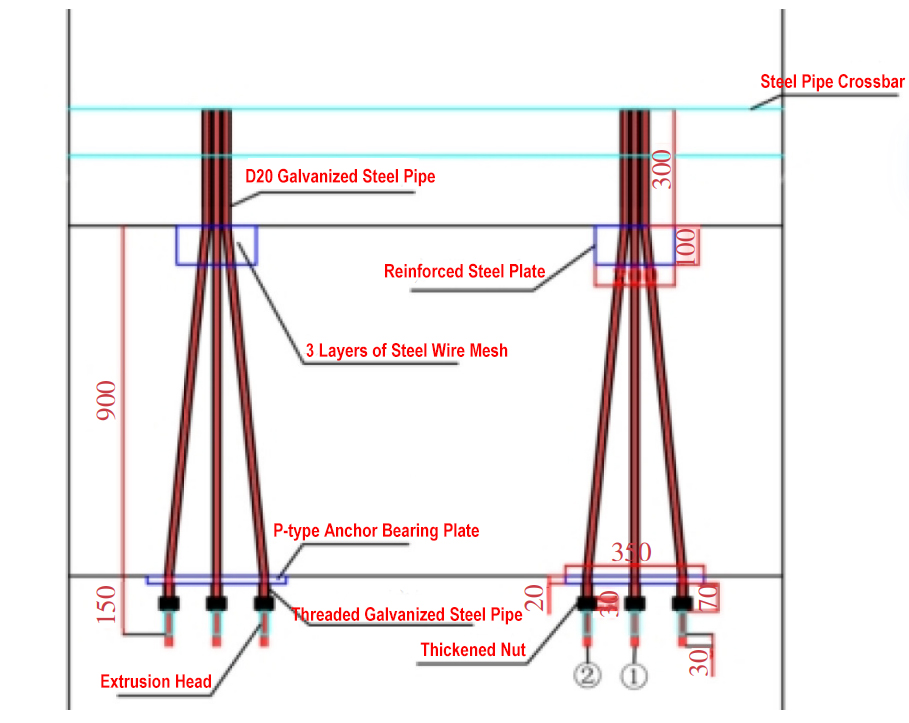
(a) Schematic diagram of steel strand pre-embedded configuration
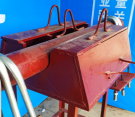
(b) Hinged connection device
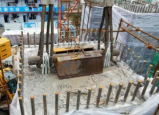
(c) Construction photos
There are two key control points during pier installation: control of the pier bottom elevation and adjustment of the pier verticality. To precisely control the pier bottom elevation, adjusting shims and limit plates are used for positioning. The specific operation is as follows: place adjusting shims at the center of the top of the prepared pile cap. The adjusting shims consist of 200mm by 200mm thin steel plates with thicknesses of 3mm, 5mm, 8mm, 10mm, and 20mm. Based on the re-measured actual height of the precast pier, these thin steel plates are used for fine adjustment. During the adjustment process, longitudinal and lateral deviations are prone to occur at the pier bottom. To avoid this, L-shaped steel limit plates are installed at the four chamfered positions on the lower opening of the pile cap. The limit plates are connected to the pile cap using expansion bolts and have pre-drilled holes for adjustment screw rods. After inserting the adjustment screw rods into the holes, the longitudinal and lateral position of the pier bottom can be fine-tuned and fixed, ensuring that the pier bottom deviation is controlled within 5mm.
Precision control of precast piers runs through the three stages of production, transportation, and installation. During the production stage, the deviation of embedded reinforcements is controlled within 2mm through sleeve positioning plates and positioning frames; during the transportation stage, UAV aerial photography and modeling are used to predict road conditions, avoiding component damage; during the installation stage, a temporary hinged device is adopted to achieve stable overturning, and the bottom deviation is controlled within 5mm using adjusting shims and limit plates. Whole-chain precision management is the key to ensuring the quality of assembled bridges.

We focus on turn-key solutions and types of formwork for Bridge and Viaduct Construction at home and abroad since 2006.


International Department: Room 2507-2508, Tower C of Wanda Plaza, Tongzhou District, Beijing 101118, China.
+86-13021287080
info@boyoun.cn

