
 Russian
 French
 Spanish
 Arabic
 Thai
Thai Indonesian

The quality of cable-stayed bridge construction depends not only on the correct application of construction techniques but also on comprehensive, systematic quality control throughout the entire process. From material delivery to process operations, from structural formation to finished product protection, negligence in any link may bury quality hazards and affect the safety and durability of the bridge. In the previous article, we systematically reviewed the main construction technical points for the substructure and superstructure of cable-stayed bridges. On this basis, this article further provides a dedicated introduction to quality management methods for cable-stayed bridge construction from three aspects: material quality control, construction process quality control, and finished product protection.
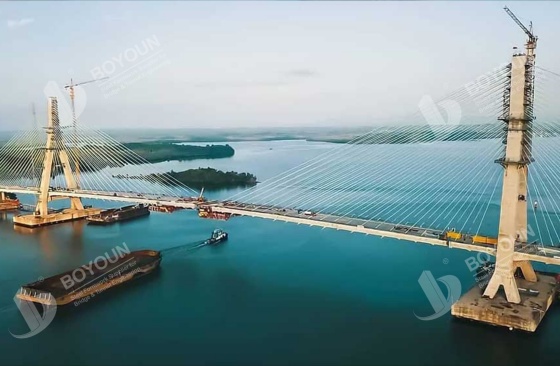
Materials used in cable-stayed bridge construction include concrete, reinforcing steel bars, prestressing steel, cables, etc. Material quality directly affects the construction quality and service life of the bridge. Therefore, material quality must be strictly controlled to ensure that the materials meet the design requirements and relevant code standards. High-strength concrete shall be used, and the optimal mix proportion design and testing of high-strength concrete shall be carried out, with quality control standards and testing methods established. Effective measures shall be taken for the pouring and curing of mass concrete to reduce the hazards of hydration heat and ensure concrete quality. Ordinary reinforcing steel bars, prestressing steel, and anchors shall be procured according to design technical specifications and strictly accepted in accordance with relevant quality inspection standards. Construction shall be carried out in compliance with construction specifications and relevant requirements. The cable system shall adopt the steel strand cable system for extradosed cable-stayed bridges, and the materials, manufacturing, and installation shall all meet relevant code requirements. Cables shall be inspected and accepted upon arrival to ensure that cable quality meets the design requirements.
Construction process quality control is the core link of quality control for cable-stayed bridge construction, mainly including the following aspects:
First, survey control: Total stations, GPS, and other surveying instruments shall be used to accurately measure the cable tower, main girder, and cables to ensure that structural dimensions and positions meet the design requirements.
Second, formwork control: Prefabricated steel formwork shall be used for construction to ensure that the formwork has sufficient strength and stiffness, preventing formwork deformation and grout leakage. Pre-assembly and inspection shall be carried out before formwork installation to ensure installation quality.
Third, concrete pouring control: The quality of concrete pouring shall be strictly controlled. Layered pouring and layered vibration methods shall be adopted to ensure concrete compactness. During pouring, vibration work shall be strengthened to prevent honeycombing and surface pitting of the concrete.
Fourth, prestressing construction control: During tensioning of prestressing steel strands, both tension force and elongation shall be controlled simultaneously to ensure that the prestressing tension force meets the design requirements. Symmetrical tensioning shall be maintained during the tensioning process, and both ends shall be kept synchronized.
Fifth, cable construction control: Appropriate measures shall be taken during cable installation to strengthen cable protection and inspection. During tensioning, both tension force and elongation shall be controlled simultaneously to ensure that the cable tension force meets the design requirements. After tensioning is completed, cable force testing shall be carried out to ensure that the cable force meets the design requirements.
Finished product protection is an important part of quality control for cable-stayed bridge construction, mainly including the following aspects:
(1) Cable tower protection: After completion of cable tower construction, effective measures shall be taken to prevent the cable tower from being impacted and contaminated. The surface of the cable tower shall be cleaned and maintained to ensure the appearance quality of the cable tower.
(2) Main girder protection: After completion of main girder construction, effective measures shall be taken to prevent the main girder from being impacted and contaminated. The surface of the main girder shall be cleaned and maintained to ensure the appearance quality of the main girder.
(3) Cable protection: After completion of cable installation, effective measures shall be taken to prevent the cables from being impacted and contaminated. The surface of the cables shall be cleaned and maintained to ensure the appearance quality and service life of the cables.
In summary, quality control for cable-stayed bridge construction is a systematic work that runs through the entire construction process, covering all aspects such as material delivery, process operations, and finished product protection. In terms of material quality control, it is necessary to start from concrete mix proportion design and testing, mass concrete hydration heat control, strict acceptance of reinforcing steel bars and prestressing steel, to the incoming inspection of the cable system, ensuring that each batch of materials meets the design requirements and code standards. In terms of construction process quality control, survey control is the prerequisite for ensuring structural dimensions and position accuracy; formwork control is the foundation for ensuring concrete appearance quality; concrete pouring control requires layered pouring and layered vibration methods to prevent honeycombing and surface pitting; prestressing construction control adopts dual control of tension force and elongation and maintains symmetrical and synchronous tensioning; cable construction requires full-process control in installation, tensioning, and cable force testing. In terms of finished product protection, effective protective measures shall be taken upon completion of the cable tower, main girder, and cables, with proper cleaning and maintenance, to ensure structural appearance quality and service life.
Through the dual drive of technology and management, penetrating quality control through the entire process and all links of cable-stayed bridge construction, quality hazards can be fundamentally eliminated, ensuring that the bridge structure is safe and reliable, aesthetically pleasing and durable, and laying a solid foundation for long-term bridge operation.

We focus on turn-key solutions and types of formwork for Bridge and Viaduct Construction at home and abroad since 2006.


International Department: Room 2507-2508, Tower C of Wanda Plaza, Tongzhou District, Beijing 101118, China.
+86-13021287080
info@boyoun.cn

