
 Russian
 French
 Spanish
 Arabic
 Thai
Thai Indonesian

In the previous two articles, we explored the technical advantages and key construction points of post-tensioned prestressed concrete bridge construction respectively. However, in actual construction, various problems are inevitable due to the influence of material quality, construction operation, environmental factors and other aspects. If these problems cannot be solved timely and properly, the structural safety and service life of the bridge may be seriously affected. Today, we sort out the three most common types of problems in post-tensioning construction, and put forward targeted solutions combined with practical cases to escort the project construction.
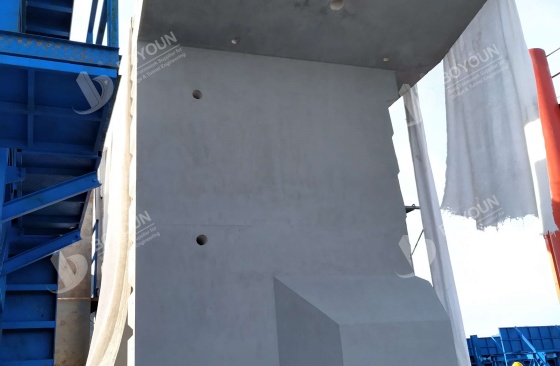
Prestress tensioning is the core link of applying prestress. Abnormal tensioning directly leads to insufficient or uneven distribution of prestress, which impairs the bearing capacity of the bridge. The common problems include insufficient tension force and abnormal elongation value.
Insufficient tension force will result in inadequate pre-compressive stress of concrete and affect the structural bearing capacity. The common causes include aging of sealing parts of tensioning equipment, jamming of prestressed tendons with ducts, and skew installation of anchors.
For example: During the tensioning of a 25m simply supported girder bridge, the tension force of 3 out of 12 steel strand bundles only reached 80% of the design value (180kN). Inspection found that the piston sealing parts of the jack were worn (not replaced after more than 500 uses), leading to hydraulic oil leakage and insufficient actual tension force. After replacing the sealing parts and recalibrating the equipment, the tension force deviation was controlled within ±2%.Solutions: Calibrate tensioning equipment every 200 tensioning operations or 6 months, and replace the sealing parts regularly (recommended every 300 operations); Clean up sundries in ducts with a hole driller before tendon threading, and apply special lubricant to curved ducts in advance; Calibrate anchors with a level during installation to ensure they are perpendicular to the axis of prestressed tendons (deviation ≤2°).
When the deviation between the actual elongation value and the theoretical value exceeds ±6%, construction must be stopped immediately for investigation. The common causes include deviation of the elastic modulus of prestressed tendons, excessive duct friction resistance, and non-standard measurement methods.
For example: During the tensioning of a 30m continuous girder bridge, the designed elongation value was 150mm, while the actual value was only 132mm (deviation -12%). Testing showed that the duct friction coefficient reached 0.3 (designed 0.2), caused by local bending of corrugated pipes during installation (small curvature radius). By increasing the tension force by 5% (from 195kN to 205kN), the elongation value was corrected to 147mm (deviation -2%), which met the requirements.Solutions: Randomly inspect the elastic modulus of steel strands upon delivery (3 reels per batch), and recalculate the theoretical elongation value if the deviation exceeds 5%; Conduct friction resistance tests on long ducts (>50m) or curved ducts before tensioning, and adjust the tension force according to the results; Adopt the sectional measurement method of "initial stress → final stress", and record the elongation value with a dial indicator (precision 0.01mm) to avoid visual measurement errors.
2. Inadequate Duct Grouting
Inadequate duct grouting will expose prestressed tendons to the air, making them prone to corrosion and affecting the long-term transmission of prestress. The common problems stem from two aspects: grouting materials and grouting technology.
Improper mix proportion of grouting materials (such as excessive water-cement ratio and incorrect admixture dosage) will lead to bleeding and segregation, forming cavities in the ducts.
For example: During the grouting of a bridge, the water-cement ratio of cement slurry reached 0.5 (code limit 0.4-0.45) without adding expanding agent. Inspection 3 days later found a 2cm-thick water layer at the top of the ducts, and the bleeding rate of cement slurry reached 8% (code limit ≤3%). The grouting was reworked with cement slurry of 0.42 water-cement ratio mixed with 10% expanding agent, and the grouting compactness met the standard after vacuum-assisted grouting.Solutions: Conduct mix proportion tests before grouting, control the water-cement ratio at 0.4-0.45 and bleeding rate ≤3%, with all bleeding absorbed within 3 hours; Select P.O 42.5 grade cement, mixed with high-efficiency water reducing agent (dosage 3%-5%) and micro-expanding agent (restrained expansion rate 0.02%-0.03%).
Insufficient grouting pressure, poor exhaust, and duct blockage will lead to discontinuous grouting and form local cavities.
For example: During the grouting of a project, the pressure gauge showed a pressure of only 0.3MPa (designed 0.5MPa), and no slurry came out of the exhaust holes. Inspection found that the grouting pump impeller was worn (causing insufficient pressure) and the ducts were blocked by concrete residue. After cleaning the ducts and replacing the grouting pump, the pressure was increased to 0.5MPa, and the exhaust holes were closed after continuous slurry discharge for 30s to ensure grouting compactness.Solutions: The grouting pump shall meet the requirement of "no-load pressure ≥0.8MPa", and keep the grouting pressure at 0.5-0.7MPa; Set exhaust holes (diameter ≥20mm) at the highest points of ducts, and install valves at the slurry outlets to ensure the valves are closed only after thick slurry is discharged continuously; Complete grouting within 24 hours after tensioning to avoid corrosion of prestressed tendons in the ducts.
As the carrier of bearing prestress, surface defects and cracks of concrete will reduce structural durability and easily cause subsequent diseases. The common problems include honeycombs and pitting surfaces, and cracks.
Honeycombs and pitting surfaces on the concrete surface caused by insufficient vibration and formwork grout leakage will affect the structural durability.
For example: During the pouring of a box girder top slab, 2㎡ of honeycombs (5-10mm in depth) appeared on the surface due to insufficient insertion depth of the vibrator (not reaching the lower layer of concrete). The loose concrete was chiseled off, and the defect was repaired with C50 fine aggregate concrete mixed with micro-expanding agent. The surface was coated with cement-based capillary crystalline coating to ensure water tightness.Solutions: Operate the vibrator with the method of "fast insertion and slow extraction", with an insertion spacing of ≤50cm and vibration time of 20-30s per point until the surface is grouted; Paste sealing rubber strips (5mm in thickness) at formwork joints, add water stop gaskets to tie rods, and conduct a water tightness test (no leakage for 24h) before pouring.
Cracks caused by concrete shrinkage, excessive temperature difference and excessive tensioning stress need to be controlled in stages.
For example: Three 6m-long dry-shrinkage cracks with a width of 0.2mm appeared on the web surface of a bridge 3 days after pouring, due to inadequate curing (no covering and sprinkling in high summer temperature). The cracks were sealed with epoxy resin slurry by low-pressure grouting (0.2MPa), and the web was covered with geotextile for moist curing for another 14 days, with no crack propagation observed.Solutions: Cover and keep the concrete moist within 12 hours after pouring; sprinkle water every 2 hours in summer, and adopt steam curing in winter (temperature gradient ≤20°C/h); Strictly control the tensioning stress (over-tensioning not exceeding 105%σcon) to avoid local stress concentration; Repair cracks with a width >0.2mm by pressure grouting, and seal cracks with a width <0.2mm by brushing epoxy resin.
Post-tensioned prestressed concrete bridge construction technology plays an irreplaceable and important role in modern bridge construction. By deeply understanding its construction principles and advantages, strictly controlling the key construction points, and effectively solving the common problems in the construction process, the quality and safety of bridge engineering can be fully guaranteed. We also welcome you to share your construction experience and insights in the comment section!

We focus on turn-key solutions and types of formwork for Bridge and Viaduct Construction at home and abroad since 2006.


International Department: Room 2507-2508, Tower C of Wanda Plaza, Tongzhou District, Beijing 101118, China.
+86-13021287080
info@boyoun.cn

