
 Russian
 French
 Spanish
 Arabic
 Thai
Thai Indonesian

In the last article, we explored the three core advantages of post-tensioned prestressed concrete bridge construction technology. The realization of these outstanding advantages relies on the precise control of every construction link. Post-tensioned construction technology features complex and interlocking processes, and any oversight in a single link may compromise the final quality and service life of the bridge. Today, we break down the four key construction links of post-tensioning and elaborate on the critical technical points, providing professional references for engineering quality control.
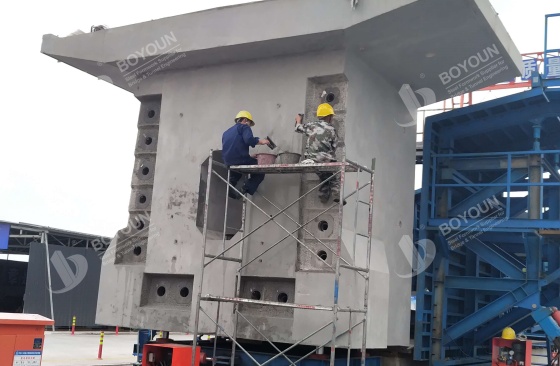
Prestressed tendons are the core components for transmitting prestress, and their fabrication and installation quality directly determine the effect of prestress application.
The cutting length of prestressed tendons must be accurately calculated according to the formula: Cutting length = Duct length + 2×(Anchor thickness + Jack working length + Exposed length), with the error controlled within ±50mm. Cutting must be done with an abrasive wheel cutter (arc cutting is strictly prohibited). After cutting, steel strands shall be straightened and bundled with 18-gauge iron wire every 1.5m to prevent torsion.
For example: In the construction of a 35m-span girder bridge, the duct length is 35m, anchor thickness 10cm, jack working length 60cm, and exposed length 30cm. The calculated cutting length is 35 + 2×(0.1+0.6+0.3) = 37m. In actual operation, the length deviation of a single steel strand was controlled within ±15mm, and bundling was carried out strictly at 1.5m intervals. The tendon threading process was smooth without jamming, laying a solid foundation for subsequent tensioning.
1.2 Tendon Threading
The tendon threading method is selected according to the duct length: manual threading for short ducts (<30m), and winch traction for long ducts (>50m). A guide cap must be installed at the front end to reduce friction.
For example: A 60m continuous girder bridge has long ducts with curved sections. Winch traction was adopted for tendon threading, and a conical nylon guide cap (5mm smaller in diameter than the duct) was installed at the front end of the steel strands. The traction direction was controlled by pulleys, and the tendon threading of a single girder was completed in only 1 hour. The exposed length deviation at both ends after threading was ≤8mm, ensuring the symmetry during tensioning.
2. Duct Forming and Installation
The duct is the laying channel for prestressed tendons, and its forming quality and position accuracy directly affect the uniformity of prestress distribution, while also requiring good sealing and durability.
2.1 Duct Material Selection
Duct materials must be adapted to the working environment: metal corrugated pipes are suitable for dry environments, and HDPE plastic corrugated pipes are ideal for corrosive environments.
For example: A coastal bridge affected by high salt spray adopted HDPE plastic corrugated pipes with a wall thickness of 2mm, whose impermeability reached 0.6MPa (0.3MPa for metal corrugated pipes). Inspection after 8 years of operation showed no corrosion of prestressed tendons in the ducts, while 5% of the ducts in the approach bridge using metal corrugated pipes in the same period showed signs of corrosion.
Ducts must be fixed with positioning steel bars, with a spacing of ≤50cm for straight sections and ≤30cm for curved sections. The position deviation is controlled within ±5mm to ensure uniform prestress distribution.
For example: In the construction of a continuous girder bridge, total station was used for setting out and positioning. Φ12mm positioning steel bars were firmly welded to the girder steel bars, with a spacing of 50cm for straight sections and 30cm for curved sections (dense arrangement). The final duct coordinate deviation was all ≤3mm. After tensioning, the stress distribution of the girder body was uniform, with a maximum stress deviation of only 2% (5% allowed by the code).
3. Concrete Pouring and Curing
Concrete is the carrier for bearing prestress, and its strength and durability directly determine the bearing capacity and service life of the bridge structure. The pouring and curing links must be strictly controlled.
3.1 Concrete Pouring
Concrete shall be poured in layers (300-500mm per layer), and vibrated with an immersion vibrator until the surface is grouted. Hitting the corrugated pipes is strictly prohibited.
For example: During the pouring of the box girder web, the principle of horizontal layering and oblique advancing was adopted, with a layer thickness of 40cm. The vibrator was inserted 50mm into the lower layer to ensure compaction. Special personnel were assigned to monitor the corrugated pipes, and a slight damage was immediately sealed with tape to avoid grout leakage and blockage. There were no honeycombs or pitting surfaces on the web after form removal.
3.2 Concrete Curing
The concrete shall be covered and kept moist within 12 hours after pouring, with a curing period of ≥7 days for Portland cement. The surface shall be kept moist to avoid dry-shrinkage cracks.
For example: A bridge was constructed in summer with a temperature of 36°C. Geotextile covering and regular sprinkling were adopted for curing, with sprinkling once every 2 hours, keeping the concrete surface humidity above 90%. The 7-day strength reached 82% of the design value, meeting the tensioning conditions, and there were no dry-shrinkage cracks on the surface.
4. Prestress Tensioning and Duct Grouting
Prestress tensioning is the core link of applying prestress, and duct grouting is the key to protecting prestressed tendons and ensuring the long-term effective transmission of prestress. The two links must be controlled collaboratively.
4.1 Prestress Tensioning
Equipment must be calibrated before tensioning (error ≤1%), and the double control method (tension force as the main control, elongation as verification) shall be adopted. The tensioning procedure is: 0→0.1σcon→1.0σcon (holding load for 2min and anchoring).
For example: The designed tension force of a bridge was 190kN, and the calibration before tensioning showed that 190kN corresponded to a pressure gauge reading of 41MPa. In actual tensioning, the tension force deviation was ≤3%, and the actual elongation was 149mm (145mm theoretical), with a deviation of +2.7%, which met the requirements, ensuring uniform stress on the girder body.
4.2 Duct Grouting
Grouting shall be carried out within 24 hours after tensioning, using cement slurry with a water-cement ratio of 0.4-0.45 (mixed with 10% expanding agent) at a pressure of 0.4-0.6MPa.
For example: A project adopted vacuum-assisted grouting technology, first evacuating to -0.08MPa, then grouting under pressure (0.5MPa). Core drilling inspection showed that the grouting compactness of the duct reached 99%, effectively avoiding the corrosion of prestressed tendons, and no abnormalities occurred after 6 years of operation.
The above four links are the core technical points of post-tensioned prestressed concrete bridge construction. From the fabrication of prestressed tendons and duct forming, to concrete curing and prestress tensioning and grouting, every step must strictly follow technical specifications and control details with precision. Only by strictly controlling every quality checkpoint can the technical advantages of post-tensioning be fully exerted to build safe, durable and high-quality bridge projects. In the next article, we will focus on the common problems in the construction process and targeted solutions to help you avoid construction pitfalls.

We focus on turn-key solutions and types of formwork for Bridge and Viaduct Construction at home and abroad since 2006.


International Department: Room 2507-2508, Tower C of Wanda Plaza, Tongzhou District, Beijing 101118, China.
+86-13021287080
info@boyoun.cn

