
 Russian
 French
 Spanish
 Arabic
 Thai
Thai Indonesian

In bridge engineering construction, the quality of box girder precast construction directly determines the bearing capacity, stability and service life of bridges. Scientific and standardized construction processes are the core prerequisite for ensuring quality. Among them, the formwork engineering, as a key link, is an important factor affecting the forming effect and construction efficiency of box girders. As a manufacturer with years of experience in the bridge formwork field, this article will detail the six key steps of box girder precast construction, sort out the core points of each link, provide practical construction references for industry peers, and interpret the application value of high-quality formwork in each step, helping to improve the quality and efficiency of bridge precast projects.
(1) Site Layout: Level the site and set up a precast yard, including a steel bar and steel strand processing area, a steel bar pre-binding area, a girder precast area, a finished girder storage area, and a finished girder loading area. The number of precast pedestals and girder storage pedestals should be reasonably set according to the scale of auxiliary works, site conditions and project construction period requirements.
(2) Construction of Girder Casting Pedestals and Storage Pedestals: Girder casting pedestals generally consist of foundations and pedestals. The foundation can be a concrete strip foundation or a reinforced concrete spread foundation. The pedestal surface is a platform that directly places and supports the bottom formwork of the girder, which is made of high-strength reinforced concrete. Spacing of 50cm can be set to facilitate the penetration of locking foot tie rods and inner formwork upward floating pull rods. Pedestals are divided into concrete pedestals, section steel pedestals and movable pedestals. The diagram below shows the construction schematic of section steel pedestals.
(3) Material Preparation: Prepare materials such as steel bars, steel strands, anchorages, corrugated pipes, cement, sand and gravel, and conduct inspection and acceptance.
(4) Equipment Preparation: Prepare mixers, gantry cranes, tensioning equipment, grouting equipment, etc., and conduct maintenance and calibration.
(1) Steel Bar Processing: In the steel bar processing area, cut, bend and process steel bars in accordance with design drawings and specification requirements to ensure that their dimensions, shapes and quantities meet the design requirements.
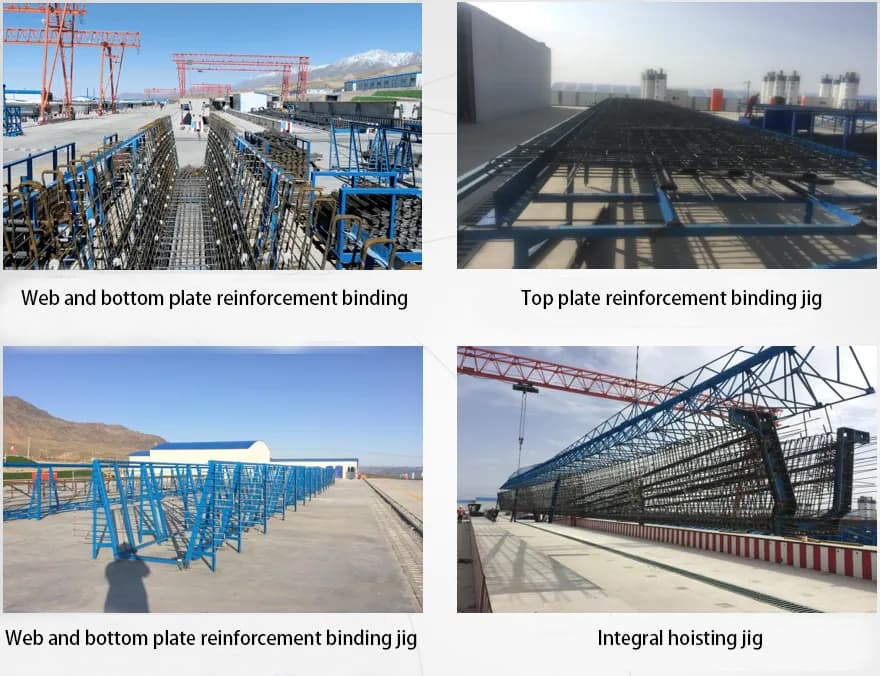
(2) Steel Bar Binding: Bind and form the steel bars on a special steel bar binding pedestal. The binding sequence is: bottom plate bottom layer steel bars → web and flange plate stirrups → prestressed pipeline layout → top plate bottom layer steel bars → installation of top plate corrugated pipes, top plate steel bar skeleton lifting rings and top plate embedded pipe positioning frames. Prestressed pipes in the girder can be positioned and fixed with "#"-shaped positioning steel bars, and both ends are sealed with sealing tape.
(3) Installation of Embedded Pipes and Fittings: Before concrete pouring, arrange and fix embedded parts such as prestressed pipelines, reserved holes and anchor bearing plates in the steel bar skeleton. The accuracy and reliability of these embedded pipes and fittings directly affect the service performance and service life of prestressed concrete box girders, and must be embedded in strict accordance with the drawings.
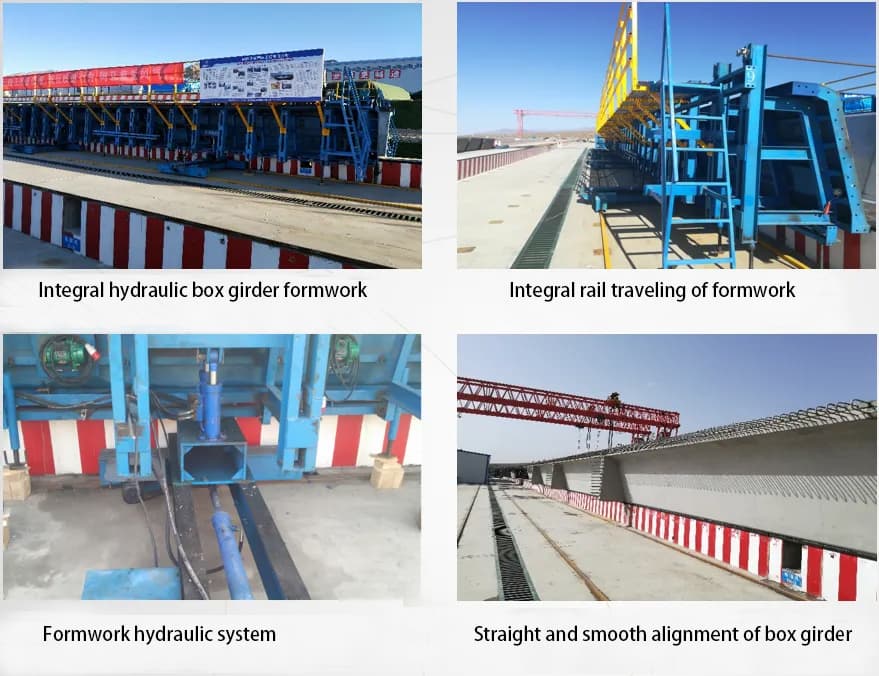
(1) Formwork Cleaning and Release Agent Coating: The formwork should be thoroughly cleaned before installation to ensure good bonding between concrete and formwork, and an appropriate release agent should be applied to facilitate demoulding after pouring.
(2) Bottom Formwork Installation: Place the bottom formwork on the girder casting pedestal, adjust the position and elevation to ensure that the bottom formwork is flat and straight.
(3) Side Formwork Installation: Use a gantry crane to hoist the side formwork to the designated position, connect it firmly with the bottom formwork, and adjust the verticality and flatness of the side formwork.
(4) Inner Formwork Installation: Erect the inner formwork after the binding of bottom and web steel bars is completed. The inner formwork is assembled into a whole in sections outside and installed in place with a gantry crane. The bottom of the inner formwork is supported on steel bar horse stools, the side plates are positioned with steel bars, and a pressure bar is set on the upper side to control its upward floating.
(1) Concrete Mixing: Strictly mix concrete according to the mix ratio in the mixing station to ensure that the workability and slump of concrete meet the requirements.
(2) Concrete Transportation: Transport concrete by concrete mixer trucks, and pay attention to preventing concrete segregation during transportation.
(3) Concrete Pouring: After formwork installation, pour concrete into the box girder by means of hanging buckets, etc. Usually, pouring starts from one end of the box girder and advances backward layer by layer to avoid concrete accumulation and cold joint formation. The pouring sequence is: first pour the bottom plate, then pour the web. When pouring the web, pour to the other end in longitudinal sections and horizontal layers.
(4) Concrete Vibration: Adopt a combined method of mainly using high-frequency external vibrators and supplemented by inserted vibrators. For areas with small feeding gaps, inserted vibrators with smaller diameters should be used for vibration.
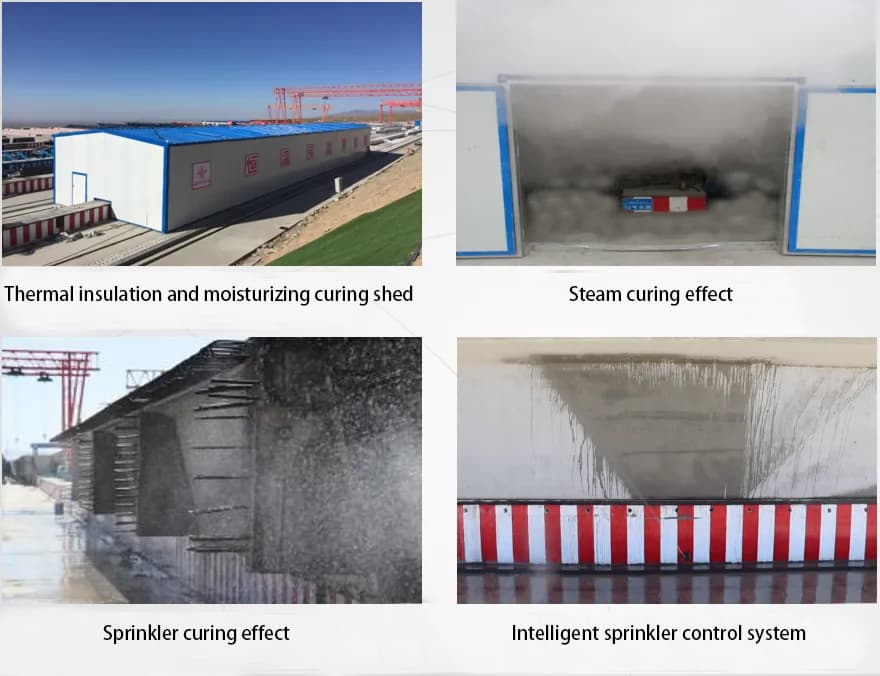
(1) Curing Method Selection: Select an appropriate curing method according to seasonal and climatic conditions. For example, spray curing can be adopted in summer, and steam curing can be adopted in winter.
(2) Curing Time Control: The concrete curing time shall generally not be less than 7 days to ensure that the concrete reaches the designed strength.
(1) Steel Strand Cutting and Bundling: Cut steel strands according to design requirements. The cutting length should meet the design size of prestressed tendons and tensioning needs. When bundling, straighten each steel strand one by one and bind them firmly to prevent mutual entanglement.
(2) Strand Threading: Thread the bundled steel strand bundles into the corrugated pipes. During threading, pay attention to avoiding friction damage between steel strands and corrugated pipes.
(3) Tensioning: Carry out prestressed tensioning when the concrete strength reaches the design requirements. Adopt symmetrical and uniform tensioning at both ends during tensioning, with stress control as the main method and elongation verification as the supplement.
(4) Grouting: Conduct duct grouting in a timely manner after tensioning is completed. Adopt vacuum-assisted grouting technology for grouting to ensure the compactness and strength of the grout.
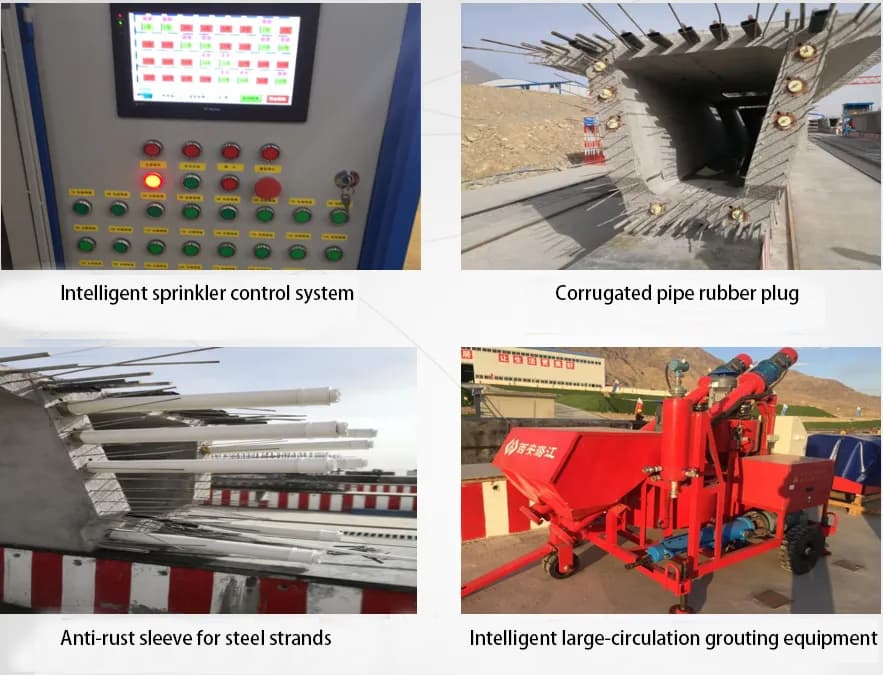
(5) Anchor Sealing: After grouting is completed, perform anchor sealing treatment on the anchorages. Use fine aggregate concrete for anchor sealing to ensure that the anchorages are firmly connected to the girder body.
In summary, the six key steps of box girder precast construction are closely linked, and quality control of each link is indispensable. As a key consumable that runs through core links such as formwork installation and concrete pouring, the quality of formwork directly affects construction efficiency and box girder forming effect. We focus on the R&D and production of bridge formwork, and can provide customized formwork solutions according to different box girder specifications, ensuring the flatness, rigidity and tightness of the formwork, and helping to promote bridge engineering efficiently and with high quality. If you have needs for box girder formwork procurement and customization, or want to learn more about the application skills of formwork in precast construction, please feel free to contact us for consultation.

We focus on turn-key solutions and types of formwork for Bridge and Viaduct Construction at home and abroad since 2006.


International Department: Room 2507-2508, Tower C of Wanda Plaza, Tongzhou District, Beijing 101118, China.
+86-13021287080
info@boyoun.cn

