
 Russian
 French
 Spanish
 Arabic
 Thai
Thai Indonesian

Linear control is a crucial guarantee for the safety and reliability of the overall structure. It is also an effective measure to ensure that the alignment of the entire bridge conforms to the construction design and that the overall stress state is reasonable. The key to linear control lies in the determination of the camber. In bridge construction, calculating the construction camber is of great significance, and accurate values can provide strong support for the overall construction quality control. However, in actual construction, controlling the camber is quite challenging. Based on practical engineering experience, three core points need to be focused on: ① Preloading the traveler to eliminate its inelastic deformation and sling gaps, and calculating the elastic deformation according to the deformation observation data; ② Strengthening monitoring and measurement during the construction process to facilitate corrections during construction; ③ Deflection caused by multiple factors such as prestress loss, concrete creep, shrinkage and unit weight. To achieve the above control objectives, it is necessary to implement various specific control measures throughout the construction process, which can be divided into the following four key links:
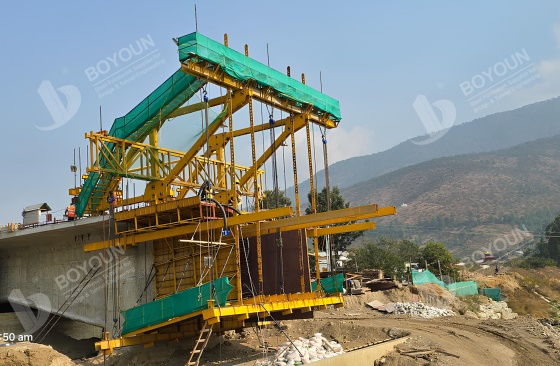
Parameter measurement is the foundation and prerequisite for linear control in cantilever form traveler construction of bridges. Since the primary purpose of linear control is to effectively ensure the reliability and safety of the structure during construction, as well as to guarantee that the bridge alignment and stress state meet the design requirements, construction personnel are required to conduct parameter measurement for bridge cantilever construction. In addition, the main content of parameter measurement is to determine the deformation value of the traveler itself, and meanwhile, it is necessary to reasonably measure important data such as concrete elasticity and prestress. Furthermore, due to the difficulty in accurately measuring the deformation value of the traveler, it is only through reasonable experiments that the measurement difficulty can be effectively reduced.
For cantilevered box girders, the formwork elevation of the segment to be cast-in-place by cantilever method should be determined according to the design elevation and camber, and formwork erection must be strictly carried out in accordance with this elevation. On the construction site, special personnel should be assigned to conduct regular observations. The changes in cantilever deflection should be monitored under four conditions: before and after concrete pouring, and before and after prestress tensioning for each segment. Based on the observed results, deflection curves should be compiled and data should be analyzed in a timely manner, so as to accurately grasp the deviation values during construction, ensure the closure accuracy of the cantilever ends of the box girders, and control the alignment of the bridge deck.
The importance of camber calculation for linear control in cantilever form traveler construction is self-evident. In the process of camber calculation, accurate and reasonable calculation results are important guarantees for the construction quality of the cantilever form traveler. However, it is quite difficult for construction personnel to control the bridge cantilever. Therefore, construction personnel must base their work on the on-site construction progress and local actual conditions, and apply different professional programs to obtain accurate calculation results. In addition, during the camber calculation, construction personnel should focus on using experimental data from different days for the calculation.
In the process of elevation monitoring, observation points should be selected scientifically and reasonably, and monitoring work should be well done to ensure that the elevation measurement nodes remain symmetrical at different construction stages. During monitoring, large temperature differences may affect the measurement results and lead to inaccuracies, which should be avoided as much as possible.
In summary, linear control in cantilever form traveler construction of bridges is a systematic and whole-process technical management work. The accuracy of parameter measurement, the timeliness of deflection control, the scientificity of camber calculation, and the standardization of elevation monitoring and closure segment construction jointly determine the final alignment quality and structural safety of the bridge. In actual construction, it is necessary to organically connect various control links, dynamically adjust control strategies in full consideration of on-site working conditions, and effectively respond to various interference factors. Only in this way can we ensure that the bridge alignment conforms to the design requirements, guarantee the overall quality and service life of the project, and lay a solid foundation for the safe operation of the bridge engineering.

We focus on turn-key solutions and types of formwork for Bridge and Viaduct Construction at home and abroad since 2006.


International Department: Room 2507-2508, Tower C of Wanda Plaza, Tongzhou District, Beijing 101118, China.
+86-13021287080
info@boyoun.cn

