
 Russian
 French
 Spanish
 Arabic
 Thai
Thai Indonesian

In the previous two articles, we conducted a systematic comparison between steel box girders and cast-in-place girders from the perspectives of structural characteristics, selection criteria, and core quality control indicators for construction quality, and we comprehensively reviewed the full-process construction techniques for steel box girders—from factory prefabrication and transportation/hoisting to on-site installation. As another important form of bridge superstructure, cast-in-place girders are widely used in urban interchange bridges, curved ramp bridges, and medium- to small-span highway bridges due to their advantages of excellent structural integrity, strong adaptability, and controllable material costs. However, cast-in-place girder construction involves multiple procedures, including falsework erection, formwork installation, concrete placement, and prestressing application. The process chain is lengthy, the sequence of operations is tightly interconnected, and numerous factors affect construction quality, making construction control a challenge that should not be underestimated. This article focuses on three core aspects: construction preparation techniques, concrete construction techniques, and prestressing construction techniques for cast-in-place girders, providing systematic technical guidance for field construction.
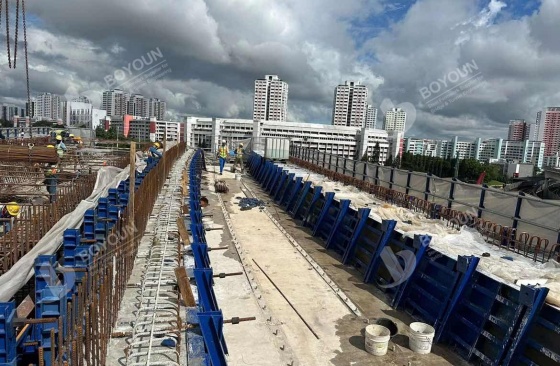
1. Construction Preparation Techniques for Cast-in-Place Girders
Construction preparation for cast-in-place girders shall encompass falsework erection, formwork installation, and rebar processing to ensure a stable foundation for subsequent construction. Falsework erection shall employ cuplock or disk-lock scaffolding systems. The spacing of vertical posts and the step spacing of horizontal members shall be determined by design calculations (e.g., vertical post spacing ≤ 1.2 m, horizontal step spacing ≤ 1.5 m). Base plates (steel or timber pads with area ≥ 0.1 m²) shall be placed under the vertical posts, and adjustable top supports shall be installed at the top of the falsework to adjust formwork elevations. After erection, the falsework shall be preloaded (using sandbags or water tanks, with preload equal to 1.2 times the self-weight of the girder) for a duration of ≥ 72 hours. Falsework settlement shall be monitored (final settlement ≤ 2 mm) to eliminate non-elastic deformation. Formwork installation shall employ steel formwork or bamboo plywood. The panel thickness of steel formwork shall be ≥ 6 mm. Joint gaps between formwork panels shall be sealed with sealing tape to prevent grout leakage. After formwork installation, cross-sectional dimensions (e.g., girder height deviation ≤ ±5 mm, web thickness deviation ≤ ±3 mm) and axis deviation (≤ 10 mm) shall be verified to ensure compliance with design requirements. Rebar processing shall follow shop drawings for cutting. Rebar connections shall adopt welding or mechanical connections (e.g., straight-thread couplers). The length of welded splices (single-side weld ≥ 10d, double-side weld ≥ 5d, where d is the rebar diameter) and the tightening torque of mechanical couplers shall comply with specification requirements. Processed rebars shall be stacked by category to avoid corrosion.
2. Concrete Construction Techniques for Cast-in-Place Girders
Concrete construction for cast-in-place girders requires strict control over mix design, placement sequence, and curing quality to ensure concrete strength and durability. The concrete mix design shall be based on design strength (e.g., C50) and workability requirements. Cement shall be ordinary Portland cement (P.O42.5R). Coarse aggregate shall be continuously graded crushed stone (particle size 5–25 mm). Fine aggregate shall be medium sand (fineness modulus 2.3–3.0). High-range water-reducing admixture (water reduction rate ≥ 20%) and fly ash (replacement ratio ≤ 30%) shall be incorporated. Concrete slump shall be controlled within 120–160 mm. Prior to placement, debris inside the formwork shall be cleaned and the formwork shall be wetted with water. Concrete shall be transported using mixer trucks, with transport time ≤ 1.5 hours. Upon arrival at the site, slump shall be tested; concrete failing to meet requirements shall not be used. Placement shall adopt a layered placement method, with each layer thickness ≤ 30 cm. Internal vibrators shall be used for consolidation, with vibration time controlled at 20–30 seconds (until no air bubbles appear on the concrete surface and grout rises), avoiding both under-vibration and over-vibration. The placement sequence shall proceed from one end of the girder toward the other, and placement of webs, bottom flange, and top flange shall be carried out simultaneously to prevent uneven formwork deformation due to asymmetric loading. After placement, the concrete shall be promptly covered with geotextile fabric and cured by water spraying. The curing period shall be ≥ 14 days. During curing, the temperature difference between the concrete surface and the ambient air shall be ≤ 25°C.
3. Prestressing Construction Techniques for Cast-in-Place Girders
Prestressing construction for cast-in-place girders shall follow the sequence of "preparation, staged tensioning, and duct grouting" to ensure precise application of prestress. During the preparation stage, the quality of prestressing tendons (e.g., seven-wire strands with tensile strength ≥ 1860 MPa) and anchorages (wedge-type anchors) shall be inspected. Tensioning equipment (jacks and pressure gauges) shall be calibrated (calibration interval ≤ 6 months) to ensure tensioning control force error ≤ ±2%. Prestressing ducts shall be cleaned (using high-pressure water flushing to remove debris inside the ducts). Bearing plates and spiral reinforcement shall be installed with accurate positioning. Staged tensioning shall follow the design sequence (typically tensioning symmetrically from both ends of the girder toward the center), employing the "dual-control method" (tensioning force as the primary control, with elongation verification as secondary control). The tensioning control force shall reach the design value (e.g., for 1860 MPa strands, the control stress is 1395 MPa). The deviation between actual elongation and theoretical elongation shall be controlled within ±6%. After each tensioning stage, anchoring shall be carried out promptly. The exposed length of prestressing tendons outside the anchorage shall be ≥ 30 mm and ≤ 50 mm. Duct grouting shall be completed within 24 hours after tensioning. Cement grout (water-binder ratio 0.26–0.28, compressive strength ≥ 30 MPa) shall be used. Grouting pressure shall be controlled at 0.5–0.7 MPa. The grouting sequence shall proceed from the low end to the high end of the duct to ensure the duct is fully filled with grout without voids.
To Wrap Up
In summary, cast-in-place girder construction is a systematic endeavor involving numerous interrelated procedures. Construction quality depends directly on the meticulous control of key processes across the preparation stage, concrete placement stage, and prestressing application stage. During the construction preparation stage, the stability of falsework erection, the precision of formwork installation, and the quality of rebar processing form the solid foundation for subsequent construction. During the concrete placement stage, the rationality of mix design, the compliance of layered placement procedures, and the adequacy of curing conditions are the core guarantees for ensuring girder strength and durability. During the prestressing stage, the accuracy of tensioning equipment, the rationality of tensioning sequences, and the compactness of duct grouting directly affect the long-term structural performance and reliability. All three stages are indispensable; any oversight in any procedure may cause irreversible impacts on structural safety.
Shandong Boyuan Heavy Industry Co., Ltd. is committed to providing high-quality formwork systems and construction equipment solutions for bridge construction. In the next article of this series, we will further focus on the quality control system for both steel box girders and cast-in-place girders, systematically establishing a comprehensive quality control framework for the construction of these two girder types from the dimensions of raw material inspection, process control, finished product testing, and acceptance criteria. Please stay tuned.

We focus on turn-key solutions and types of formwork for Bridge and Viaduct Construction at home and abroad since 2006.


International Department: Room 2507-2508, Tower C of Wanda Plaza, Tongzhou District, Beijing 101118, China.
+86-13021287080
info@boyoun.cn

