
 Russian
 French
 Spanish
 Arabic
 Thai
Thai Indonesian

Precast segmental box girders, offering advantages such as rapid construction speed, adaptability to both long-line and short-line match-casting processes, and suitability for intercity railways, expressway interchanges, and municipal sea-crossing bridge projects, have become the mainstream structural form in prefabricated bridge construction. Steel formwork for segmental box girders is a high-precision, non-standard, reusable turnover asset, distinctly different from conventional cast-in-place box girder formwork. It imposes stringent combined requirements for forming accuracy, sealing structures, hydraulic stripping, and keyway shear key shaping, making it a material category prone to procurement pitfalls in bridge yard procurement and project material tendering. Drawing upon highway bridge construction standards, hands-on precast yard practices, and industry procurement risk management cases, this article summarizes five high-frequency misconceptions in project procurement, aiming to assist project departments and procurement personnel in compliant selection, rigorous cost control, and mitigation of construction quality risks.
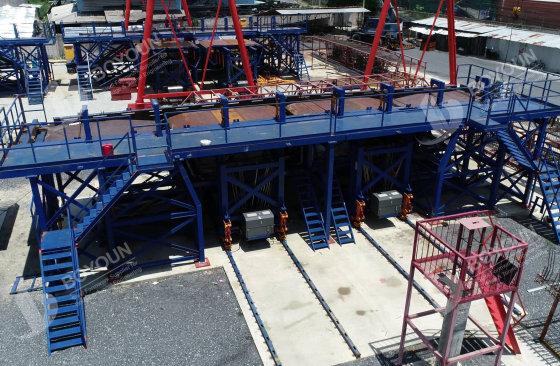
Generally, direct formwork purchase cost accounts for only 35%-45% of total formwork engineering cost; hidden costs such as rework, schedule delays, premature scrappage, and labor wastage account for a significantly larger share.
Low-price formwork typically uses reduced-thickness face plates and simplified stiffening ribs, achieving only 10-30 reuses; compliant thickened formwork can achieve 80-120 reuses, resulting in lower amortized cost per use.
On-site risks: When a small manufacturer quotes more than 15% below the market average, common issues include face plate thickness reduction (e.g., specified 6mm but actually 4mm or less), downgraded channel steel sections, and enlarged rib spacing. During concrete placement, the formwork bulges and deforms, causing extensive displacement misalignment, honeycombing, and surface pitting on the girder body. The labor and concrete repair costs far exceed the purchase price difference, while also delaying the girder fabrication schedule and incurring project penalty costs.
Procurement controls: Apply total cost of ownership (TCO) accounting in bid comparisons; specify in the contract the steel grades and thicknesses of face plates and stiffening ribs, and include a compensation clause for failure to meet the specified number of reuses; use ultrasonic thickness gauges for spot-checking plate thickness on each delivered panel upon site arrival.
Bridge formwork face plates and stiffening main members shall be made of Q235B or higher-grade steel, with material certificates provided; weld surface roughness shall be Ra ≤ 12.5μm, and defects such as incomplete penetration, slag inclusion, and missed welds are prohibited.
Small workshops often use recycled scrap steel plates and non-standard channel steel, with manual welding performed without non-destructive testing (NDT), resulting in weld cracking under stress and uneven plate surface deformation.
On-site risks: Under lateral concrete placement pressure, weld tears may occur, posing a blowout safety hazard; surface flatness exceeds tolerances, resulting in poor visual quality of the girder and deductions during quality audits; in coastal, high-chloride environments, substandard steel corrodes rapidly, rendering the formwork scrap after fewer than 20 reuses.
Procurement controls: Contractually require mill test certificates for steel materials and welding procedure qualification records (PQR) to accompany deliveries; conduct random weld inspections during factory pre-assembly and require the manufacturer to provide dye penetrant test (PT) inspection records.
Segmental box girder formwork is a complete system comprising outer formwork, hydraulically collapsible inner formwork, sealing gaskets for joints, match-casting positioning devices, and synchronized hydraulic systems. The stripping efficiency of the inner formwork directly determines the daily production capacity of the precast yard.
On-site risks: Low-cost proposals often simplify the hydraulic synchronization mechanism, causing non-synchronous retraction on each side of the inner formwork, resulting in stripping jams. Forced prying by workers damages girder edges and corners; inferior, ordinary sealing strips lack adequate elasticity and abrasion resistance, leading to continuous grout leakage at joints and causing sand streaks and honeycombing on girder sides; absence of dedicated keyway sealing structures results in mortar buildup on match-cast joint faces, creating massive post-finishing workload.
Procurement controls: Procure the complete inner and outer formwork package including hydraulic accessories as an integrated set; specify in the contract the gasket material and the allowable synchronization error tolerance for hydraulic cylinders; require the manufacturer to perform on-site installation and commissioning.
A large number of intermediaries and small workshops use stolen photographs from major bridge projects and lack actual fabrication track records for short-line/long-line segmental box girder formwork, being only capable of producing conventional cast-in-place formwork.
On-site risks: The manufacturer lacks the capability for detailed engineering design of segmental girders, unable to accurately address shear keys, variable cross-sections, and external prestressing embedment hole positions. Upon delivery, extensive on-site modification is required, causing project delays of 15-30 days; the manufacturer is unfamiliar with formwork design for short-line match-casting beds, resulting in incompatibility between formwork and bed positioning and consequent loss of geometric control in girder fabrication.
Procurement controls: Require the manufacturer to provide supply contracts, site completion photographs, and owner acceptance records for comparable segmental box girder projects from the past two years; where feasible, arrange site visits to observe ongoing segmental formwork production lines.
Industry standards: Infrastructure material procurement specifications mandate that non-standard segmental box girder formwork must pass full factory pre-assembly inspection prior to shipment; formwork warranty, repair, replacement parts, and delay liabilities shall be contractually stipulated.
On-site risks: The manufacturer ships in knocked-down form without factory trial assembly, leading to joint misalignment, bolt-hole mismatches, and missing components during on-site assembly, forcing work stoppages while awaiting replacement parts; during operation, hydraulic systems or bracing components fail, and the manufacturer's after-sales response is slow (over 72 hours), causing precast yard shutdown; no penalty clauses for delayed delivery exist, allowing arbitrary production scheduling by the manufacturer, resulting in uncompensated idle costs for precast yard equipment and labor crews.
Procurement controls: Mandatorily incorporate into the contract: factory pre-assembly inspection and acceptance clauses, 24-hour technical after-sales support, daily liquidated damages for delivery delays, free replacement for deformation/out-of-tolerance dimensions, and preferential supply of spare parts.
Unlike conventional formwork, segmental box girder formwork imposes rigorous requirements for dimensional accuracy, structural adaptability, system completeness, and durability/corrosion resistance, and must be compatible with the two dedicated construction processes—long-line and short-line match-casting. At the current stage of bridge material procurement, low-bid awards, emphasis on appearance over material quality, and focus on delivery over after-sales support remain the predominant pitfalls. It is recommended that all precast yards, general contractor project departments, and procurement teams abandon a single-minded price-comparison mindset, and instead adopt a comprehensive selection approach that considers project construction methodology, coastal vs. inland working conditions, project schedule, and required formwork reuse cycles. Implementing the three critical procurement controls—material verification, factory pre-assembly, and contractual rights and obligations—will fundamentally mitigate issues such as blowout, grout leakage, substandard girder visual quality, schedule stoppages, and additional cost overruns, thereby ensuring compliant and efficient segmental box girder precast construction and successful acceptance through supervision and final project handover.

We focus on turn-key solutions and types of formwork for Bridge and Viaduct Construction at home and abroad since 2006.


International Department: Room 2507-2508, Tower C of Wanda Plaza, Tongzhou District, Beijing 101118, China.
+86-13021287080
info@boyoun.cn

