
 Russian
 French
 Spanish
 Arabic
 Thai
Thai Indonesian

The open-web continuous rigid-frame bridge, also known as the arch-girder composite continuous rigid-frame bridge, is developed by hollowing out the web of the box girder at the root section of a conventional continuous rigid-frame bridge. By determining reasonable root depth, open-web segment length, and depths of the upper and lower chord segments, an open-web section is formed where the lower edge of the lower chord and the lower edge of the solid-web segment are continuous and transition smoothly. The lower chord, upper chord, and main pier of the open-web rigid-frame bridge are connected to form a triangular zone. The lower chord primarily functions under compression, fully leveraging the high compressive strength of concrete. Simultaneously, it reduces the structural length of the solid-web segment, optimizes structural stress, and thus enhances the spanning capacity. According to research, the economic applicable span range for an open-web continuous rigid-frame bridge is 200 to 400 meters. The structural composition of an open-web continuous rigid-frame bridge primarily includes the pier (double-legs or single-column type), the lower chord and upper chord in the root hollowed-out region, the conventional solid-web segments, closure segments, etc., as shown in Figure 1.
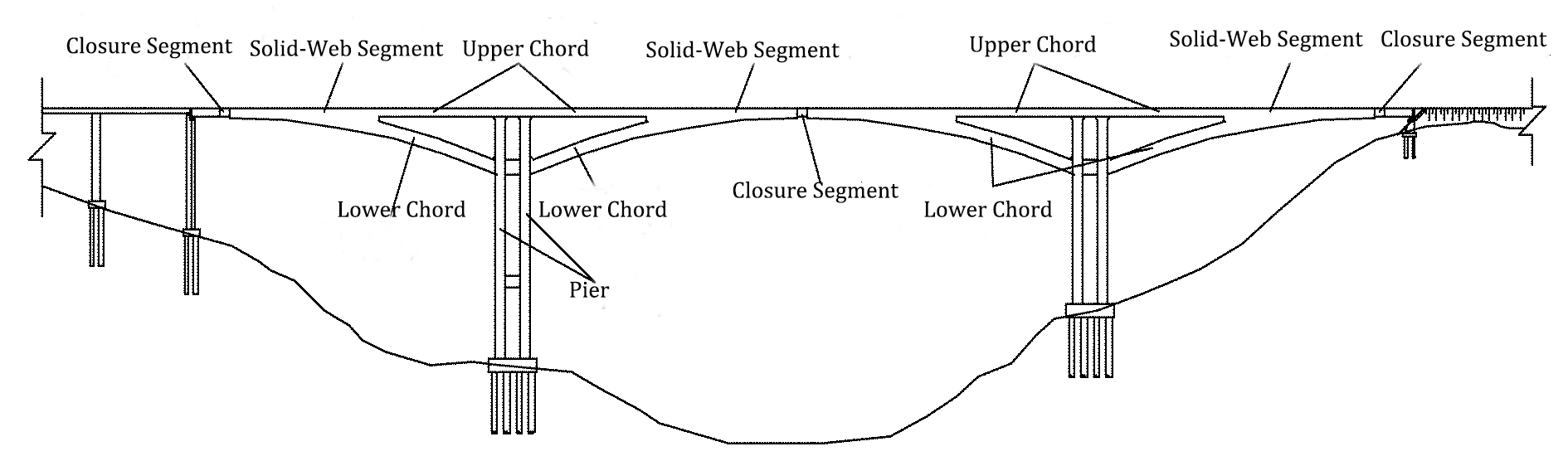
Fig. 1 Structural Composition of Open-Web Continuous Rigid-Frame Bridge
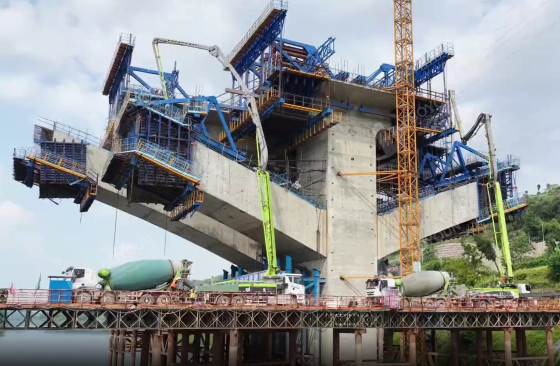
The overall structural behavior of the open-web continuous rigid-frame bridge remains that of a prestressed concrete girder bridge. It retains the advantages of the prestressed concrete continuous girder bridge, such as convenient cantilever construction, smooth driving comfort, strong adaptability to changes in route alignment, and mature construction and maintenance technologies, while significantly improving the spanning capacity of concrete girder bridges. Compared with conventional continuous rigid-frame bridges, the structural system of the open-web continuous rigid-frame bridge has the following characteristics:
(1) In the hollowed-out triangular zone, the lower chord is primarily under compression, exhibiting arch-type stress characteristics; the upper chord is primarily under tension, which can balance the compression force in the lower chord. The hollowed-out triangular zones on both sides of the main pier are symmetrical, and the compression forces in the lower chords and tension forces in the upper chords on both sides essentially cancel each other out, forming a self-balancing stress system.
(2) The pier root section, which bears significant negative bending moment, transforms from a beam-type sectional stress pattern to an open-web triangular zone frame stress pattern, improving the structural load-bearing efficiency of the pier root section.
(3) Hollowing out the triangular zone reduces the length of the mid-span solid-web segment, thereby decreasing the stress and deflection of the mid-span segment.
(4) The presence of the lower chord reduces the pier height and improves the stability and stress performance of tall piers.
(5) Hollowing out the root region reduces the structural dead weight, lowers the scale of substructures and foundations, and improves the structural seismic capacity.
Open-web continuous rigid-frame bridges can be arranged as single main span, multiple main spans, or single-T configurations. The piers can be double-leg thin-walled piers or box-shaped column piers. The span arrangements are shown in Figures 2, 3.
Open-web continuous rigid-frame bridges can also be combined with conventional continuous rigid-frame bridges to form arrangements with large and small spans, thereby enhancing adaptability to terrain, as shown in Figure 4.
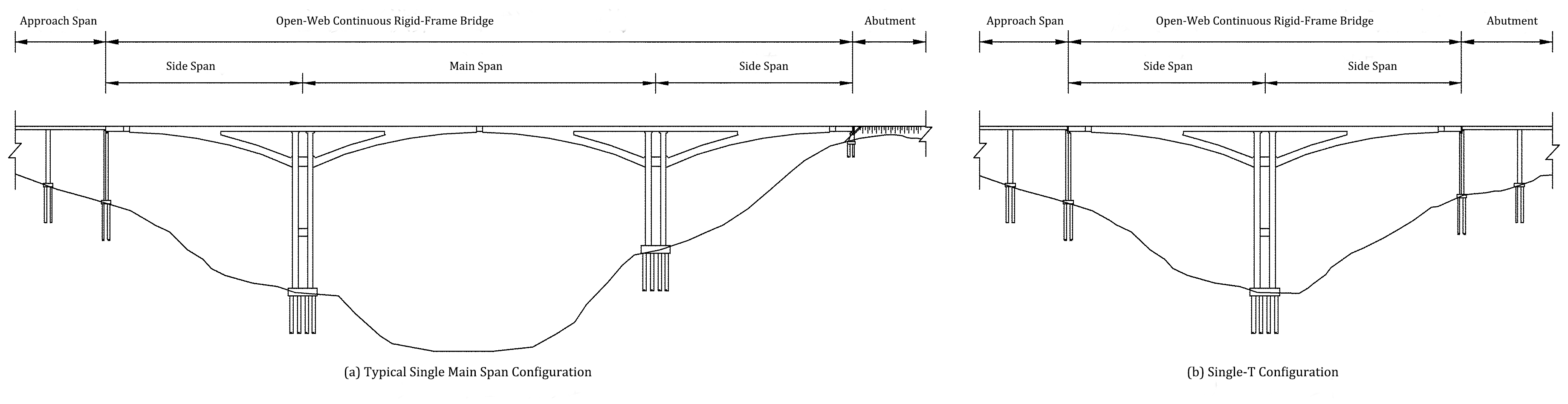
Fig.2 Span Arrangement of Open-Web Continuous Rigid-Frame Bridge with Piers Consisting of Two Thin-Walled Legs
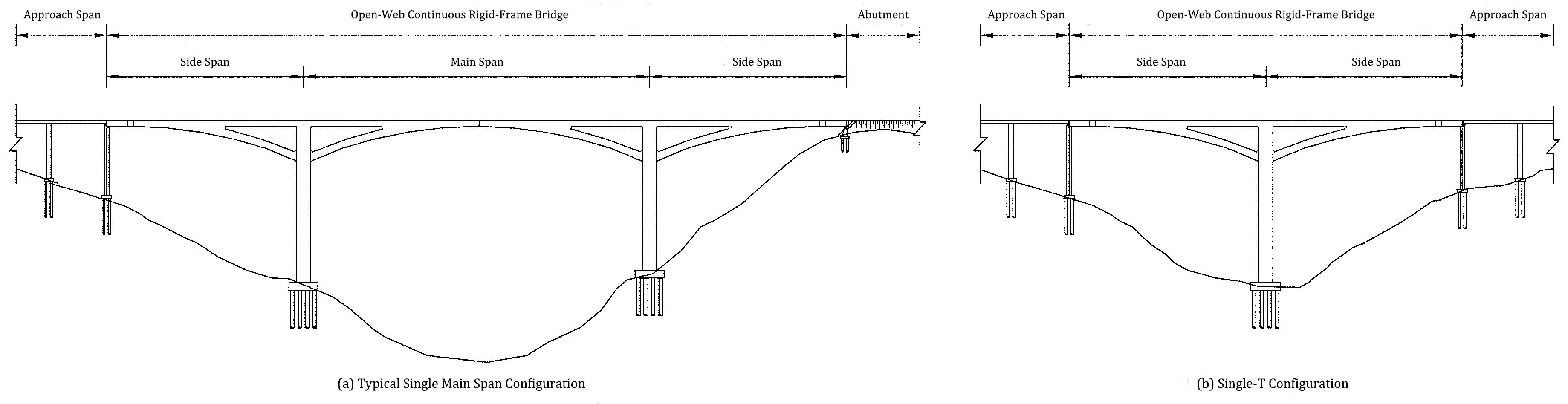
Fig. 3 Span Arrangement of Open-Web Continuous Rigid-Frame Bridge with Mono-columned Piers
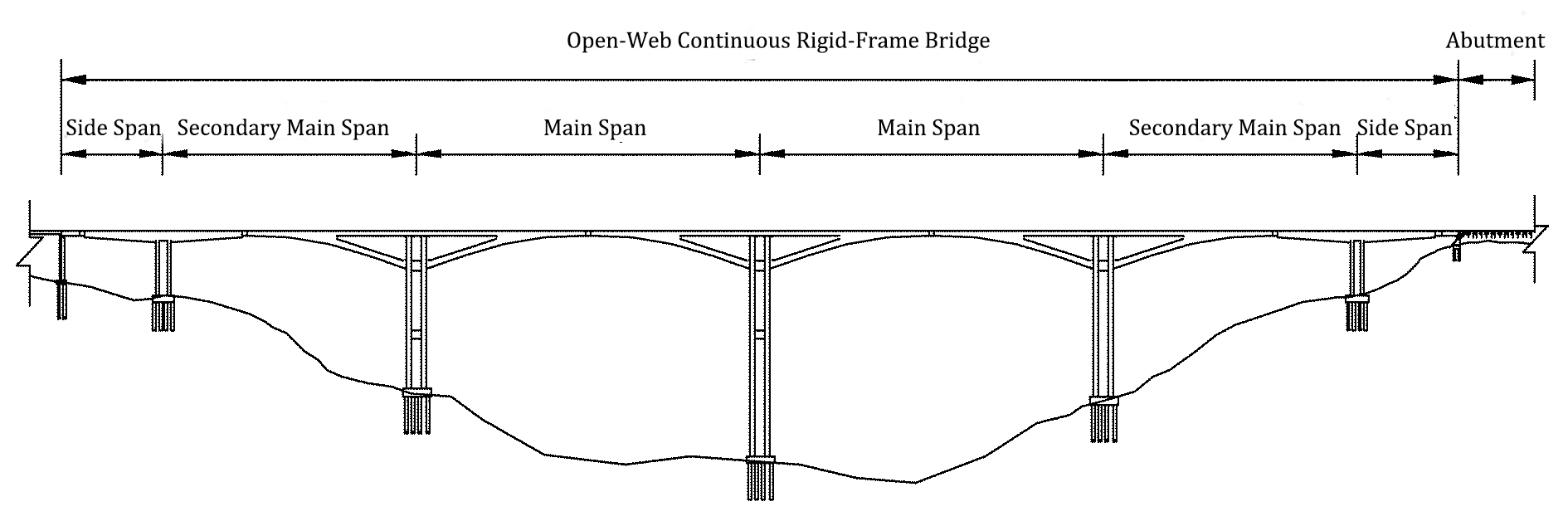
Fig. 4 Configuration of Combined Open-Web and Conventional Continuous Rigid-Frame with Multiple Main Spans
Similar to conventional continuous rigid-frame bridges, the piers of an open-web continuous rigid-frame bridge are rigidly connected to the superstructure, eliminating the need for large bearings. The piers bear the axial forces, bending moments, and longitzudinal displacements of the girder caused by prestressing, concrete shrinkage and creep, and temperature changes, transmitted from the superstructure. The shear force at the pier base, induced by the longitudinal displacement of the superstructure girder, decreases with increasing pier height and decreasing pier stiffness. Therefore, when arranging spans, appropriate pier height and pier cross-sectional dimensions should be selected. Based on engineering experience, for double-limbed thin-walled piers, the pier height should generally not be less than 1/5 to 1/4 of the distance between the pier and the zero point of longitudinal displacement of the superstructure girder caused by uniform overall temperature rise and fall.
The general construction method for the superstructure of an open-web continuous rigid-frame bridge involves first constructing the open-web segment. After the upper and lower chords converge, the construction method transitions to the balanced cantilever casting of the conventional solid-web segments using form travelers until closure, ultimately completing the superstructure construction. The construction method for this bridge type is generally similar to that of a conventional continuous rigid-frame bridge, with the difference lying in the implementation of the open-web segment. The open-web segment structure is typically situated atop tall piers, making falsework construction difficult. Its construction method has certain particularities, imposes high demands on construction equipment, and requires close attention to stress and deformation control during construction.
During the completed bridge and subsequent operation phases, the lower chord segments in the open-web region primarily function as compression and shear-resisting members, and are typically provided with fewer longitudinal prestressing tendons. Although the upper chord segments are prestressed members, their cross-sectional dimensions and flexural stiffness are smaller than those of the lower chord segments. During construction, neither the upper nor lower chord structure can independently withstand the construction loads of long cantilever form travelers; auxiliary means such as temporary supports or stay cables are required to accomplish the cast-in-place cantilever construction using form travelers.
In summary, the open-web continuous rigid-frame bridge is particularly suitable for long-span bridges on tall piers in mountainous areas. Preliminary research indicates that its economic applicable span range is 200 to 400 meters. This bridge type is constructed using the balanced cantilever method, and its engineering cost indices, operational maintenance technical requirements and costs are comparable to those of conventional continuous rigid-frame bridges.
Although this bridge type is more complex in terms of detail design, prestressing layout, and construction of the open-web segment compared to traditional rigid-frame bridges, imposing higher demands on construction equipment and process control, its outstanding spanning capacity and structural performance in complex environments such as deep mountainous valleys make it a highly competitive option for long-span bridge schemes. As design theories and construction technologies continue to mature, the open-web continuous rigid-frame bridge is destined to play an even more important role in future transportation infrastructure construction.

We focus on turn-key solutions and types of formwork for Bridge and Viaduct Construction at home and abroad since 2006.


International Department: Room 2507-2508, Tower C of Wanda Plaza, Tongzhou District, Beijing 101118, China.
+86-13021287080
info@boyoun.cn

