
 Russian
 French
 Spanish
 Arabic
 Thai
Thai Indonesian

In modern bridge engineering, the rational selection of superstructure types and effective control of construction quality directly affect the safety, economy, and durability of the project. Steel box girders and cast-in-place box girders, as the two most widely used core load-bearing structures in bridge construction today, represent two major technical approaches: prefabricated assembly construction and cast-in-place monolithic construction. Steel box girders, with their advantages of light weight, high strength, strong spanning capability, and high degree of factory prefabrication, occupy an important position in long-span bridges and construction-constrained scenarios. Cast-in-place girders, on the other hand, demonstrate irreplaceable applicability in small-to-medium span bridges and special-shaped section construction due to their excellent structural integrity, strong adaptability, and low material costs. However, significant differences exist between these two girder types in terms of load transfer mechanisms, material properties, construction techniques, and quality control. A systematic review of their structural characteristics, applicable scenarios, and control indicators is of great significance for improving bridge engineering design and construction quality. This article discusses these aspects from three dimensions—structural characteristics, selection criteria, and core quality control indicators—to provide reference for similar engineering practices.
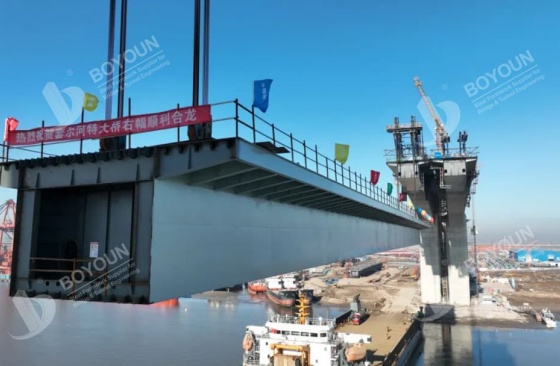
Steel box girders use steel as the primary load-bearing material. A typical structure consists of top slabs, bottom slabs, webs, and stiffening ribs, generally adopting a box-shaped cross-section. They feature high strength, high rigidity, and light self-weight. The elastic modulus of steel is approximately 206 GPa, and the tensile strength can reach 345 MPa or above, enabling effective resistance to long-span loads. The cross-sectional form is flexible and can be designed as single-cell single-box or multi-cell multi-box configurations according to load requirements. Components can be prefabricated in factories and installed conveniently on site.
Cast-in-place girders use reinforced concrete as the core material. The entire structure is formed through on-site rebar tying and concrete pouring. Cross-sections are mostly T-shaped, I-shaped, or box-shaped. The compressive strength of concrete is generally not less than C50, relying on the cooperative load transfer between steel reinforcement and concrete. The structure offers strong integrity and good durability, with crack resistance further enhanced through the configuration of prestressing tendons. However, the self-weight is relatively large (approximately 25 kN/m³), imposing higher bearing capacity requirements on the substructure. These differences in structural characteristics directly determine the different emphases in construction techniques and quality control for the two girder types.
The applicable scenarios for steel box girders and cast-in-place girders are determined by engineering conditions and functional requirements.
Steel box girders are lightweight and highly adaptable to span lengths, with a span range of 50–200 m. They are suitable for long-span bridges such as cross-river and cross-sea bridges, as well as main line bridges of urban interchange viaducts. They are particularly appropriate for sites with limited construction space where rapid assembly is required, such as bridge renovations above existing traffic lines—factory prefabrication and on-site hoisting can significantly reduce road occupation time. In harsh environments such as low-temperature and high-humidity conditions, steel anti-corrosion treatment technologies are well-developed, ensuring good applicability.
Cast-in-place girders are suitable for small-to-medium span bridges (10–40 m), such as urban municipal bridges and highway branch line bridges. Monolithic pouring is well-suited for curved sections and special-shaped cross-section construction. Materials are readily available with low cost, making them widely applicable in projects with flexible schedules and adequate pouring conditions.
The selection should be based on multiple factors including span length, construction schedule, environmental conditions, and cost considerations, ensuring the structural solution matches the project requirements.
Quality control for steel box girder and cast-in-place girder construction focuses on core indicators related to structural safety, durability, and stability.
In terms of strength:
For steel box girders, control the steel yield strength and tensile strength of welded joints (not less than 90% of the base metal).
For cast-in-place girders, ensure concrete compressive and tensile strengths meet the requirements (e.g., 28-day compressive strength of C50 concrete ≥ 50 MPa), with prestressing tendon tensioning control force deviation ≤ ±5%.
In terms of stiffness:
For steel box girders, the mid-span deflection after installation shall not exceed 1/500 of the span length.
For cast-in-place girders, the deflection after formwork removal shall comply with specified limits, and long-term service deflection increments shall be controllable.
In terms of durability:
For steel box girders, the dry film thickness of anti-corrosion coating shall be ≥ 200 μm, with adhesion grade not less than Level 1.
For cast-in-place girders, concrete impermeability grade shall be ≥ P6, freeze-thaw resistance grade ≥ F150, and steel reinforcement cover thickness deviation within ±5 mm.
Geometric dimensional accuracy and connection joint quality are also core indicators.
In summary, steel box girders and cast-in-place girders each have distinct advantages in structural characteristics, applicable scenarios, and core quality control indicators. The rational selection between the two requires comprehensive consideration of multiple constraints, including span conditions, construction schedules, environmental factors, and economic costs. Steel box girders excel in high strength, light weight, factory prefabrication, and rapid installation, making them suitable for long-span and construction-constrained scenarios. Cast-in-place girders excel in structural integrity, controllable cost, and wide adaptability, making them suitable for small-to-medium spans and complex linear bridge alignments. At the quality control level, strength, stiffness, durability, and geometric accuracy are the core elements commonly emphasized for both girder types, but their specific control standards and methodological approaches differ fundamentally and must be precisely grasped in construction practice.
Shandong Boyoun Heavy Industry Co., Ltd. is consistently committed to providing high-quality bridge steel formwork, cast-in-place girder formwork, formwork traveler systems, and supporting construction equipment solutions for the bridge construction sector. In our upcoming series of articles, we will further explore, drawing on our company's years of engineering practice and technical expertise, the key construction techniques for steel box girders, the key construction techniques for cast-in-place girders, and the quality control systems for both steel box girders and cast-in-place girders. Please stay tuned for more in-depth discussions.

We focus on turn-key solutions and types of formwork for Bridge and Viaduct Construction at home and abroad since 2006.


International Department: Room 2507-2508, Tower C of Wanda Plaza, Tongzhou District, Beijing 101118, China.
+86-13021287080
info@boyoun.cn

