
 Russian
 French
 Spanish
 Arabic
 Thai
Thai Indonesian

In bridge construction, especially for heavy-duty, long-span and harsh-environment bridge projects, the selection of construction technology directly determines the project quality, service life and comprehensive cost. As a core technology in modern bridge engineering, post-tensioned prestressed concrete construction technology has gradually become the preferred solution for numerous large-scale bridge projects due to its unique technical characteristics. This article deeply analyzes the core construction advantages of post-tensioned prestressed concrete bridges, and explains why it stands out in the industry and becomes an indispensable choice for high-standard bridge construction with bridge formwork matching.
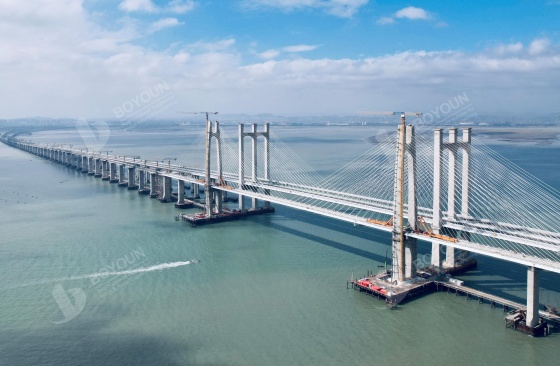
Post-tensioning technology applies pre-compression to the tension zone of concrete in advance through prestress, which offsets the tensile stress generated by loads during the service stage, thus breaking the bearing limit of ordinary reinforced concrete structures. It is especially suitable for heavy-duty and long-span application scenarios, and can give full play to the structural performance with the cooperation of high-quality prestressed concrete bridge formwork.
For example: The original design of a freight special line bridge adopted ordinary reinforced concrete girders with a maximum bearing capacity of 300kN/axle for a single girder, which could not meet the traffic requirements of heavy-duty trains with 490kN/axle. After replacing with post-tensioned prestressed concrete girders and optimizing the layout of prestressed tendons (16 strands of steel strands are arranged for each girder) with the precise support of customized bridge steel formwork, the bearing capacity of a single girder is increased to 500kN/axle. The monitoring data after 6 years of operation show that the maximum strain value of the girder body is 120με (design limit 200με), the structural stability is 40% better than that of ordinary girder bodies, and no deformation accumulation caused by overloading has occurred.
The pre-compressive stress makes the concrete in a compressed state before bearing the load, which fundamentally inhibits the generation of cracks, reduces the intrusion channels of corrosive media such as water and chloride ions, and significantly improves the durability of the structure in harsh environments. High-precision bridge formwork can ensure the forming quality of concrete members, and together with post-tensioning technology, it builds a double guarantee for the anti-crack performance of bridge structures.
For example: A cross-sea bridge in a coastal city adopted post-tensioning construction technology, and a pre-compressive stress of 0.7MPa was applied to the girder body to resist the influence of seawater erosion and dry-wet cycle. The detection after 10 years of operation shows that the maximum crack width of the post-tensioned girder body is only 0.08mm (code limit 0.2mm), and the steel bar corrosion rate is 0.02mm/year; while the crack width of the ordinary reinforced concrete approach bridge built in the same period has reached 0.3mm, and the steel bar corrosion rate is 0.06mm/year, which is three times that of the post-tensioned girder body. The expected durability life of the post-tensioned girder body can reach 50 years, far exceeding the 30-year design life of the ordinary girder body.
Post-tensioning technology optimizes the structural stress through prestress, reduces the consumption of redundant materials, reduces the structural dead weight while ensuring strength, and thus reduces the load and cost of foundation engineering. The reasonable design of bridge formwork can further optimize the concrete pouring and forming process, reduce material waste, and realize the dual saving of materials and costs together with post-tensioned prestressed technology.
For example: The approach bridge of a Yangtze River bridge adopted post-tensioned prestressed concrete continuous girders (span 50m). Compared with the ordinary reinforced concrete scheme of the same span with the matching construction of professional prestressed bridge formwork: the steel bar consumption is reduced from 210kg per linear meter to 140kg, a reduction of 33%, saving 3.5t of steel bars for a single span (50m); the concrete consumption is reduced from 1.8m³ per linear meter to 1.5m³, a reduction of 17%, saving 15m³ of concrete for a single span; the foundation load is reduced by 22% due to the decrease of girder dead weight, which reduces the diameter of pier pile foundation from 1.8m to 1.5m, and the foundation cost of a single pier is reduced by 28,000 USD. The whole bridge (100 spans) has saved more than 2,800,000USD in materials and foundation costs in total.
From improving the bearing capacity and enhancing the durability to significantly saving costs, the advantages of post-tensioned prestressed concrete technology run through the whole life cycle of bridge construction and operation. With the perfect matching of high-quality bridge formwork, these technical advantages can be better exerted, effectively improving the construction efficiency and project quality of bridge engineering. It is not difficult to understand why it has become the core construction scheme for heavy-duty and long-span bridges. In the following articles, we will focus on the key technical points of post-tensioning construction, and explain how to effectively combine with bridge formwork construction to land these advantages stably.

We focus on turn-key solutions and types of formwork for Bridge and Viaduct Construction at home and abroad since 2006.


International Department: Room 2507-2508, Tower C of Wanda Plaza, Tongzhou District, Beijing 101118, China.
+86-13021287080
info@boyoun.cn

