
 Russian
 French
 Spanish
 Arabic
 Thai
Thai Indonesian

With the transformation of the transportation infrastructure industry towards greenization, industrialization and high efficiency, assembly construction has become the mainstream trend in the bridge construction field due to its prominent advantages such as short construction period, controllable quality, energy conservation and environmental protection. As the core components of the lower structure of bridges, the construction standardization of prefabricated pier columns and capping beams directly determines the overall bearing capacity, stability and service life of bridges. This article will elaborate on the core key points of the assembly construction of prefabricated pier columns and capping beams in detail.
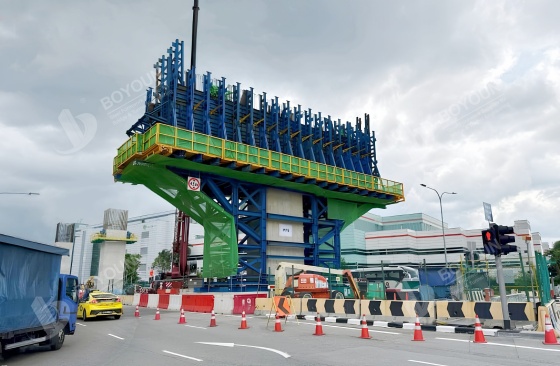
Adequate and detailed pre-construction preparation must be completed before the official start of the assembly construction of prefabricated pier columns and capping beams. This includes, but is not limited to, a comprehensive cleaning and leveling of the construction site to ensure the ground is solid and flat enough to bear the pressure of heavy machinery and material stacking; pre-planning the component transportation routes according to the design scheme to avoid traffic congestion or road damage; establishing a sound quality and safety management system, defining the responsibilities and authorities of managers at all levels, and strengthening technical training and safety education for front-line operators; last but equally important, conducting effective communication and coordination with local government departments and relevant stakeholders to gain the maximum understanding and support.
The hoisting of prefabricated pier columns is a highly technical and high-risk construction operation. Since a single column can reach a height of tens of meters and a weight of over 100 tons, high-performance hoisting equipment must be adopted in the hoisting process, and the command and dispatch must be undertaken by an experienced professional team. Before hoisting, technical personnel will carefully check every detail, such as the selection of lifting points, the safety factor of rigging, and wind speed changes, to ensure absolute safety. During hoisting, the operation shall be carried out step by step in strict accordance with the established procedures: the column shall be slowly lifted to a certain height for a test hoisting inspection, and then continue to be lifted until it is completely off the ground after confirmation of no abnormalities.
The fabrication and installation of temporary supports must be completed before the hoisting of prefabricated capping beams. Temporary supports are not only important auxiliary facilities in the capping beam hoisting process, but also one of the key factors to ensure construction safety. According to the specific engineering geological conditions and design requirements, suitable steel is selected as the main structural material and cut and processed into the required shape according to specific specifications. Then, it is assembled into a stable and reliable supporting structure by welding, bolt connection and other methods. During installation, special attention shall be paid to the reinforcement treatment of the foundation at the bottom of the support to ensure no settlement or inclination occurs during the entire construction period.
The hoisting and installation of prefabricated capping beams can be started after the temporary supports are installed and accepted. Similar to column hoisting, the hoisting of capping beams also relies on large cranes. The difference is that due to the long length and large self-weight of capping beams, the hoisting process places higher demands on the professional skills and coordination ability of operators. Before hoisting, a comprehensive inspection of the capping beam shall be carried out to ensure its intact appearance and normal state of internal prestressed tendon bundles. During hoisting, a multi-point binding method shall be adopted to make the stress evenly distributed and avoid local deformation. As the crane slowly lifts, the capping beam gradually leaves the ground and moves smoothly along the predetermined path to the position above the designated location. At this time, ground staff immediately start precise measuring instruments to fine-tune and correct the position of the capping beam until it fully meets the design requirements. Afterwards, high-strength bolts or other forms of connectors are used to firmly fix the capping beam between the columns on both sides to form a complete bridge structural unit.
The wet joint of the capping beam refers to the continuous connection part formed by cast-in-place concrete between two adjacent prefabricated capping beams. To enhance the integrity and durability of wet joints, reinforcement connection work must be well done in the early stage of construction. Normally, a certain number of longitudinal reinforcements are reserved at the ends of prefabricated capping beams for connection with the corresponding reinforcements on adjacent capping beams. The main connection methods include lap welding and sleeve grouting connection. Regardless of the method adopted, it is imperative to ensure that the tensile strength of the connection part is not lower than that of the base metal itself, and the connection surface is clean and free of contaminants to ensure good bonding performance.
Following the completion of reinforcement connection, prestress is then applied to the wet joints. This is to offset the tensile stress generated by vehicle loads in the later stage, thereby extending the service life of the bridge. Prestress application is generally carried out by using tensioning jacks with anchorage systems. In specific operation, first, jacks and anchorage devices are accurately installed in accordance with the design drawings, then the oil pressure is gradually increased to make the steel strands produce elastic elongation until the specified tension value is reached. It is worth noting that the loading shall be kept at a constant speed during the tensioning process, and the changes of various parameters shall be closely monitored. If any abnormality is found, the operation shall be stopped immediately to find out the cause. After the completion of tensioning, anchorage sealing shall be carried out in a timely manner to prevent water intrusion and subsequent corrosion.
Formwork hanging construction of wet joints is an important link to ensure the quality and appearance effect of concrete pouring. Formwork hanging refers to a concrete forming method that uses suspended formwork instead of traditional supporting structures. In comparison, this method has the characteristics of convenient installation and disassembly, small space occupation, and no impact on other construction processes. In actual operation, the selection and layout of hanging formwork shall comprehensively consider various factors such as the width and height of wet joints and the surrounding environment, and strive to meet the construction requirements with economic rationality. At the same time, to ensure that the hanging formwork does not deform or shift during concrete pouring, its stiffness and stability must be strictly inspected.
The final step is the concrete pouring construction of wet joints. Considering that wet joints are located in high-altitude operation environments, the selection of concrete mix proportion must ensure both good fluidity and fast early strength development. Appropriate water reducers and early strength agents are usually added to optimize the concrete performance. Before pouring, all debris in the wet joints shall be completely removed, and the base surface shall be wetted with water without ponding. The pouring shall be carried out continuously in layers, with the thickness of each layer controlled at about 30 cm, and fully vibrated and compacted with an inserted vibrator. To prevent concrete bleeding, the surface can be covered with plastic film for moisture conservation and curing. After the concrete final sets, the hanging formwork is removed, and the prestressed tendons are gradually relaxed at specified time intervals to allow them to shrink and reset naturally.
The assembly construction of prefabricated pier columns and capping beams is a comprehensive test of technical precision, process control and safety guarantee, and high-quality formwork products are an indispensable basic support for this test. As a manufacturer deeply engaged in the bridge formwork field, we always take construction needs as the orientation, focus on the core pain points of assembly construction, and create formwork solutions with sufficient stiffness, high precision and convenient disassembly and assembly to help improve construction efficiency and project quality. If you have any needs for the selection and customization of prefabricated bridge formwork, please feel free to communicate and contact us at any time.

We focus on turn-key solutions and types of formwork for Bridge and Viaduct Construction at home and abroad since 2006.


International Department: Room 2507-2508, Tower C of Wanda Plaza, Tongzhou District, Beijing 101118, China.
+86-13021287080
info@boyoun.cn

