
 Russian
 French
 Spanish
 Arabic
 Thai
Thai Indonesian

High pier construction in bridge engineering is a core technical procedure to ensure the safety and stability of long-span bridges. This article provides an in-depth analysis of the full-process application of high pier construction technology, from construction preparation and measurement setting-out to rebar engineering, concrete pouring, and steel formwork installation. It systematically elaborates on key processes such as turnover formwork technology and scaffolding erection checking calculations. Through rigorous quality control and mechanical checking calculations, the complex construction environment is effectively managed, and engineering risks are reduced. Mastering these key technical points of high pier construction is crucial for enhancing the durability and construction efficiency of the overall bridge structure, providing a reliable technical solution and practical reference for similar projects.
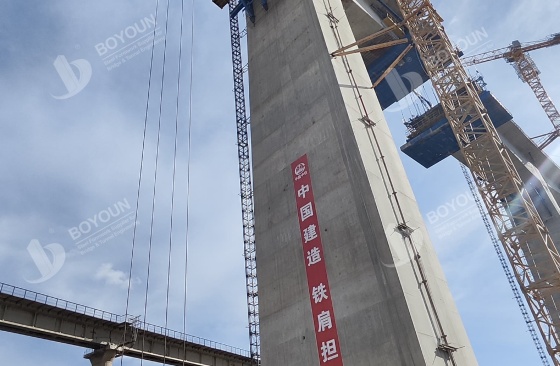
Before applying high pier construction technology, thorough preparation work must be completed. Adequate preparation not only improves construction efficiency but also affects the quality of high pier construction. During preparation, a feasible construction technical plan must be developed based on actual construction conditions. Formulating a construction technical plan can better promote the progress of the engineering project. To better survey the construction environment, it is necessary to accurately obtain data on the construction environment to assist subsequent construction. When formulating the engineering construction plan, a detailed material demand plan is also required. Simultaneously, frontline workers must be trained and guided, enabling them to fully master the key tasks and critical node elements of high pier construction technology.
Before applying high pier construction technology in bridge engineering, measurement setting-out of the pier column must be carried out first to ensure that the construction meets actual requirements. Additionally, the error occurring in the pier column must be controlled. Measurement setting-out ensures the quality of the entire project and plays a role in reducing difficulty.
During the implementation of high pier construction technology in bridge engineering, scaffolding must be erected strictly according to the engineer's requirements. After erection is completed, construction of the pier column rebar engineering can proceed. All construction processes must strictly comply with relevant regulations. After rebar processing is completed, the rebars should be numbered and then arranged in an orderly manner. During rebar welding, care must be taken to avoid joints. According to seismic design requirements, the error from the center point should be controlled within 2 cm.
Before proceeding with high pier construction technology, the situation must be understood, data information comprehensively collected, and construction scaffolding erected. When setting the centerline, it should be placed within the area around the high pier, preferably controlled within a 20mm range. Secondly, the construction procedure should be carried out according to the relevant process content, with the spacing between the formwork and the roof panel not exceeding 30 cm. When operating hydraulic equipment, resistance should be minimized to improve the optimization effect. Finally, a suitable pouring construction method is determined based on the specific height of the high pier. After pouring is completed, controlled measurement is also required, and the pouring results must be inspected to ensure logical sequencing and connectivity during pouring.
Before concrete pouring, the concrete should first be mixed using large forced-action concrete mixers. The mixing process requires professional personnel to operate strictly according to requirements. After mixing is completed, the metering equipment should be checked, and only used after passing inspection. During concrete mixing, the concrete must be mixed to a uniform state before use. During transportation, the mixer truck needs to maintain a constant speed to avoid affecting the concrete quality. Before concrete pouring, all embedded part positions must be carefully inspected. After pouring is completed, the embedded parts are removed. The poured concrete should be regularly sprinkled with water for concrete curing.
During high pier construction in bridge engineering, multiple concrete pouring operations are required. Before each pouring, a steel formwork assembly is necessary. When processing steel formwork, the surface flatness and dimensions of the steel formwork must be strictly controlled. Only components meeting the standards can be used. During installation, the stability of the installation must be ensured to reduce leakage. Finally, attention should be paid to the joints of the steel formwork to minimize the probability of gaps. If unavoidable gaps occur during splicing, they should be promptly sealed with sponge strips. Before steel formwork installation, rust removal and application of release agent are required. The quality of the steel formwork engineering directly affects the appearance quality of the concrete. Therefore, to ensure the concrete mix proportion, a vibration step should be added during the pouring process. Information on concrete quality should be promptly reported to the construction manager. During pouring, special attention should also be paid to the concrete surface to avoid damage as much as possible. When the concrete reaches a certain strength, the steel formwork can be removed. Removal should follow the correct sequence, adhering to the principle of removing later-installed components first. After removal, the steel formwork should be promptly cleaned. After cleaning, it should be stored in a designated place for future use.
Scaffolding erection checking calculation is the most technically demanding step in the entire construction process. The construction environment of bridge engineering is inherently very complex and difficult. To reduce difficulty, construction personnel generally use pier column scaffolding to assist and minimize deformation. When installing scaffolding, the overall building structure should not be affected. Before erection, mechanical checking calculations are required. Within the entire load-bearing structure, the section experiencing the greatest force is the vertical member of the structural members. Therefore, special attention should be paid to the calculation of this part during analysis.
High pier construction in bridge engineering is both the most common construction content and the most special step in the construction sequence. Therefore, during construction, assistance from turnover formwork technology is needed to complete the work. Throughout the construction process, fully utilizing the application of turnover formwork technology is necessary to better ensure construction safety and quality. During construction, problems must be identified and solved promptly to guarantee the effectiveness of bridge construction without affecting the smooth completion of the bridge project.

We focus on turn-key solutions and types of formwork for Bridge and Viaduct Construction at home and abroad since 2006.


International Department: Room 2507-2508, Tower C of Wanda Plaza, Tongzhou District, Beijing 101118, China.
+86-13021287080
info@boyoun.cn

