
 Russian
 French
 Spanish
 Arabic
 Thai
Thai Indonesian

However, as the industry shifts from traditional cast-in-place methods to precast techniques, one critical factor determines project success: the box girder formwork. The design and manufacturing quality of the formwork directly influence dimensional accuracy, surface finish, and overall production efficiency of precast box girders. Proper formwork selection not only ensures structural quality but also helps control construction costs and project timelines. This article examines the key factors in formwork selection for precast box girders, providing practical guidance for bridge contractors and engineering teams.
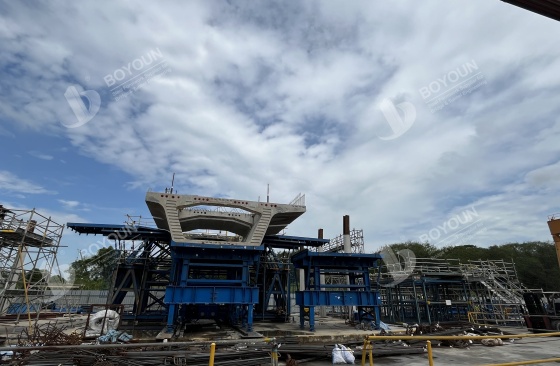
The choice of formwork material is a fundamental decision in precast box girder production. Traditional materials include steel, aluminum alloy, and steel-timber composites, with high-strength composites emerging in recent years.
Steel molds are widely used in large-scale precast box girder production due to their high strength, excellent wear resistance, and long service life. For high-volume projects requiring hundreds or thousands of identical girders, steel remains the industry standard. Aluminum alloy molds offer advantages in weight, machinability, and corrosion resistance, making them suitable for more precise or smaller-scale box girder production. Composite material molds, although more expensive, provide superior temperature resistance, corrosion resistance, and dimensional stability under specialized conditions. When selecting mold material, factors such as structural characteristics of the box girder, production batch size, and construction environment must all be considered to reach a reasonable decision.
The manufacturing precision of the formwork directly determines the geometric accuracy, surface quality, and structural safety of the precast box girder. Poorly designed molds or excessive manufacturing tolerances can lead to dimensional errors, irregular shapes, and compromised structural stability.
To ensure precision, the design phase must include detailed analysis of girder dimensions, shape, and construction conditions, while accounting for assembly tolerances, concrete shrinkage, and temperature effects. Surface treatment is equally important. Techniques such as polishing, chrome plating, and specialized coatings improve wear resistance and corrosion resistance, while reducing surface defects such as air bubbles and cracks. Proper surface treatment ensures high-quality box girder surface finish and extends formwork service life.
In mass precast box girder production, formwork is used repeatedly at high frequency. Therefore, service life and maintainability directly impact production efficiency and cost.
Selecting reusable, high-wear-resistant molds reduces long-term production costs and minimizes the frequency of mold replacement. Additionally, ease of maintenance and repair must be considered during the selection process. Molds that are difficult to repair or expensive to maintain can cause production stoppages and project delays. Choosing formwork that is easy to maintain, repair, and clean ensures production continuity and improves overall construction efficiency.
Formwork design must also consider the specific production process and construction methods employed. When using advanced techniques such as slipforming or self-propelled launching systems, the structure and design of the formwork require special attention to compatibility with these systems.
Slipforming requires formwork capable of withstanding high vertical and horizontal loads, while self-propelled launching equipment demands high structural stability and precise fit. Therefore, formwork design must fully account for the requirements of these construction technologies to ensure stable and safe load-bearing during the erection process.
In precast box girder production, formwork is far more than a simple container. It is the critical component that determines the quality of every single structural element. A mistake in formwork selection can lead to dimensional deviations, surface defects, costly on-site corrections, and project delays. Conversely, a well-designed, precision-engineered mold becomes a powerful engine for cost savings and efficiency gains.
As a professional manufacturer specializing in bridge steel formwork, we understand the value behind every millimeter of precision. With years of experience in the precast concrete formwork industry, we have supplied high-quality steel molds for numerous bridge projects across highways, railways, and urban rail transit systems.
What we deliver is more than just a steel mold. We provide fully customized precast box girder formwork solutions tailored to each client's specific project requirements. Our services include detailed drawing optimization, structural load analysis, and hydraulic system integration for automated formwork handling.
When you choose us as your formwork partner, you benefit from:
- High manufacturing precision – Our molds achieve ±1mm accuracy, ensuring perfect fit for every box girder
- Superior wear resistance – Our high-cycle design significantly reduces long-term amortization costs
- Seamless compatibility – Our formwork works perfectly with slipforming and self-propelled launching systems
- Fast on-site erection – Our designs reduce labor requirements and accelerate project timelines
We are committed to helping bridge contractors and engineering teams achieve both quality and efficiency in their precast box girder production. Our technical team works closely with clients from the design phase through to on-site commissioning, ensuring that every formwork delivers optimal performance.
Do not let poor formwork design become your project bottleneck. Contact us today to discuss your next bridge project and receive a customized formwork solution from a trusted bridge steel formwork supplier.

We focus on turn-key solutions and types of formwork for Bridge and Viaduct Construction at home and abroad since 2006.


International Department: Room 2507-2508, Tower C of Wanda Plaza, Tongzhou District, Beijing 101118, China.
+86-13021287080
info@boyoun.cn

