
 Russian
 French
 Spanish
 Arabic
 Thai
Thai Indonesian

As a mainstream form of highway bridge superstructure, the construction quality of cast-in-place box girders directly determines the bearing capacity and service life of the bridge. Full supports, with their adaptability to complex terrains and precise control over girder alignment, are widely used in the construction of small and medium-span bridges. However, the construction process is influenced by multiple factors such as support stability, concrete quality, and prestress control, making it prone to alignment deviations and structural cracking. This article systematically reviews the key technical points of the entire full-support cast-in-place box girder construction process, establishing a standardized technical framework from the perspectives of support erection and preloading, reinforcement and formwork construction, concrete pouring, and prestress control, aiming to provide a theoretical reference for improving construction quality and ensuring structural safety in similar projects.
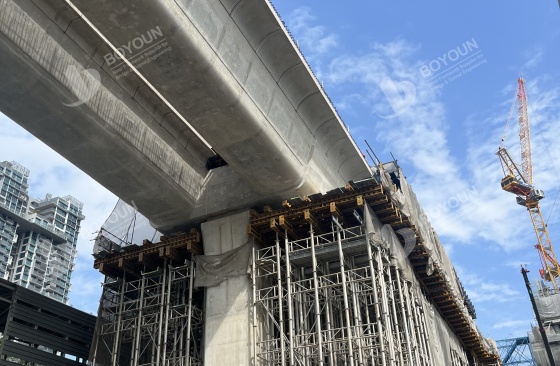
Support erection follows the procedure of "bottom-up, layer-by-layer erection":
Step 1: Adjustable Base Plate Installation. The base plate is made of Q235 steel. During installation, it must be fully in contact with the top surface of the cushion layer and leveled with a spirit level, with a horizontal deviation ≤2mm. The exposed length of the screw rod is strictly controlled at ≤30cm, and after adjustment, it is locked with double nuts. The bottom of the vertical member must be centered on the base plate to avoid eccentric loading that could deform the base plate. The vertical member is a φ60×3.2 mm Q235B steel tube, with each vertical member weighing ≤15kg for easy manual handling and installation.
Step 2: Vertical Member Erection. The requirement of "staggered joint arrangement" must be strictly followed: the first layer of vertical members uses alternating lengths of 1.5m and 2.0m, with the vertical staggered distance between joints of adjacent vertical members ≥50cm to prevent the joint ratio on the same cross-section from exceeding 50%. After every three layers of vertical members are erected, the verticality is checked with a plumb line, with deviation ≤1‰ of the vertical member height.
Step 3: Horizontal Member and Diagonal Member Installation. When connecting horizontal members to the disc-lock nodes of vertical members, the pins must be fully inserted into the disc holes, with a pull-out resistance ≥3kN. After horizontal member installation, a 2m straightedge is used to check horizontality, with deviation ≤5mm/m to avoid local sagging affecting load transfer. Diagonal members are arranged at "every 2 vertical member spacings vertically and every 3 step spacings horizontally," with an angle of 45°–60° relative to the vertical members. The pins at both ends are also hammered into self-locking positions to form triangular stable units. For areas where the support height exceeds 8m, a horizontal strengthening layer is added every 6m to enhance overall lateral stiffness.
Step 4: Top Bracket Adjustment. The top bracket uses an adjustable type with a screw rod diameter ≥48mm, and the exposed length of the top bracket screw rod is ≤40cm. A 5mm thick rubber pad is placed at the contact point between the top bracket and the timber beam to prevent deformation of the timber beam under pressure, ensuring uniform load transfer to the vertical members. After erection is completed, a special acceptance inspection is organized, focusing on node locking rate, vertical member verticality, and overall flatness. Only after passing the inspection can the next process be proceeded to.
The purpose of preloading is to eliminate non-elastic deformation of the support and verify its bearing capacity. The preloading load is 110% of the self-weight of the girder, applied using sandbags for uniform loading. Before preloading, monitoring points are arranged, with one monitoring cross-section every 1/4 span length longitudinally along the box girder, and 5 monitoring points per cross-section.
Loading is carried out in 4 stages. After each stage of loading, suspension is applied, and settlement is monitored at 12-hour intervals. When the average settlement over a continuous 12-hour period is ≤2mm, the next stage of loading can proceed. After full loading, monitoring continues for 72 hours. When the average settlement over a continuous 24-hour period is ≤1mm and the average settlement over a continuous 72-hour period is ≤5mm, the preloading is deemed qualified.
Unloading is carried out in the reverse order of loading. After each stage of unloading, rebound is monitored, and the elastic and non-elastic deformations of the support are calculated. Based on the elastic deformation parameters and the preset camber (the camber is determined through calculation), the top bracket elevation of the support is adjusted to ensure that the girder alignment meets the design requirements.
Reinforcement Construction: The principle of "factory-standardized processing and on-site precise installation" is adopted. Reinforcement processing is centrally carried out in the factory, using CNC cutting and bending machines to ensure the dimensional deviation ≤±10mm. During on-site installation, the bottom slab reinforcement follows the order of "bottom layer first, then top layer, layered binding," with spacing deviation ≤±5mm.
The web reinforcement and bottom slab reinforcement are connected using double-fillet welds (weld length ≥5d) or mechanical connections. Double-fillet welds must be full, free of slag inclusions and porosity. Mechanical connections use Class I straight thread couplers, with joints staggered, joint ratio on the same cross-section ≤50%, and center-to-center distance between joints ≥35d.
Prestressing Duct: A Φ90 metal corrugated duct is used. Before arrival on site, a water filling test and radial stiffness test are required. During installation, a "#"-shaped positioning reinforcement is placed every 0.8m along straight sections. The duct joints use a corrugated duct of the same type but one size larger in inner diameter, and the joints are wrapped with sealing tape for no less than 2 turns to prevent grout leakage during concrete pouring that could block the duct.
Formwork Construction: The installation order is bottom form → side form → internal form. The timber beams under the bottom form are placed at 30cm center-to-center spacing, with flatness deviation ≤2mm. The bottom form uses 15mm thick bamboo plywood, and 20mm wide double-sided grout stop tape is applied at the joints to ensure tightness without leakage.
The side form and bottom form are connected using M12 bolts. External transverse timber beams and vertical Φ48×3.5mm steel tube supports are provided. One end of the support is fixed to the support vertical member through a coupler, and the other end tightens against the side form. The verticality of the side form is checked with a 2m straightedge, with deviation ≤3mm/m.
The internal form is assembled using bamboo plywood, with a "#"-shaped Φ48 steel pipe support arranged inside. A 5cm thick timber beam is placed between the support and the formwork to avoid local pressure deformation. A 150×100cm manhole is reserved at the top of the internal form for each span to facilitate subsequent removal and debris cleaning. Additional Φ12mm reinforcement is added around the manhole, and when closed, micro-expansive concrete is used to ensure tight integration with the original concrete.
After formwork installation is completed, the axis deviation is checked with a total station, requiring ≤10mm, and the elevation deviation is checked with a level, requiring ±10mm. The alignment must meet the design camber requirements. Only after passing the inspection can the next process be proceeded to.
Concrete is centrally mixed in a batching plant, transported to the site by mixer trucks, and poured using a truck-mounted pump. Before pouring, the formwork joints, reinforcement cover, and prestressing duct positions are checked, and debris inside the formwork is removed.
Pouring is carried out in two stages: the first stage pours up to the junction of the web and top slab, and the second stage pours the top slab and wing slab. The interval between the two pours is ≥24h, and the concrete strength from the first pour must be ≥5MPa. The pouring sequence advances symmetrically from the mid-span toward both ends, with a layer thickness ≤30cm. The web is poured simultaneously on both sides to avoid internal formwork displacement. Vibration is performed using an internal vibrator, with vibration spacing ≤30cm and vibration time of 15–20 seconds, until no bubbles appear on the concrete surface and grout flows. The vibrator must not touch the prestressing duct or reinforcement.
Concrete curing begins within 12 hours after pouring completion by covering with geotextile fabric and sprinkling water to keep it moist. The curing period is ≥7 days. In high-temperature weather, the frequency of sprinkling is increased; in low-temperature weather, insulating cotton quilts are used to prevent thermal cracking.
Prestressing tensioning is carried out after the concrete strength reaches 90% of the design strength and the age is ≥7 days. An intelligent tensioning system is used, and the tensioning sequence follows the principle of "middle first, then both sides; web first, then bottom slab." The tensioning control adopts "dual control of tension force and elongation," with the tension control stress σcon = 0.75fpk = 1395MPa, and the deviation between actual elongation and theoretical elongation is within ±6%. The tensioning process is carried out in 3 stages: 25% σcon → 35% σcon → 100% σcon, with a holding time of 5 minutes.
Duct grouting is carried out within 48 hours after tensioning completion. C50 cement grout is used, with a water-to-binder ratio of 0.26–0.28 and a fluidity of 180–220mm. An intelligent circulating grouting process is adopted, with a grouting pressure of 0.5–0.7MPa and a pressure holding time ≥5 minutes to ensure that the duct is fully filled with cement grout. After grouting, the density of the cement grout at the grouting port and exhaust port is checked. If unqualified, regrouting is performed.
Anchorage end encapsulation uses C50 micro-expansion concrete. Before encapsulation, debris on the anchor surface is cleaned, and the reinforcement is welded firmly. After concrete pouring, curing is carried out for 7 days to ensure tight integration with the girder body.
Full-support cast-in-place box girder construction is a systematic project. From the "millimeter-level" precision control of the support foundation to the staged settlement monitoring during preloading, from the increased density of positioning reinforcement for prestressing ducts to the "dual control" verification of the intelligent tensioning system, technical deviations at any stage may be magnified step by step, ultimately affecting the alignment accuracy and structural safety of the girder. The five key technical points systematically reviewed in this paper—support erection, preloading verification, reinforcement and formwork, concrete curing, and prestress control—constitute a standardized technical chain for cast-in-place box girder construction. Practice has proven that only by running "refinement" through the entire process of design, processing, construction, and monitoring can quality hazards such as support instability, alignment deviations, and structural cracking be fundamentally avoided, ensuring the safety and durability of the bridge structure.
Shandong Boyoun Heavy Industry Co., Ltd. has many years of technical accumulation in the field of bridge steel formwork and supporting equipment. If you encounter any questions regarding formwork selection or process optimization in cast-in-place box girder construction, please feel free to contact us for discussion.

We focus on turn-key solutions and types of formwork for Bridge and Viaduct Construction at home and abroad since 2006.


International Department: Room 2507-2508, Tower C of Wanda Plaza, Tongzhou District, Beijing 101118, China.
+86-13021287080
info@boyoun.cn

