
 Russian
 French
 Spanish
 Arabic
 Thai
Thai Indonesian

The successful completion of a bridge pier and abutment lies not only in its perfect performance during pouring but also in its long-term stability and reliability in service. The mission of the formwork system, as a construction tool, does not end with the setting of concrete. High-quality acceptance checks provide a satisfactory conclusion to the project, while scientific maintenance management is the key for formwork manufacturers to help customers reduce costs and achieve sustainable asset appreciation. This article starts from the final quality acceptance standards and extends to daily formwork maintenance and full-cycle benefit assessment, presenting a complete management closed loop.
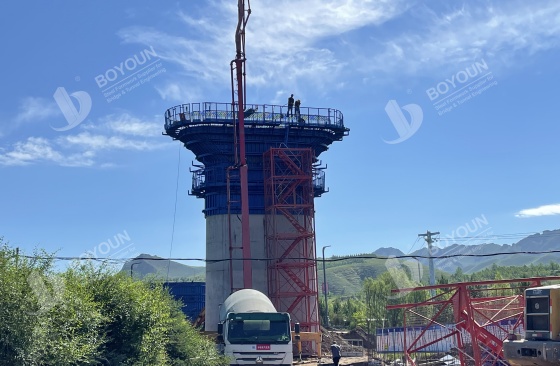
Formwork acceptance requires item-by-item verification of key indicators according to specifications. For axis position, measure the deviation between the formwork centerline and the design axis using a total station; the allowable deviation is controlled within ±10mm, ensuring the overall pier and abutment position meets design requirements. For top surface elevation, measure the formwork top elevation using a level; allowable deviation ±20mm, avoiding excessive pier and abutment height after subsequent concrete pouring. For cross-sectional dimensions, measure the internal length and width of the formwork using a tape measure or caliper; allowable deviation +5mm / -0mm, preventing insufficient cross-sectional size that would affect structural load-bearing or excessive size causing material waste. For surface flatness, use a 2m straightedge and feeler gauge; deviation should be ≤3mm per 2m, ensuring a smooth surface without obvious unevenness after concrete pouring. For joint step offset, use a straightedge pressed against the formwork joint; deviation ≤1mm, avoiding step marks on the concrete surface. For diagonal deviation, control the difference by measuring the diagonal lengths of the formwork to ≤3mm, ensuring a regular shape. For embedded parts acceptance, focus on positional accuracy; measure the deviation between embedded parts and design position using a tape measure or total station, controlling it within ±10mm. Perform a three-dimensional coordinate re-check before pouring to confirm no positional deviation, preventing impact on subsequent equipment installation.
After formwork is dismantled, promptly carry out maintenance work. First, use a high-pressure water gun to rinse residual concrete from the formwork surface, then use a wire brush to clean stubborn adhered material. Use a grinding wheel or perform shaping repair on surface scratches or deformed areas to ensure the formwork appearance is intact. After maintenance, store formwork by type. Steel, wood, and aluminum alloy formwork should be stored separately in dry, ventilated areas. Stacking height ≤2m, with wooden blocks at the bottom to elevate and avoid moisture. Apply anti-corrosion paint to wood formwork, and anti-rust paint to steel and aluminum alloy formwork to prevent rusting or decay during long-term storage. Formwork accessories such as bolts and positioning pins should be stored separately. Use sherardizing treatment to enhance corrosion resistance. Regularly check accessory wear during use; the number of turnover uses should not exceed 15 times. Replace accessories beyond this number to avoid connection loosening due to accessory failure. Use dedicated water-based release agents. Such release agents are easy to clean and non-polluting to concrete, effectively reducing bonding between formwork and concrete. It is strictly forbidden to use substitute materials like waste oil, which can easily penetrate the concrete affecting its strength and also pollute the formwork surface, shortening its service life.
After formwork removal, conduct long-term monitoring of the pier and abutment structure. Regularly inspect the pier and abutment surface for defects such as cracks or spalling. Use a total station to measure pier and abutment verticality and settlement to assess structural stability. Simultaneously, inspect the bridge's anti-corrosion coating for damage and the drainage system for clear flow, preventing rainwater immersion or corrosion from affecting the pier and abutment service life. All monitoring data must be recorded in detail, establishing a complete monitoring file to provide a basis for subsequent maintenance. Full-cycle benefit assessment of the formwork system should cover the design, construction, and maintenance phases. Compile data on formwork turnover, material wastage rate, and maintenance costs. Analyze whether design parameters (e.g., panel thickness, support spacing) are reasonable and whether construction processes (e.g., installation sequence, dismantling timing) have room for optimization. Based on the assessment results, adjust subsequent formwork design schemes and construction processes to improve the economy and practicality of the formwork system.
From the macro control of design principles to the precise calculation of design points; from the strict safety control during construction to the final quality acceptance and meticulous maintenance – the management of formwork systems in bridge pier and abutment construction is an interlocking, indispensable chain.
As a bridge formwork manufacturer, we provide not just a product, but a complete solution throughout the entire process. We hope this four-article series helps you gain a more comprehensive and in-depth understanding of the essence of formwork system design and safety control. We will continue to commit ourselves to technological innovation and quality service, joining hands with you to build safer, more durable, and more economical bridge projects.

We focus on turn-key solutions and types of formwork for Bridge and Viaduct Construction at home and abroad since 2006.


International Department: Room 2507-2508, Tower C of Wanda Plaza, Tongzhou District, Beijing 101118, China.
+86-13021287080
info@boyoun.cn

