
 Russian
 French
 Spanish
 Arabic
 Thai
Thai Indonesian

As mentioned earlier, scientific design is the cornerstone of a successful formwork system. However, no matter how perfect the design drawings, their effect will be greatly compromised if strict safety controls are lacking during construction. Bridge pier and abutment construction represents a typical high-risk operation. The safety control during formwork installation, dismantling, and concrete pouring directly relates to personnel safety and project success. This article, as the third part of the series, focuses on the construction phase, from preparation and process control to high-altitude work and emergency management, comprehensively outlining the key measures for formwork construction safety control.
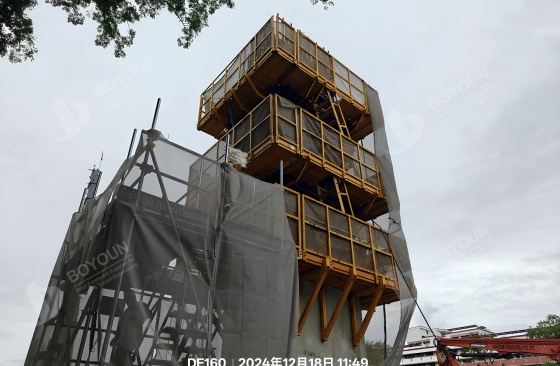
Safety technical disclosures must combine written and oral forms. Technical personnel explain the workflow of formwork installation and dismantling step by step to the construction team, clarifying safety requirements for each step, such as lifting point selection during hoisting and key points of high-altitude work protection, while informing about risks such as collapse and falls, and corresponding responsibilities. Signatures are required for confirmation and records are kept to ensure construction personnel clearly understand operating procedures. Site signs should be placed in conspicuous locations. The construction area is demarcated with colorful flags or fencing. Safety warning signs like "Caution: Fall Hazard" and "No Climbing" are posted around formwork supports and work platforms. Access prohibition signs are placed at site entrances with dedicated personnel on duty to restrict non-construction personnel from entering, preventing hazards caused by unauthorized entry. Material and equipment inspections must be itemized. Check the appearance of formwork, tie rods, and diagonal braces upon arrival for deformations or cracks, verifying that specifications match design requirements. Hoisting equipment such as tower cranes and mobile cranes require inspection of brake systems, wire rope wear, and limit switch effectiveness. Perform no-load and full-load test runs to confirm stable performance; only after passing acceptance can they be used.
Formwork installation proceeds according to a defined sequence: first, level and position the bottom formwork; after installation, use temporary supports to fix and prevent displacement; then use measuring instruments to correct position and verticality; once qualified, install formwork hoops to enhance integrity; install tie rods at design spacing to transfer lateral loads; finally, install upper formwork layers sequentially, checking connection tightness after each layer. Dismantling follows the principle of "remove later-installed parts first, remove first-installed parts later." Remove non-load-bearing formwork and supports first, then load-bearing structures. Dismantle in segments not exceeding 4 meters in height. Use ropes to lower dismantled components slowly; it is strictly forbidden to push over entire sections or throw components from height. For verticality and elevation control, use both a theodolite and a plumb bob for double-checking. Allowable deviation for pier heights below 30m is ±15mm; for heights above 30m, ±25mm. Adjust promptly if deviations are found. Use a level for elevation measurement to ensure pier and abutment height conforms to design. Control the layer thickness of concrete pouring within 50cm. Insert the vibrator into the lower concrete layer to a depth of not less than 10cm. Assign dedicated personnel to observe formwork deformation and support displacement throughout the process; if abnormal conditions occur, suspend pouring and reinforce.
Work platforms must be built to standard, using disc-buckle scaffolding as the supporting frame. The spacing and step distances of scaffolding vertical members must meet design requirements. Fully plank with wooden scaffold boards and fix them firmly. Gaps between scaffold boards should not exceed 5cm to prevent workers from stepping through. Install 1.2m high guardrails on the outside of the platform, add 18cm high toe boards at the bottom, and hang dense safety nets on the outside with a mesh density not less than 2000 mesh per 100cm² to prevent falls of people and objects. Safety lines and harnesses must be used correctly. On work surfaces higher than 2m, install steel wire ropes as safety lines along the work direction, with a rope diameter not less than 12mm and secure anchorage points. Workers must wear double-lanyard safety harnesses. During construction, attach the two lanyards to different firm structural components separately to ensure continuous protection, avoiding the failure of protection caused by attaching only one lanyard. Rest platforms should be reasonably arranged, one every 5 meters in height, with a platform width not less than 1.2m. Scaffold boards must be laid densely and fixed firmly. The perimeter of the platforms should also be equipped with guardrails and toe boards, providing safe temporary rest areas for workers, preventing risks from fatigue caused by prolonged suspended work at height.
Emergency plans must define specific handling procedures: for formwork collapse accidents, establish steps for component clearance and personnel rescue; for fall-from-height accidents, plan routes for casualty transport and medical treatment; clarify responsible persons and contact methods for each step to ensure rapid response after an accident. Emergency supplies require regular inspection and replenishment. Test the load-bearing capacity of rescue ladders, check the integrity of high-altitude rescue equipment such as baskets and ropes. First aid kits should contain common items like hemostatic drugs and bandages. All emergency supplies are stored in designated locations for easy access. Organize regular emergency drills simulating formwork collapse or personnel fall scenarios to enhance the emergency response capabilities and coordination efficiency of construction personnel. Risk inspections need to form a normalized mechanism. Regularly use a torque wrench to check the torque values of formwork connection bolts, ensuring bolts are tightened properly. Check the stress condition of tie rods for any loosening or deformation. Record identified safety hazards, assign responsible persons and deadlines for rectification. After rectification, re-inspect and accept to ensure hazards are completely eliminated, guaranteeing safety throughout the formwork construction process.
Safety is the bottom line of construction and the core embodiment of a formwork manufacturer's service value. From technical disclosure to process monitoring, from protective facilities to emergency plans, strict control at every step reflects responsibility for the project and respect for life.
Once the safe pier and abutment are successfully built and the formwork is smoothly dismantled, the focus shifts to quality verification and asset maintenance. In the concluding article of this series, we will introduce "Quality Acceptance and Maintenance Management for Bridge Piers and Abutments and Formwork", exploring how to maximize the life-cycle value of formwork through scientific acceptance and maintenance.

We focus on turn-key solutions and types of formwork for Bridge and Viaduct Construction at home and abroad since 2006.


International Department: Room 2507-2508, Tower C of Wanda Plaza, Tongzhou District, Beijing 101118, China.
+86-13021287080
info@boyoun.cn

