
 Russian
 French
 Spanish
 Arabic
 Thai
Thai Indonesian

During the post-tensioning process of simply-supported prestressed box girders, cracks frequently occur at the anchorage zones and beam ends. When the tensile stress exerted on the concrete in the anchorage zone at the end of the compressed box girder exceeds the ultimate tensile strength of concrete, local concentrated rhombic cracks with varying widths appear at the beam ends. These tension-induced cracks not only affect the appearance of the girder but also pose potential safety and quality hazards, directly impairing the durability of the main structure of the girder. In severe cases, they may even lead to the scrapping of the box girder.
Therefore, adopting necessary preventive and control measures to avoid the occurrence of tension-induced cracks is of great significance for ensuring the quality of prestressed box girders. This article introduces the causes and treatment measures for tension-induced cracks at the beam ends of simply-supported box girders.
To resist the local compression caused by tensioning, 3 to 4 layers of cross-grid tpye anti-crack reinforcement mesh are usually arranged at the beam ends of prestressed box girders. However, due to the narrow space and the interference of anchor bearing plates and spiral reinforcements, the installation of reinforcements is inaccurate and fails to meet the design requirements. Meanwhile, the tensioning notches are generally designed as plain concrete without anti-crack reinforcement, which reduces the compression resistance of the concrete under the anchors.
In addition to the structural reinforcement of the girder body, anti-crack reinforcement under anchors and corrugated pipe positioning reinforcement are added at the beam ends of prestressed box girders, resulting in dense reinforcement that hinders concrete vibration. Meanwhile, the obstruction of anchor bearing plates, spiral reinforcements and corrugated pipes also prevents the insertion of vibrators, leading to honeycombs and voids in the concrete at the tensioning ends, which consequently causes tension-induced cracks.
Premature formwork removal of box girders will cause water loss on the concrete surface and generate cracks. Delayed, inadequate or non-standard curing by sprinkling water and covering will result in uneven moisture evaporation between the internal and external parts of concrete, reducing the pre-shrinkage stress of concrete and causing drying shrinkage cracks. At the same time, it will also affect the strength development of concrete.
During the installation of prestress systems, the prestress ducts are not perpendicular to the anchor bearing plates. During tensioning, the center lines of the anchorage devices, prestressed tendons and jacks are not concentric, leading to uneven tensioning stress, eccentric compression on the concrete under the anchors at the tensioning ends and subsequent concrete cracking. Tensioning can only be carried out when the concrete strength, elastic modulus and age of the box girder meet the design requirements; otherwise, concrete cracking will also occur.
Prestress tensioning will cause upward camber of the girder body, which in turn leads to compression at both ends of the girder. When the tensile stress on the beam ends exceeds the ultimate tensile strength of concrete, the girder body will crack. To avoid excessive upward camber of the box girder, which may cause excessive deflection after girder erection and affect the stress performance of the girder body, reverse camber is usually set on the precast bed to ensure that the alignment of the bridge meets the design requirements after construction.
Wedge blocks of the girder body are usually arranged at both ends of the girder to adjust the longitudinal and transverse slopes of the girder, ensure horizontal close contact between the girder and the bearings, and achieve uniform stress distribution. After the upward camber of the girder caused by tensioning, the constraint of the wedge blocks at the bottom of the girder will generate transverse friction force, resulting in extrusion at the beam ends. When the pressure is too high and exceeds the ultimate tensile strength of concrete, the beam ends will crack.
(1) The spiral reinforcements of the anchorage devices shall be closely attached and fixed to the anchor bearing plates to achieve the effect of shock absorption of spiral reinforcements and prevent girder cracking.
(2) Lengthen the longitudinal horizontal reinforcements at the tensioning notches so that the distance from the extended ends to the end formwork is not more than 3 cm, and add U-shaped reinforcements to form an anti-crack reinforcement mesh.
(3) Replace the well-shaped anti-crack reinforcement mesh under the anchors with U-shaped reinforcement mesh to facilitate the installation of reinforcements in accordance with the design drawings. Ensure that the spacing of the reinforcement mesh is 10 cm and the distance from the anchorage devices is not more than 8 cm, as shown in Figure 1.
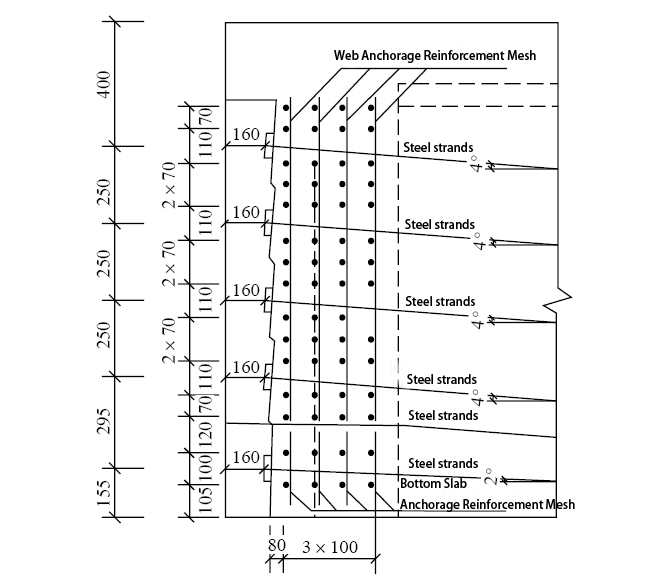
Figure 1:Schematic Diagram of Reinforcement Mesh Arrangement Under the Continuous End Anchorage of the Bridge Deck
Install external vibrators on the webs of the box girder to enhance the vibration of concrete at the beam ends. Reserve vibration positions when installing prestress ducts. During the pouring of the top slab of the box girder, assign special personnel to vibrate the reinforced concrete behind the anchors with a 30-type vibrator. Strictly control the vibration time to avoid insufficient vibration, missing vibration or over-vibration, so as to ensure dense vibration and cement paste bleeding on the concrete surface.
(1) During winter construction, formwork can only be removed when three conditions are met: the surface temperature of concrete cools down to below 5 °C, the temperature difference between the internal and external parts of concrete is below 20 °C, and the concrete specimens cured under the same conditions reach the critical strength against freezing.
(2) Affected by high temperatures in summer, to avoid drying shrinkage cracks caused by water loss on the concrete surface due to premature formwork removal, carry out curing by sprinkling water with the formwork installed for 1 day before removing the formwork.
(3) The side formwork of the box girder can only be removed when the concrete strength reaches not less than 2.5 MPa, without edge chipping and corner damage, and the appearance quality of the concrete is guaranteed.
(4) After removing the side formwork, start the automatic sprinkler system in the girder yard in a timely manner to conduct sprinkling curing on the girder body. The curing period shall not be less than 7 days to ensure curing effectiveness. Focus on strengthening sprinkling and covering curing with geotextiles at the beam ends to maximize the strength of the concrete at the tensioning ends.
(1) The ends of the well-shaped positioning reinforcements designed in the drawings are prone to damage the corrugated pipes and interfere with the main reinforcements, making installation difficult. It is advisable to replace the well-shaped reinforcements with U-shaped reinforcements. Meanwhile, weld the positioning reinforcements firmly to the main reinforcements of the box girder, and densify the positioning reinforcements at key positions such as the start and end points of the horizontal and vertical bends of the steel strands to ensure accurate positioning of the prestress ducts, avoid duct displacement that affects the alignment of prestress tendons and causes prestress loss.
(2) Fill the joints between the corrugated pipes and the bell mouths of the anchor bearing plates with foaming agent. Use corrugated pipes one size larger as sleeves to connect the joints of the corrugated pipes, and wrap them tightly with wide adhesive tape to prevent grout leakage during concrete pouring and avoid duct blockage. Meanwhile, densify the positioning reinforcements of the corrugated pipes to ensure that the prestress ducts are perpendicular to the anchor bearing plates, so as to achieve uniform stress on the prestressed tendons during tensioning.
(3) Insert lining pipes into the corrugated pipes before pouring concrete. The lining pipes shall have certain hardness and bending capacity. During concrete pouring, move the lining pipes back and forth to prevent grout leakage and blockage of the corrugated pipes and improve the smoothness of the corrugated pipe curves.
(4) After pouring the box girder concrete, clean the prestress ducts in a timely manner to ensure unobstructed ducts. Number the prestressed tendons before threading to prevent tangling and dislocation of individual tendons. During installation, check whether the tool anchors and working anchors are matched and installed strictly in accordance with the designed number of holes and specifications, and ensure that the anchor bearing plates and working anchors can be closely attached, and the top surfaces of the clamping pieces are flush after anchoring. During tensioning, ensure the concentricity of the jacks, prestressed tendons and anchorage devices to prevent eccentric compression.
(5) Use on-site concrete specimens cured under the same conditions to test the concrete strength before tensioning. Tensioning can only be carried out when three conditions are satisfied: both the concrete strength and elastic modulus reach more than 90% of the designed values, and the age of concrete is not less than 7 days. Focus on conducting rebound tests on the concrete strength at the tensioning positions of the beam ends to ensure that the concrete strength meets the requirements of prestress tensioning.
(6) Before tensioning, check whether the clamping pieces of the tool anchors and working anchors clamp the prestressed tendons tightly to avoid slippage. Long-term use of clamping pieces will lead to reduced hardness, making them unable to clamp the prestressed tendons after tensioning, which will also cause slippage. Check whether there are cracks in the concrete on the side of the working anchors; if necessary, take grouting measures to ensure concrete density and avoid concrete cracking caused by eccentric compression during tensioning. Check whether there are air holes and sand holes on the anchor bearing plates, verify the matching of the models of the working anchors and anchor bearing plates, and replace them if necessary.(7) During the tensioning process, ensure synchronous, symmetrical, step-by-step and uniform tensioning of the prestressed tendons at both ends of the box girder, and guarantee the effective holding time of the tensioning force to avoid concrete cracking due to uneven stress during tensioning.(8) In the tensioning process, strictly control the tensioning force and elongation value with double indicators. The tensioning force shall not be less than the designed tensioning force, and the elongation value shall not exceed ±6% of the designed elongation value. During step-by-step tensioning, record the elongation of the prestressed tendons in a timely manner and compare it with the designed theoretical elongation. If the elongation changes significantly, make adjustments promptly.
When setting reverse camber on the girder fabrication bed, refer to the reverse camber parameters in the drawings, and make the longitudinal direction of the bed into a smooth circular curve or quadratic parabola. Strictly control the alignment of the bed through adjustable fasteners or sand cylinders. Finally, after the overall installation and forming of the bed, conduct fine adjustment with a precision level to ensure the accurate reservation of the reverse camber value of the bed, so as to reduce the upward camber of the box girder.
The reserved groove molds for the wedge blocks at the bottom of the girder shall be made of stainless steel with a longitudinal slope of 135° along the bridge. Before binding the reinforcement of the box girder, apply silicone grease on the molds and then place rubber strips to reduce the transverse friction force between the wedge blocks at the bottom of the girder and the box girder, avoid stress concentration at the girder ends caused by tensioning, thereby reducing the constraint of the wedge blocks on the upward camber deformation of the girder body and preventing tension-induced cracks at the beam ends. Due to the varying lengths of box girders, the positions of the wedge blocks will change. When arranging the wedge blocks, adjust the size of the wedge blocks or increase/decrease the length of the bed to ensure accurate and close contact between the wedge blocks and the bearings, so as to guarantee universality.
The formation of tension-induced cracks in simply-supported prestressed box girders is a complex process caused by multiple factors. Improper treatment of cracks in box girders will not only increase the cost of defect treatment but also affect the progress of box girder prefabrication. In severe cases, it will directly threaten people's lives and property safety. In view of the serious consequences caused by the quality hazards of box girder cracking, the construction shall focus on the method of prevention first, process control and comprehensive disposal. By adopting the preventive and control measures for tension-induced cracks in simply-supported prestressed box girders, the quality problem of tension-induced cracks at the beam ends of box girders is effectively solved, achieving good application results.

We focus on turn-key solutions and types of formwork for Bridge and Viaduct Construction at home and abroad since 2006.


International Department: Room 2507-2508, Tower C of Wanda Plaza, Tongzhou District, Beijing 101118, China.
+86-13021287080
info@boyoun.cn

