
 Russian
 French
 Spanish
 Arabic
 Thai
Thai Indonesian

Under vertical loads, the bending moment of the beam in a continuous rigid-frame bridge is usually smaller than that of a continuous beam or simply supported beam with the same span, and its spanning capacity is greater than that of ordinary beam bridges. Therefore, prestressed concrete rigid-frame bridges are currently the main bridge type for long-span bridges.
Double thin wall pier and single thin wall pier are the mainstream types of main piers for continuous rigid-frame bridges. There are significant differences between the two in terms of stiffness characteristics, force performance, and construction adaptability, making them suitable for different engineering scenarios and technical requirements. This article will systematically analyze the technical characteristics and applicable boundaries of the two pier types from three core dimensions: main pier type comparison, construction stage requirements, and completed bridge applicability, providing professional references for the selection of main piers in engineering design.
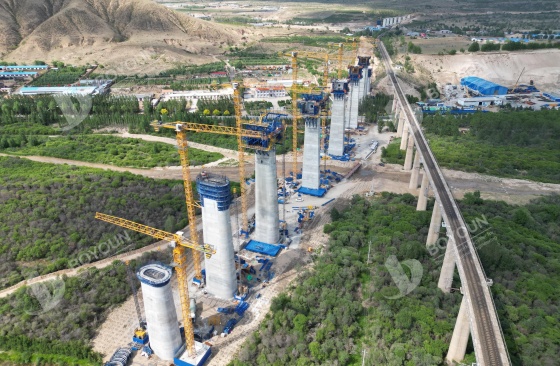
Continuous rigid-frame bridges located in mountainous areas or canyons usually have relatively high piers. The design of high piers must not only consider the internal forces of the bridge in the completed state but also the internal forces and structural stability under various working conditions during the construction stage. At present, a large number of long-span high-pier continuous rigid-frame bridges have been built in China. Most of these completed continuous rigid-frame bridges adopt double thin wall piers or single thin wall piers, and double thin wall piers are more widely used than single thin wall piers. The design of high piers for continuous rigid-frame bridges needs to consider the following factors:
1. To adapt to the deformation of the upper structure of the bridge caused by temperature and concrete shrinkage and creep, the longitudinal design of the bridge must have a certain stiffness.
2. The flexural stiffness and torsional stiffness of the piers should be appropriately designed to ensure the stability and safety under various working conditions during the construction stage.
3. The transverse stiffness of the piers should be designed to be as large as possible to resist crosswind loads and reduce structural deformation caused by vehicle eccentric loads.
4. To reduce the impact of wind loads on the bridge structure, the transverse windward area and shape of the piers should be reasonably designed.
5. The longitudinal stiffness of the piers should be designed by comprehensively considering seismic requirements and geological conditions. For sites with good conditions, the longitudinal stiffness of the piers should be designed to be relatively flexible.
Due to the relatively small longitudinal stiffness along the bridge, double thin wall piers have strong adaptability to the longitudinal deformation of the bridge, so this type of pier is widely used in continuous rigid-frame bridges with a pier height of less than 50m. Compared with single thin wall piers, double thin wall piers have the following advantages:
1. Under the conditions of the same ability to adapt to system temperature and concrete shrinkage and creep, and the same longitudinal thrust stiffness, it can provide a certain flexural stiffness to resist unbalanced loads during the cantilever construction stage.
2. The longitudinal thrust stiffness of the piers can be adjusted not only by adjusting the section size of a single limb, the spacing of tie beams, and the section of tie beams of the double thin wall piers but also by setting temporary tie beams during the construction stage to adjust the longitudinal thrust and flexural stiffness of the piers, so that the piers can meet the force requirements of each stage.
3. Double-limb piers have a smaller transverse windward area and wind load shape coefficient, which makes them more suitable for resisting crosswind loads in canyons.
For single-limb section piers with a height greater than 50m, hollow sections are generally adopted. This type of section is similar to two single-walled hollow piers, with relatively high construction difficulty and cost. If double thin wall piers are adopted, the section size of a single limb also needs to be increased. The single-limb box section has both large flexural and torsional stiffness and large longitudinal thrust stiffness. This characteristic is more favorable during the construction stage and can better resist unbalanced loads during the construction stage. However, in the later operation stage, under the action of temperature and concrete shrinkage and creep, the structure will generate large internal forces. Both the pier columns and the foundation are in an unfavorable stress state, requiring larger section sizes and steel bar quantities, resulting in increased costs and decreased economy.
Sliding form and climbing form construction technologies are two commonly used technologies for high pier construction. To adapt to sliding form and climbing form construction technologies, the piers should adopt a relatively simple shape. Compared with double thin wall piers, single thin wall piers are more convenient for construction. During the cantilever casting construction of the main beam with a form traveler, the structural stability is the lowest when the form traveler construction of the farthest end beam body is completed. Under this working condition, the safety of single thin wall piers is generally stronger than that of double thin wall piers. Due to the greater torsional stiffness of single thin wall piers than double thin wall piers, the wind resistance of single thin wall piers is stronger under crosswind action during the construction stage. For double thin wall piers, temporary connection structures can be set to enhance their torsional stiffness, thereby improving wind resistance safety.
A double-walled pier is composed of two parallel thin-walled concrete piers fixed with the main beam. The rigid connection node formed by it and the main beam has high flexural stiffness but weak thrust resistance. Therefore, this structure can allow the upper structure to have large longitudinal displacement along the bridge, reduce the negative bending moment at the pier top of the main beam, and make the overall internal force distribution of the structure more uniform and reasonable. For single-limb piers, a large negative bending moment peak usually appears at the pier top of the main beam. For double thin wall piers, each pier position has two supporting points for the main beam, and the negative bending moment of the main beam here will be peak-clipped, and the maximum negative bending moment will be much smaller than that of single-limb piers. Therefore, when double thin wall piers are adopted, the beam height of the main beam at the fixed connection between the pier and the beam can be made lower, and the structure is lighter and more beautiful.
In general, single thin wall piers have stronger thrust resistance and torsional strength than double thin wall piers, but their flexibility is not as good as that of double thin wall piers, allowing a smaller amount of longitudinal deformation along the bridge. However, with the increase of pier height, the flexibility of single thin wall piers also increases. Therefore, when the pier height is very high, it is more reasonable to adopt single thin wall piers as the pier type. The fixed connection between the pier and the beam of the continuous beam can reduce the negative bending moment peak at the pier column of the main beam, so the internal force distribution of the upper structure is more uniform. Under the same engineering volume, due to the two supporting points at one pier position of the double-walled pier, the net spacing of each span of the main beam is reduced, the internal force of the main beam is also reduced accordingly, and the upper structure is more economical.
In summary, the selection of double thin wall piers and single thin wall piers for continuous rigid-frame bridges must be based on a comprehensive assessment of pier height, topographical environment, construction conditions, and economy: when the pier height is less than 50m and it is necessary to adapt to large longitudinal deformation along the bridge and crosswind environment in canyons, double thin wall piers are more suitable due to their advantages of strong deformation adaptability and uniform internal force distribution; when the pier height exceeds 50m and high requirements are placed on construction convenience and torsional and thrust stiffness, single thin wall piers can better meet the needs of structural safety and long-term operation. Accurately grasping the technical characteristics and applicable boundaries of the two pier types is the key to realizing the unity of scientificity, economy, and safety in the engineering design of continuous rigid-frame bridges. Based on professional technical accumulation, we deeply analyze the core logic of engineering components and provide professional solutions with both theoretical support and practical guidance for the design and construction of bridge engineering.

We focus on turn-key solutions and types of formwork for Bridge and Viaduct Construction at home and abroad since 2006.


International Department: Room 2507-2508, Tower C of Wanda Plaza, Tongzhou District, Beijing 101118, China.
+86-13021287080
info@boyoun.cn

