
 Russian
 French
 Spanish
 Arabic
 Thai
Thai Indonesian

The complex terrain and variable environmental conditions in mountainous areas impose higher requirements on the design and construction of viaducts. As the main components of beam bridges, the construction quality of pier columns and pier cap is crucial to the overall functional performance and service life of the bridges. To address the challenges of efficiency and quality in bridge engineering construction, a technology known as precast construction has emerged at the right time. This study aims to analyze the precast construction methods for pier columns and pier cap in mountain viaduct projects.
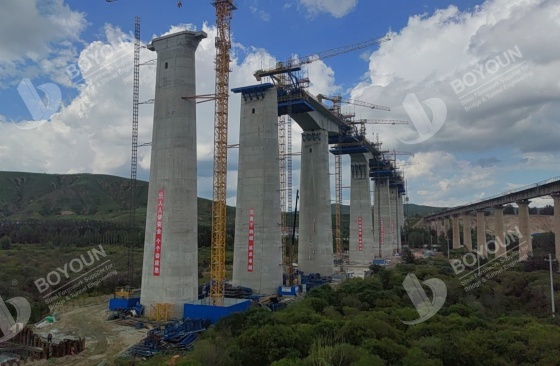
The design characteristics of mountain viaducts are mainly influenced by terrain, climatic conditions and traffic demands. The design of pier columns and pier cap is particularly critical. Due to the complex and undulating terrain in mountainous areas, bridge design must fully consider foundation bearing capacity and stability. Detailed geological surveys are essential, especially for construction on soft soil layers or rock formations, to ensure that the design of bridge pier columns complies with local geological conditions.
Mountainous areas are usually characterized by variable climatic conditions, such as frequent rainfall and snowmelt. This requires the design to take into account the impact of water scouring and freeze-thaw cycles on piers and pier cap. Therefore, in terms of material selection, it is necessary to use high-strength and corrosion-resistant concrete, as well as special waterproof and anti-freezing treatment measures, to enhance the durability and safety of the structure.
Design of Pier Column Erection and Capping Beam Layout:
While considering the unique topography and geomorphology of mountainous areas, climatic conditions, load requirements, characteristics of construction materials and environmental protection factors must be integrated into the design. This ensures the structural safety, stability and economic rationality. Meanwhile, efforts should be made to optimize the design scheme in terms of sustainability, meet the specifications of engineering technology and maintain ecological balance.
Precast construction technology is a modern construction method that involves prefabricating bridge components in factories and then assembling them quickly at the construction site. The core advantages of this technology lie in its high efficiency and flexibility. It can effectively overcome the limitations of traditional construction methods in terms of time, cost and quality control.
By prefabricating components in a controlled factory environment, precast construction significantly improves the quality and precision of components. The superior production conditions in factories can effectively avoid the impact of weather and environmental factors on construction quality, ensuring that the strength and stability of each component meet the design requirements.
The application of this technology can significantly shorten the construction period. Prefabrication of components and on-site construction can be carried out simultaneously. The precast construction method enables the completion of large-scale bridge construction in a short period, thus reducing the overall project cycle. In addition, the precast construction method can significantly reduce the reliance on human resources at construction sites. This avoids project delays and potential safety hazards caused by labor shortages.
In numerous bridge construction projects, the adoption of standardized precast technology in production and design not only improves the economic benefits of construction, but also enhances the repeatability of the construction process. precast construction reduces on-site concrete pouring, thus demonstrating excellent environmental performance. This construction method conforms to the modern concept of sustainable development.
Moreover, precast construction makes bridge components easy to disassemble and replace, which significantly improves the convenience of bridge maintenance and management, and extends its service life. Precast construction technology has shown outstanding advantages in many fields.
In summary, the design of pier columns and pier cap for mountain viaducts must be accurately adapted to the complex terrain and variable climate. The precast construction technology, with its core advantages of controllable quality, improved efficiency and environmental friendliness, perfectly meets the core requirements of safety, high efficiency and sustainability for mountain bridge construction. It provides a feasible solution to solve the construction challenges of mountain bridges.
Based on this, the next article will focus on the practical application of precast construction technology for pier columns and pier cap in mountain viaduct projects. It will specifically elaborate on the core contents including construction preparation and material selection, key technologies in the construction process, and construction site management and monitoring. Combined with actual engineering scenarios, it will systematically expound the implementation path and application key points of precast construction technology in the construction of pier columns and pier cap of mountain viaducts, providing more targeted technical references for relevant engineering practices.

We focus on turn-key solutions and types of formwork for Bridge and Viaduct Construction at home and abroad since 2006.


International Department: Room 2507-2508, Tower C of Wanda Plaza, Tongzhou District, Beijing 101118, China.
+86-13021287080
info@boyoun.cn

