
 Russian
 French
 Spanish
 Arabic
 Thai
Thai Indonesian

In the previous article, we systematically introduced the technical differences and engineering applicability between steel box girders and cast-in-place girders from three dimensions: structural characteristics, applicable scenarios and selection criteria, and core quality control indicators, providing a preliminary overview of these two main types of bridge superstructures. As one of the two primary forms of bridge superstructures, steel box girders are widely used in long-span bridges and construction-constrained scenarios due to their advantages of high strength-to-weight ratio, high degree of factory prefabrication, and rapid construction speed. However, the full realization of these advantages depends on precise control throughout the entire process chain—from factory fabrication to on-site installation. As the second article in this series, this paper focuses on three key aspects: prefabrication and processing techniques, transportation and hoisting techniques, and on-site installation and connection techniques for steel box girders, systematically summarizing the key construction techniques to provide technical reference for similar projects.
1. Prefabrication and Processing Techniques for Steel Box Girders
The prefabrication and processing of steel box girders shall be carried out under standardized factory operations, with core processes including raw material pretreatment, component fabrication, and welded forming. In the raw material pretreatment stage, the steel surface shall be descaled (using shot blasting to achieve a cleanliness grade of Sa2.5), and after removal of mill scale and oil contaminants, a shop primer shall be applied (dry film thickness ≥ 80 μm). Plate cutting shall be performed using CNC plasma cutting or laser cutting, with cutting precision controlled within ±1 mm to ensure accurate component dimensions. In the component fabrication stage, the top flange, bottom flange, and webs shall be bent and stamped according to design drawings; stiffeners (such as U-ribs and I-ribs) shall be fabricated using dedicated dies to ensure uniform cross-sectional geometry. During assembly of webs and stiffeners, jig positioning shall be adopted with positioning deviation ≤ ±2 mm, followed by tack welding for fixation prior to formal welding. Welded forming shall employ gas shielded metal arc welding (GMAW) or submerged arc welding (SAW). The fillet welds between webs and the top and bottom flanges shall be continuous, with weld leg heights conforming to design requirements (typically ≥ 8 mm). Post-weld non-destructive testing (NDT) shall be conducted—ultrasonic testing (UT) for internal defects and magnetic particle testing (MT) for surface defects—to ensure a 100% weld acceptance rate.
2. Transportation and Hoisting Techniques for Steel Box Girders
The transportation of steel box girders shall be carried out with transportation equipment and routes selected based on component dimensions and weight. Small steel box girders (single-segment weight ≤ 50 t) may be transported using flatbed trailers, with dedicated supports for fixation prior to transport. Rubber pads shall be placed at the contact surfaces between supports and the steel box girder to prevent component deformation during transit. Large steel box girders (single-segment weight > 100 t) shall be transported using hydraulic axle modular trailers, with multi-axle coordinated control to maintain transportation stability. The transportation route shall be surveyed in advance to ensure that road surface bearing capacity and turning radius meet the requirements. For the hoisting process, a hoisting plan shall first be designed, with the appropriate crane (e.g., 500 t truck crane) selected based on the steel box girder weight (e.g., 150 t). Hoisting points shall be arranged in accordance with design requirements (typically at the junctions of webs and stiffeners), using dedicated rigging (such as shackles and wire ropes), with protective padding provided at the contact surfaces between the rigging and the steel box girder. A trial lift shall be conducted prior to formal hoisting (lifting height of 10–20 cm, holding time of 10–15 minutes) to inspect rigging load conditions and component balance. During formal hoisting, the lifting speed shall be controlled (≤ 0.5 m/min), with tag lines used to adjust the component attitude to avoid collision with surrounding structures and ensure smooth and precise positioning.
3. On-site Installation and Connection Techniques for Steel Box Girders
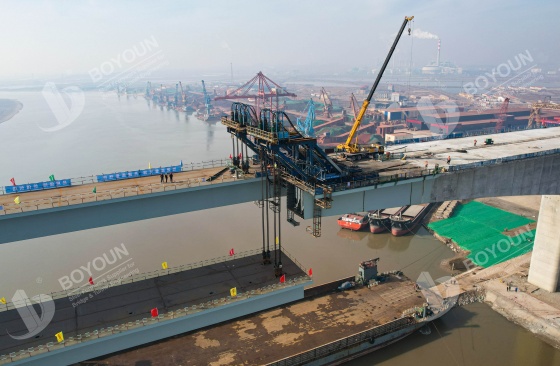
The on-site installation of steel box girders shall follow the principle of "precise positioning, staged connection, and symmetrical welding." Prior to installation, the bearing top elevations and axis positions shall be verified, with deviations controlled within ±2 mm. The bearing padstones shall be leveled (using epoxy resin mortar for leveling, with a thickness of 5–10 mm). After the first segment of the steel box girder is positioned, three-dimensional positioning shall be performed using a total station, with elevation adjustments (using jack pushing, adjustment precision ≤ ±1 mm) and axis deviation corrections (using lateral pulling, deviation ≤ ±2 mm). Temporary fixation (using steel section supports or tack welding) shall be applied after positioning. Subsequent steel box girder segments shall be precisely aligned with the installed segments, with the joint gap between adjacent segments controlled within 2–5 mm. After alignment, temporary connection (installation of high-strength bolts with initial tightening torque reaching 50% of the design torque) shall be carried out first, followed by permanent connection. The connection process is primarily based on welding, with the welding sequence proceeding symmetrically from the center outward—web butt welds shall be welded first, followed by top flange and bottom flange butt welds. Interpass temperature shall be controlled during welding (≥ 150°C, ≤ 350°C) to avoid welding stress concentration. After welding is completed, NDT shall be performed again, and upon acceptance, the temporary fixation devices shall be removed to complete the installation.
To Wrap Up
In summary, the construction process for steel box girders encompasses three core stages: factory prefabrication and processing, logistics transportation, and on-site installation and connection—each of which exerts a critical influence on the final structural quality. During the prefabrication and processing stage, strict control shall be exercised over raw material pretreatment precision, component fabrication dimensions, and welded forming quality to ensure that components leave the factory fully compliant with design requirements. During the transportation and hoisting stage, appropriate equipment and routes shall be selected based on component characteristics, and the feasibility of the plan shall be verified through trial lifts to ensure hoisting safety and precise positioning. During the on-site installation stage, the principles of "precise positioning, staged connection, and symmetrical welding" shall be adhered to, relying on total station precision positioning and full-process NDT verification to ensure that the finished bridge geometry and connection quality meet specification requirements. The systematic and precision-oriented nature of steel box girder construction techniques dictates that every detail of quality control must not be overlooked.
Shandong Boyoun Heavy Industry Co., Ltd. remains committed to providing high-quality formwork systems and construction equipment solutions for the bridge construction. We firmly believe that continuous process optimization and strict standard implementation are the fundamental guarantees for delivering excellence in engineering projects. In the next article of this series, we will continue to focus on the key construction techniques for cast-in-place girders in bridge construction, systematically presenting the critical technologies and control points throughout the entire cast-in-place construction process—from falsework erection, formwork installation, and rebar placement to concrete placement and curing.

We focus on turn-key solutions and types of formwork for Bridge and Viaduct Construction at home and abroad since 2006.


International Department: Room 2507-2508, Tower C of Wanda Plaza, Tongzhou District, Beijing 101118, China.
+86-13021287080
info@boyoun.cn

