
 Russian
 French
 Spanish
 Arabic
 Thai
Thai Indonesian

As long-span bridge engineering continues to advance toward more complex terrains and greater spanning capabilities, steel-concrete composite bridges are becoming the mainstream choice in modern bridge design due to their excellent mechanical properties and economic efficiency. In the process of transforming these large-scale bridges from drawings to physical entities, steel formwork systems—especially high-precision construction equipment such asform traveler formworkand segmental assembly formwork—directly affect structural forming quality and construction efficiency. This article discusses the new structural system of long-span composite bridges from three dimensions: structural form innovation, material selection and composite design, and structural detailing, while simultaneously analyzing the technical requirements and supporting solutions for steel formwork construction equipment.
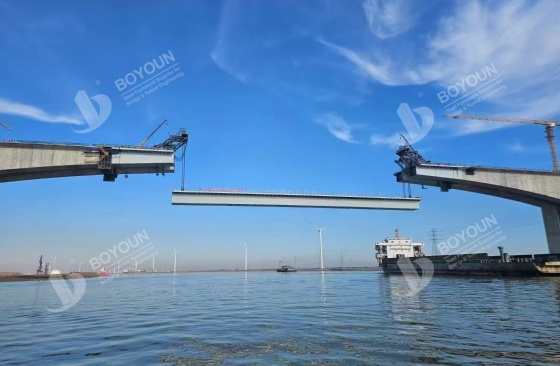
Structural form innovation of long-span composite bridges is extremely critical for meeting the demands of modern bridge engineering. Traditional single-material structural forms, such as pure steel arches and pure concrete beams, can no longer effectively cope with larger spans and more complex loading conditions. By organically combining steel and concrete, the advantages of both materials can be fully exploited, improving the overall bearing capacity and stability of the bridge. In terms of structural form, the combination of multiple systems such as arches, beams, and cables achieves multi-directional and reasonably distributed structural forces, which greatly enhances material utilization efficiency and structural toughness. Innovative design also encompasses modular construction, segmental assembly, and the application of integral prestressing, thereby strengthening overall structural coordination and reducing construction difficulty. It is worth noting that the realization of such structural forms places higher demands on the partitioning accuracy, assembly stiffness, and reusability of steel formwork. For example, in segmental assembly construction, precast segment formwork and hydraulic formwork systems must cooperate to achieve precise control of complex alignments; in arch-girder connection sections, the design and processing quality of special-shaped formwork directly affects the effectiveness of joint stress transfer. Through rational structural shape optimization, material consumption can be reduced, achieving a combination of economy and durability, while also providing favorable conditions for the standardized and serialized manufacturing of steel formwork.
Scientific material selection is crucial for improving the structural performance of long-span composite bridges. Steel, due to its high strength and good plasticity, is widely used in primary load-bearing components; concrete, with its excellent compressive performance and durability advantages, is often used as secondary components or protective layers. The rational combination of steel and concrete allows each material to fully demonstrate its advantages and complement each other. The application of modern high-performance steel and concrete has further enhanced the bearing capacity and durability of bridge structures, while reducing structural self-weight and subsequent maintenance costs. From the perspective of steel formwork manufacturers, material combination design also affects the material selection and matching of formwork systems. For example, in the steel-concrete interface areas, the stiffness, surface flatness, and demolding performance of steel formwork directly affect concrete forming quality and interface cooperative working capacity; in composite girder bridges constructed using form traveler cantilever casting, the form traveler formwork must bear the wet weight of concrete and accommodate deformations caused by prestressing, and its material and construction must be highly coordinated with the main structural design. By optimizing material matching and connection methods, efficient and coordinated stress transfer can be achieved, while also taking into account construction convenience and later maintenance accessibility, laying a solid foundation for the sustainable development of overall structural performance.
The structural detailing of new long-span composite bridges exhibits two characteristics: diversity and coordination. The structural detailing not only encompasses the design of main load-bearing components but also includes the system integration of connection nodes, supports, and auxiliary facilities. The high-strength node technology used in the connection between steel arches and concrete girders can effectively control local stress concentration and deformation, ensuring the continuity and toughness of the overall structure. Structural detailing fully considers temperature changes, load effects, and deformation requirements during construction, endowing the structure with self-adaptive adjustment capabilities through the provision of expansion joints, seismic measures, and prestress adjustments. From the perspective of steel formwork supporting construction, these detailing characteristics impose clear requirements on formwork partitioning logic, support systems, and adjustment mechanisms. For example, in girder segments with prestressing ducts and anchorage zones, the accuracy of pre-drilled holes in steel formwork must reach the millimeter level to avoid stress concentration caused by misalignment. Overall detailing emphasizes modularization and standardization, facilitating manufacturing and installation—this is precisely the core advantage of steel formwork manufacturers. Through standard panel systems, adjustable connectors, and universal accessories, construction efficiency can be significantly improved while reducing engineering risks.
The design and implementation of new structural systems for long-span composite bridges is not only a subject for structural engineers but also inseparable from the strong support of high-precision, high-adaptability steel formwork systems. From segmental assembly to form traveler cantilever casting, from hydraulic climbing formwork to special-shaped joint formwork, behind every structural innovation lies higher demands on formwork design, manufacturing, and on-site coordination capabilities. As a professional manufacturer of bridge steel formwork, we continuously follow the development trends of new bridge structures and are committed to providing integrated solutions for various composite bridges, ranging from drawing detailing and formwork design to fabrication and on-site technical services. For discussions on steel formwork supporting solutions for specific bridge projects, please feel free to contact us. Our next article will introduce the key technology research of new structural systems for long-span composite bridges.

We focus on turn-key solutions and types of formwork for Bridge and Viaduct Construction at home and abroad since 2006.


International Department: Room 2507-2508, Tower C of Wanda Plaza, Tongzhou District, Beijing 101118, China.
+86-13021287080
info@boyoun.cn

