
 Russian
 French
 Spanish
 Arabic
 Thai
Thai Indonesian

As a type of composite force system bridge, the cable-stayed bridge has been widely used in modern bridge engineering due to its advantages such as large spanning capacity, lightweight structure, and aesthetic appearance. However, cable-stayed bridges are characterized by complex structures, numerous construction procedures, and high precision requirements. Their construction quality directly affects the bearing capacity, service life, and operational safety of the bridge. This article systematically elaborates on the key technical points in cable-stayed bridge construction from the perspectives of substructure construction and superstructure construction, covering core aspects such as pile foundations, pile caps, piers and abutments, box girders, and prestressing, with the aim of providing technical reference for similar bridge construction.
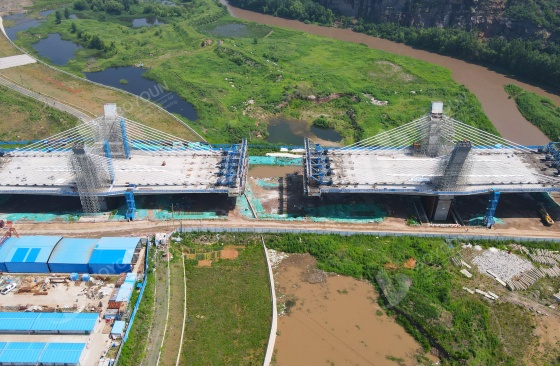
During substructure construction, the construction unit must follow a series of code requirements: Before construction surveying and setting out, data such as the control chainage stations, pile position coordinates, design elevations, and cable coordinates of each bridge pier and abutment must be rechecked and recalculated. If any discrepancy with the design drawings is found, the design unit shall be notified promptly for review. The pile foundation shall be mechanically bored. During construction, care shall be taken to prevent hole collapse and ensure quality. If the geological conditions differ from the survey data, the geological survey unit and the design unit shall be notified promptly. After boring, the hole shall be cleaned promptly to ensure that the sediment thickness at the pile bottom does not exceed 5 cm. Deepening the borehole depth shall not be used as a substitute for hole cleaning. When pouring concrete for the pile foundation, care shall be taken to prevent the reinforcement cage from floating up. The concrete pouring for each pile must be completed in one continuous operation without being poured in separate segments.. Pile foundation quality testing shall be carried out in accordance with the construction specifications, and ultrasonic testing methods shall be adopted for all pile foundations.
During abutment construction, to reduce excavation and support work, the method of excavating and pouring concrete in the original trench shall be adopted for the base layer. Blasting operations shall not be permitted during open-cut trenching. During excavation, reinforcement of the pit walls shall be strengthened. After the base is cleaned, the foundation shall be poured promptly to avoid prolonged exposure of the foundation pit or soaking by surface water, which would affect the bearing capacity of the foundation soil. If the geological conditions differ from the survey data, the geological survey unit and the design unit shall be notified promptly.
The pile cap is a mass concrete. Effective measures shall be taken during construction to reduce the hazards of hydration heat. When pouring in multiple stages, the joint surface of the old concrete shall be chiseled and cleaned before pouring new concrete. After the pile cap is poured, the pier body and abutment body shall be poured promptly so that the concrete age of the pier and abutment does not differ significantly from that of the foundation concrete. The backfill around the pile cap shall be mixed sand and gravel and compacted in layers, with each layer thickness not exceeding 20 cm and a compaction degree ≥ 95%.
The concrete color of piers and abutments shall be consistent. Effective measures shall be taken for the formwork to ensure that the poured concrete has accurate dimensions, a smooth and aesthetically pleasing surface, and is free from rust spots and color differences. The quality and strength of the pier and abutment concrete shall be ensured. Attention shall be paid to the treatment of construction joints to ensure structural integrity. After the abutment concrete reaches the required strength, backfilling behind the abutment shall be carried out according to design requirements. Embedded parts and reserved holes required for construction shall be addressed upon project completion by removing temporary construction components, plugging construction reserved holes, and smoothing the surface. In addition, riprap anti-scour measures shall be provided at the pier locations.
During box girder construction, regardless of the type of falsework (including pier-side brackets), the foundation must be treated to ensure that the bearing capacity and deformation of the foundation are within allowable ranges. Stiffer materials shall be selected for erecting the falsework. After the falsework is erected, it shall be preloaded at 120% of the pouring weight to eliminate uneven settlement of the falsework foundation and non-elastic deformation of the falsework. Before falsework construction, the falsework shall be designed and necessary calculations shall be performed based on the bridge span structure to ensure the quality of the box girder pouring. During construction, the outline dimensions of the box girder shall be strictly controlled, and construction errors shall be kept within the allowable range of the construction specifications. To prevent cracking and edge damage of the box girder concrete, formwork removal shall only be carried out when the concrete strength meets the code requirements. When the free fall height of concrete exceeds 2 m, a chute or a tremie pipe must be used to convey the concrete. The box girder may be poured in multiple stages. Before pouring new concrete, the joint surface of the old concrete shall be chiseled and cleaned to ensure the integrity of the new and old concrete. The concrete color of the entire bridge shall be consistent. Cement from the same manufacturer and the same brand shall be used whenever possible. Effective measures shall be taken for the formwork to ensure that the poured concrete has accurate dimensions, a smooth and aesthetically pleasing surface, and is free from rust spots and color differences. Holes opened for construction needs and all construction embedded parts shall be restored to their original condition after construction, and anti-rust and aesthetic treatment shall be applied. Before concrete pouring, all embedded components shall be placed according to the relevant drawings without omission. Deck system construction shall be carried out after the box girder construction falsework is removed.
Prestressing steel and anchors shall be inspected, accepted, and properly stored in batches upon arrival. The indicators of steel strands shall be sampled and tested according to regulations. Unqualified materials shall be prohibited, and the elongation calculation shall be recalculated. Anchors shall be used together with tensioning equipment. Jacks shall be selected according to the instruction manual. Equipment shall be calibrated, inspected, and repaired regularly; unqualified equipment shall be replaced. Welding of prestressing steel is prohibited. Sections with joints shall be cut off. Steel strands shall be cut using a mechanical disc cutter. Rust removal shall be carried out before use. Tensioning equipment shall be calibrated according to regulations. Corrugated pipes shall be inspected in batches; unqualified pipes shall not be used. Steel strand ducts shall be accurately positioned according to the drawings, and the connections shall be sealed. Positioning rebar shall be used to fix the ducts to prevent upward floating and displacement. Damage caused by vibrator rods and reinforcement construction shall be prevented. During anchor installation, the bearing plate plane shall be perpendicular to the duct, the anchor hole center shall be aligned with the duct center, and the connection between the duct and the anchor end shall be properly handled. The threading method for long steel strands shall be studied. The anchor clamps and the cone holes of the anchor head shall be kept clean. Tensioning shall only be carried out when the concrete strength reaches 90% of the design strength and the age is not less than 7 days. Except for single-end tensioning explicitly specified in the design, symmetrical and synchronous tensioning shall be adopted for all other cases. Tensioning shall adopt dual control of tension force and elongation, with the error within 6%. Under the initial tensioning force, markings shall be made and the elongation shall be measured. If insufficient, the cause shall be identified and supplemental tensioning shall be carried out. The tensioning sequence is: 0 → initial stress → σcon (hold for 5 min) → anchoring. After tensioning, it is strictly forbidden to strike the anchor head and steel strands. Excess steel strands shall be cut off using a cutting machine according to code requirements. Vacuum-assisted grouting shall be carried out within 24 hours after tensioning. Before grouting, the ducts shall be cleaned to ensure compactness (standby power supply shall be available). The falsework shall not be removed until the grout strength reaches 100%.
In summary, cable-stayed bridge construction is a systematic engineering project. The construction of substructure elements such as pile foundations, pile caps, and piers and abutments is the foundation for ensuring the overall stability of the bridge, while the box girder pouring and prestressing tensioning of the superstructure are the keys to achieving structural force performance. During construction, every process must be strictly controlled—from pile foundation boring and hydration heat control of mass concrete pile caps, to falsework preloading and box girder dimensional accuracy, from dual-control of prestressing tensioning to compact duct grouting. Negligence in any link may pose safety hazards for bridge operation.
The strict implementation of technical measures is only the basis for quality assurance. A systematic construction quality control system is the core of management throughout the entire process. The next article will introduce the methods of construction quality control, which will be elaborated from three aspects: first, material quality control; second, construction process quality control; third, finished product protection. Through the dual control of technology and management, the construction quality of cable-stayed bridges can meet design expectations, laying a solid foundation for the long-term safe operation of the bridge.

We focus on turn-key solutions and types of formwork for Bridge and Viaduct Construction at home and abroad since 2006.


International Department: Room 2507-2508, Tower C of Wanda Plaza, Tongzhou District, Beijing 101118, China.
+86-13021287080
info@boyoun.cn

