
 Russian
 French
 Spanish
 Arabic
 Thai
Thai Indonesian

Structural quality acceptance, formwork support removal, site cleanup and restoration, and post-construction hazard inspection after the completion of the main structure of a cylindrical pier constitute the final link in the full-cycle safety management. They are also critical steps to ensure qualified engineering quality, eliminate potential safety hazards, and standardize the construction site. Following the previous two articles on construction preparation and on-site construction control, this article focuses on various closing works after completion, breaking down the safety key points of quality acceptance, standardized formwork removal, site cleanup, and hazard investigation one by one, making up for control shortcomings, and fully closing the safety control loop of the entire cylindrical pier construction cycle.
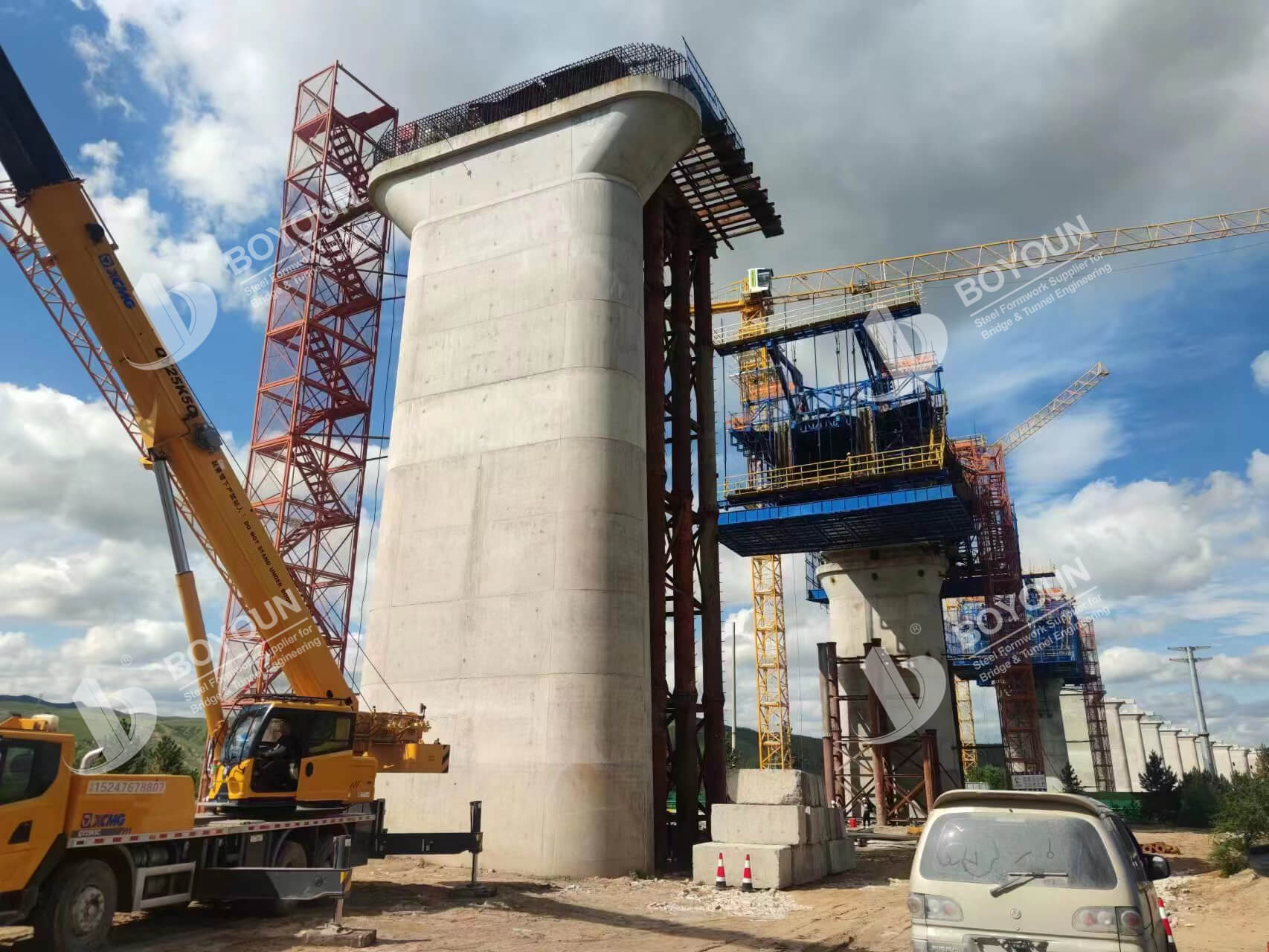
Before proceeding with subsequent processes such as upper structure construction of the pier and subgrade backfilling, a comprehensive and detailed quality acceptance must be carried out on the main structure of the cylindrical pier, with strict verification of key indicators including appearance quality, dimensional deviation, concrete strength, and reinforcement cover thickness. Priority inspection shall be given to the appearance of the pier shaft to ensure a smooth surface without defects such as honeycombing, pitting, exposed reinforcement, corner damage, or cracks. The verticality deviation of the pier shaft shall be strictly controlled within ≤3mm, height deviation within ±5mm, and section size error within ±10% of the design value to ensure compliance with structural dimensions. A steel bar detector shall be used to measure the reinforcement cover thickness to ensure deviations fall within the allowable range of specifications. Concrete strength shall be based on the test results of 28-day standard cube specimens and must reach the designed strength. It is strictly prohibited to forcefully proceed with the next process without acceptance or when the strength is substandard, so as to avoid insufficient structural bearing capacity, damage, deformation, and subsequent safety hazards.
2. Standardize Formwork Removal Operations
The removal of formwork and support systems is a high-risk link easily overlooked after construction completion. Blind removal or early formwork removal can easily lead to collapse accidents. The removal time must be determined strictly based on concrete strength reports. Among them, load-bearing formwork and support systems can be removed only after the concrete strength reaches more than 75% of the design strength. Non-load-bearing side formwork can be removed only when the concrete strength reaches 2.5MPa and the surface and edges can be protected from damage. Before formwork removal, a special warning zone shall be delineated in advance, warning signs shall be set up, and special personnel shall be assigned for on-site duty to prohibit unrelated personnel from entering the warning area. During removal, the principles of top-down removal, segmented dismantling, first-installed-last-removed, and last-installed-first-removed shall be strictly followed. Large-area overall removal, violent knocking, and forced prying are strictly prohibited to prevent falling injuries from formwork, steel pipes, fasteners and other components. Meanwhile, proper protection of the finished pier shaft shall be implemented to avoid damage to the concrete surface and edges. Removed steel formwork, steel pipes, bolts, clips and other components shall be promptly cleaned of mortar and debris, inspected for deformation or damage. Qualified components shall be sorted and stacked regularly with proper protection and maintenance to improve turnover utilization and avoid messy accumulation and road occupation.
3. Clean the Site and Inspect Potential Hazards
Upon full completion and qualified acceptance of construction, the construction site shall be comprehensively cleaned in a timely manner. Waste materials such as steel bar ends, waste formwork, packaging scraps, and concrete residues shall be centrally transported; remaining construction materials shall be sorted and stored; construction machinery and tools shall be maintained and orderly removed from the site. Site access shall be kept unobstructed, ground obstacles and construction waste shall be removed, and the site shall be restored to a clean and tidy state. Simultaneously, layered backfilling and compaction of the foundation pit shall be completed with a compaction coefficient ≥0.95. The on-site drainage system shall be overhauled to ensure smooth drainage and eliminate hidden dangers such as foundation settlement, slope landslide, and site water accumulation. A comprehensive inspection shall be conducted around the cylindrical pier and the construction site to clean up remaining potential safety hazards one by one. A secondary re-inspection of the concrete structure shall be carried out to detect carbonation depth, chloride ion content and impermeability performance, ensuring the structural durability and long-term stability meet standards. Afterwards, temporary facilities such as temporary safety signs, protective railings and scaffolding shall be removed as needed, site enclosures shall be cleaned up, and the normal traffic environment shall be restored, achieving a complete construction and safety control task with a clean site, exhausted materials and cleared site.
Cylindrical pier construction runs through the entire cycle of early preparation, mid-term implementation and later completion. Safety control in the three stages is interlinked, progressive and indispensable. The lack of control in any link may trigger a chain of safety risks. From careful planning and strict source control in the preparation stage, to strict compliance with procedures and close process control in the construction stage, and to detailed closing and closed-loop management in the completion stage, only by fully implementing national standards, enforcing full-staff safety responsibilities, refining various control measures, and strengthening on-site supervision and inspection can various safety accidents such as formwork collapse, falls from height and mechanical injuries be effectively avoided. The personal safety of construction personnel can be fully guaranteed, and the pier structure quality can be ensured to be qualified, stable and durable.
As a professional manufacturer of cylindrical pier formwork, we have long been deeply engaged in engineering construction safety and quality control. We not only provide high-precision and high-stability steel formwork for cylindrical piers, but also provide construction parties with full-process technical guidance and safety control suggestions, supporting the safe and efficient construction of various bridge and elevated projects, and strictly adhering to the dual standards of safety and quality.

We focus on turn-key solutions and types of formwork for Bridge and Viaduct Construction at home and abroad since 2006.


International Department: Room 2507-2508, Tower C of Wanda Plaza, Tongzhou District, Beijing 101118, China.
+86-13021287080
info@boyoun.cn

