
 Russian
 French
 Spanish
 Arabic
 Thai
Thai Indonesian

As the foundational structure of a bridge, the construction quality of piers and abutments directly affects the overall stability and safety of the bridge. The formwork system is a critical link in pier and abutment construction. The rationality of its design affects the quality of structural formation, while safety control ensures the protection of personnel and equipment during construction. Today, as bridge construction becomes increasingly large-scale and complex, the formwork system has transcended its definition as a simple "container" to become a systematic engineering effort integrating structural safety, economic efficiency, and construction feasibility.
This article, as the opening of the series, starts from the macro-level design principles to discuss how to control from the source, laying a solid foundation of safety and quality for bridge pier and abutment construction.
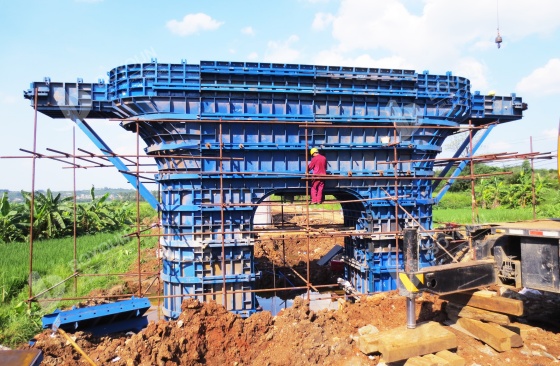
The formwork must fully withstand loads at all construction stages. The self-weight of concrete acts continuously as the pouring height increases; pouring impact force originates from concrete falling and the operation of distribution equipment; construction live loads include the weight of personnel and equipment; and wind loads must also be considered for open-air construction. Under these loads, the formwork's strength must resist stress to prevent cracking, its rigidity must control deformation to avoid dimensional deviations in the pier or abutment, and its stability must be ensured through rational support and connection designs. All performances must be verified through mechanical calculations. Load combinations need to cover different construction scenarios. The concrete lateral pressure in basic loads must be calculated considering pouring speed and temperature, while vibration loads are calculated based on the vibrator's power. Accidental loads, such as lifting impact forces, need to account for unexpected contact during component transportation and installation, ensuring that combined loads can cope with extreme conditions. The design process must follow relevant code requirements to ensure that the load-bearing capacity, rigidity, and stability of the formwork and its supports fully meet standards, laying the foundation for construction safety.
The selection of formwork type must precisely match the structural form of the bridge pier or abutment. Circular piers use curved formwork panels spliced to fit the curvature; round-ended piers use a combination of straight and curved segments to ensure smooth transitions; special-shaped piers require custom-made formwork due to their unique structures. For special-shaped structures, BIM modeling technology can be used to simulate the assembly process in a virtual environment, checking joint gaps and dimensional accuracy, and correcting defects in advance to avoid appearance issues such as honeycombing or step offsets after concrete pouring. The dimensions of formwork segments should be determined based on the lifting capacity and working radius of the hoisting equipment. The weight of a single piece is generally controlled not to exceed 3 tons, which avoids lifting difficulties due to overweight while also reducing the increased splicing workload caused by too many small segments, balancing installation convenience and construction efficiency.
Formwork design needs to balance cost and turnover efficiency. Steel formwork is sturdy and durable, capable of over 50 turnovers with maintenance, making it suitable for long-term projects with large quantities, where costs can be amortized through multiple reuses. Wood formwork has low cost and is easy to process, but is susceptible to environmental influences, with turnovers not exceeding 5 times, making it more suitable for temporary structures or small-batch pier and abutment construction. Configuration of formwork can reduce costs through optimization. If piers and abutments in a continuous beam bridge share common dimensional segments, universal segment formwork can be designed for multi-pier reuse, while custom-shaped segment formwork is individually made for special-shaped parts, reducing the number of dedicated formwork units. Composite formwork, such as the steel-frame plywood system, uses the steel frame for rigidity and the plywood facing to adapt to special-shaped areas, balancing stability and flexibility to further control overall costs.
The installation and dismantling processes should simplify complex steps, reducing the time and difficulty of work at height. During installation, modular assembly methods are adopted, using prefabricated connecting components for quick assembly, avoiding time-consuming on-site cutting and welding. During dismantling, a reasonable sequence is planned to ensure components can be smoothly detached from the pier or abutment, reducing damage caused by manual prying. Connection methods should be easy to operate: pin connections allow quick fixing and removal, bolt connections use common wrench tools, avoiding special connectors that increase operational difficulty. Anti-loosening measures should also be designed at joints to prevent loosening due to vibration during construction. Surface treatment of formwork should focus on practicality: applying waterproof coatings prevents material damage from moisture, and applying release agent reduces concrete adhesion, extending the formwork's service life, lowering subsequent maintenance costs, and improving overall economy.
In summary, an excellent formwork system design is the unity of safety, adaptability, economic efficiency, and operability. It is not only a precise reflection of mechanical calculations but also a deep insight into every aspect of the construction site.
Having grasped these core design principles, the next step is to implement them into specific material selection and structural details. In the next article, we will continue to analyze in depth the "Key Design Points for Bridge Pier and Abutment Formwork Systems", breaking down key technical parameters one by one, from formwork types and structural connections to support systems. Stay tuned.

We focus on turn-key solutions and types of formwork for Bridge and Viaduct Construction at home and abroad since 2006.


International Department: Room 2507-2508, Tower C of Wanda Plaza, Tongzhou District, Beijing 101118, China.
+86-13021287080
info@boyoun.cn

