
 Russian
 French
 Spanish
 Arabic
 Thai
Thai Indonesian
In the previous article, we have elaborated on the core problems that may exist in the construction of tunnel secondary lining, such as improper grasp of construction timing, insufficient positioning accuracy of formwork trolleys, and concrete quality defects. These problems directly restrict the construction quality and operational safety of tunnel projects. To specifically address the above pain points and achieve quality improvement and efficiency enhancement in secondary lining construction, optimizing the construction technology system has become a key path. Focusing on the entire process of secondary lining construction, this paper systematically expounds the core strategies for improving the secondary lining technology of tunnels, covering key links such as the determination of construction timing, upgrading of formwork trolleys, and optimization of concrete construction, so as to provide professional technical guidance for the implementation of optimization schemes for tunnel secondary lining construction.
To avoid structural problems caused by improper construction timing, empiricalism should be abandoned, and a comprehensive criterion system based on monitoring data and numerical simulation should be established. Specifically, a threefold control standard of "deformation rate + cumulative deformation + time" can be adopted: the secondary lining construction can be considered only when the surrounding rock displacement rate does not exceed 0.15 mm/day for 3 consecutive days, the cumulative deformation reaches more than 80% of the predicted total deformation, and the time since the completion of initial support is not less than 30 days (which can be appropriately extended for weak surrounding rock). In addition, numerical simulation software such as FLAC3D can be used to predict the long-term deformation trend of surrounding rock and assist in judging the optimal construction window. This multi-dimensional and quantitative method can effectively balance the requirements of construction safety and progress.
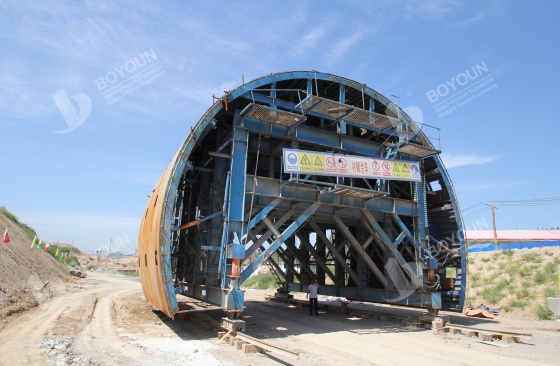
To improve the positioning accuracy of formwork trolleys, laser guidance and automatic leveling technology should be promoted. By installing laser receiving targets on the trolley and linking them with total stations or GNSS systems, the 3D coordinates of the trolley can be obtained in real time, and the hydraulic outriggers can be automatically adjusted to control the positioning error within ±5 mm. At the same time, optimize the structural design of the trolley, such as adopting segmented formwork to adapt to variable cross-sections, adding air vents at the vault to exhaust air, and configuring attached high-frequency vibrators to enhance concrete compactness. Furthermore, the designed BIM model can be imported into the construction management system, and the actual excavation contour can be obtained through point cloud scanning, which is compared with the designed cross-section to early warn potential over-excavation and under-excavation areas, guide the fine adjustment of the trolley, and realize "digital-driven construction".
The optimization of concrete performance is fundamental to improving lining quality. It is recommended to use self-compacting concrete (SCC) with a low water-binder ratio (0.35~0.40) and high fluidity. By adding mineral admixtures such as fly ash and ground granulated blast-furnace slag (GGBS) and high-efficiency polycarboxylate superplasticizers, workability and durability can be improved while ensuring strength. During the pouring process, the layered thickness (50 cm) and the height difference between the two sides (50 cm) should be strictly controlled, and symmetric and continuous pumping should be adopted to prevent uneven stress on the formwork. To solve the problem of vault compaction, grouting pipes can be pre-embedded at the top of the formwork, and micro-expansive cement slurry can be injected into the suspected cavity areas detected by radar within 7 days after formwork removal, realizing the double guarantee of "first pouring and then supplementing".
Construction joints are weak links of the lining structure and must be strengthened with multiple measures. For circumferential construction joints, both embedded rubber waterstops and external waterstops should be installed to form a double waterproof barrier. At the junction of new and old concrete, the laitance must be completely chiseled off to expose fresh aggregates, which are then rinsed with high-pressure water, and then a cement-based permeable crystalline interface agent is applied to enhance the bonding force. For sections with deformation joints, removable waterstops should be used, and sufficient deformation space should be reserved in the joints to avoid tearing of waterstops or cracking of concrete due to temperature or settlement deformation.
The construction of the waterproof layer should follow the principle of "prevention first and process control". Before laying, the base surface of the initial support must be strictly inspected and accepted to ensure no sharp protrusions, no open water, and no loose objects. The waterproof board adopts a double-weld thermal fusion welding process, the weld width is not less than 10 mm, and 100% air pressure testing is carried out to ensure tightness. After laying, the entire line should be scanned with an electric spark leak detector to timely find and repair pinholes or microcracks. In addition, drainage blind pipes can be arranged between the waterproof board and the initial support to guide the orderly discharge of local seepage water and avoid water pressure accumulation.
In summary, through a series of strategies such as scientifically determining the secondary lining construction timing, improving the intelligence level of formwork trolleys, and optimizing concrete construction technology, various pain points in tunnel secondary lining construction can be fully solved, and the construction quality and structural reliability of the secondary lining can be significantly improved. The implementation of these tunnel secondary lining technology improvement measures can not only enhance the overall performance of the composite support system but also provide a solid guarantee for the long-term safe operation of tunnel projects. In the future, with the continuous iteration of intelligent construction technology, the optimization scheme of secondary lining construction will continue to be upgraded, promoting the tunnel construction industry towards a higher quality and more efficient direction.

We focus on turn-key solutions and types of formwork for Bridge and Viaduct Construction at home and abroad since 2006.


International Department: Room 2507-2508, Tower C of Wanda Plaza, Tongzhou District, Beijing 101118, China.
+86-13021287080
info@boyoun.cn

